This book is the second part of a projected trilogy by Drummond (also known as King Boy D of The KLF) and Manning (better known as Zodiac Mindwarp of the band Zodiac Mindwarp and the Love Reaction). The first book, ‘Bad Wisdom’, was published in 1996 or so.
Relevant flashback: as I was travelling on the tube one Friday morning in 1996 or so, I was reading ‘Bad Wisdom’. An Australian woman asked me what I was reading, and if it was any good. My reply was that it was kind of a travel book, but written by two authors, and one of them was totally unreliable, so you didn’t know how much to believe. This was true, but the reality of the situation was that the woman was friendly and pretty, and I didn’t want to alienate her by telling her the full truth, which is that Bad Wisdom was without a doubt one of the most insane and filthy books I’d ever read in my life.
And that’s the case with the follow-up too; as Drummond and Manning write of their journey up the Congo to perform a Punch and Judy show for the President in an attempt to win back their souls from the Devil (see, told you it was mad), pretty much every taboo is on show: racism, sexism, murder, homophobia, rape, cannibalism, paedophilia, and just about every scatological variation you could think of.
The two authors alternate their sections, though even that’s questionable, as it becomes clear partway through that Manning’s added fictionalised events under Drummond’s name. Drummond, on the whole, tries to give a linear version of events – or at least as linear as can be, given that we’re possibly dealing with a journey which may not have taken place in anything like the form depicted – whilst Manning’s sections are (at least I hope) utter fiction: depicting himself as a serial killer in league with a sexually depraved murderous BBC international reporter, sexual predator and alcoholic, Manning’s sections are at first fairly shocking, and then after a while amusing in so far as he does seem able to keep coming up with scenarios which are more and more designed to shock. It’s pretty obvious that he’s doing it for effect – though quite what effect he’s hoping to achieve, I’m at a bit of a loss to ascertain – and there’s a funny section where Drummond asks the reader why they think Manning writes the stuff he does. It almost suggests a degree of despair at his co-writer, as the gross imagery does tend to overwhelm the insights which lurk within Drummond’s sections.
The book’s about twice the length of its predecessor, and Drummond admits on the penultimate page that a reader would need to be pretty dedicated to have made it that far, and he’s not wrong, really; it feels a bit like a wade in every conceivable kind of filth, so it might be seen as something of an endurance test, but having finished it, I feel it was worthwhile, though I can’t quite tell you why. Whether it’s merely because I feel vaguely as if I’ve read something which could legitimately be classified as ‘obscene’, and have therefore put one over on ‘the man’, or whether I’ve just become so inured to the horror on show in the book and have effectively made myself slightly less sensitised, I couldn’t really say. But it felt worth reading, and I suspect that if the third volume ever sees print (I have some doubts – the first volume was published by Penguin, and the second by the smaller Creation Books, apparently on the grounds that the racism on display, however feigned, put Penguin off), I’ll be back to read that.
Despite some concern about what new obscenities Manning will once again commit to the page, and how much (or how little) they might startle me.
Wednesday, March 01, 2006

LIST: My list of five, like in that Friends episode
In the Friends episode ‘The One With Frank Junior’ (series 3, episode 5), there’s a plotline about the characters having a list of five famous people who … well, you know, you would. When this episode first went out in the UK in about 1996 or 1997, it was back in the days when it wasn’t seen as twee to talk about Friends (though this was before the show had stopped being a comedy in favour of being more like a soap opera, so there may well be a link between quality and conversational-acceptability there).
Anyway, there was quite a lot of discussion of this at the time amongst people I knew (of both sexes), with various lists being drawn up. As we approach something like ten years since that time, I’m pathetically proud of the fact that my list has not changed at all, so thought I’d share it. So, in hypothetical order (and with the inevitable explanations), here are the details of the five women who I feel have a certain, indefinable…
1. Janeane Garofalo – if you’ve seen her in ‘The Truth About Cats And Dogs’, you’ll understand the appeal, I’m sure. Sharp-witted and equally sharp-tongued, I’m led to believe she sometimes doesn’t get mainstream film work because of a refusal to lose weight, or to go along with corporate thinking. Which makes her all the more attractive, to my mind.
2. Isabella Rossellini – amusingly enough, was almost on Ross Geller’s list, and appears briefly, in the Friends episode in question. Obviously, she resembles her mother, but without the slightly glacial quality which I find rather off-putting. For a long time she was perhaps best known for her modelling work (and if there’s any truth to the persistent rumour that Lancome cancelled her contract because they felt she was too old, then colour me appalled), but she’s actually a rather good actress – her performances in Blue Velvet and Fearless are solid, for example.
3. Thandie Newton –winner of the BAFTA for Best Supporting Actress a couple of weeks ago, but I first saw her in the film ‘Flirting’ and thought ‘cripes ablimey, she’s rather fetching’. And I am still not wrong. Suffers to my mind from frequently being in films which don’t really showcase her ability (M:I-2 would be a perfect example). And I gather she interrupted her acting career to do a degree at Cambridge, so she’s clearly as clever as she is attractive.
4. Gabrielle Reece – is an Olympic beach volleyball player and model, and is over six feet tall. In interviews, she comes across as rather bright, but I must admit the immediate and profoundly shallow appeal for me is the idea of a woman who’s taller than me, and as fit as Ms Reece clearly is, in a physical situation.
5. Sherilyn Fenn – has troubled me since I saw her in Twin Peaks, which is one of my favourite TV programmes ever. Is there a connection? I don’t know, and it’s not relevant here. Suffice it to say I find Ms Fenn most alluring, not least because of her striking smile, and the way the mole to the side of her eyebrow makes it look like a reclining exclamation mark (trust me on this).
Don’t know who any of these women are ? I recommend a Google Search. And why not tell me YOUR chosen five ? I’d be interested to know, and if nothing else it would make me feel like this blog entry isn’t the shallowest thing I’ve ever taken the trouble to type. Still, as I say, it’s coming on for ten years now, and the list remains unchanged, which I think speaks well of my taste.
Anyway, there was quite a lot of discussion of this at the time amongst people I knew (of both sexes), with various lists being drawn up. As we approach something like ten years since that time, I’m pathetically proud of the fact that my list has not changed at all, so thought I’d share it. So, in hypothetical order (and with the inevitable explanations), here are the details of the five women who I feel have a certain, indefinable…
1. Janeane Garofalo – if you’ve seen her in ‘The Truth About Cats And Dogs’, you’ll understand the appeal, I’m sure. Sharp-witted and equally sharp-tongued, I’m led to believe she sometimes doesn’t get mainstream film work because of a refusal to lose weight, or to go along with corporate thinking. Which makes her all the more attractive, to my mind.
2. Isabella Rossellini – amusingly enough, was almost on Ross Geller’s list, and appears briefly, in the Friends episode in question. Obviously, she resembles her mother, but without the slightly glacial quality which I find rather off-putting. For a long time she was perhaps best known for her modelling work (and if there’s any truth to the persistent rumour that Lancome cancelled her contract because they felt she was too old, then colour me appalled), but she’s actually a rather good actress – her performances in Blue Velvet and Fearless are solid, for example.
3. Thandie Newton –winner of the BAFTA for Best Supporting Actress a couple of weeks ago, but I first saw her in the film ‘Flirting’ and thought ‘cripes ablimey, she’s rather fetching’. And I am still not wrong. Suffers to my mind from frequently being in films which don’t really showcase her ability (M:I-2 would be a perfect example). And I gather she interrupted her acting career to do a degree at Cambridge, so she’s clearly as clever as she is attractive.
4. Gabrielle Reece – is an Olympic beach volleyball player and model, and is over six feet tall. In interviews, she comes across as rather bright, but I must admit the immediate and profoundly shallow appeal for me is the idea of a woman who’s taller than me, and as fit as Ms Reece clearly is, in a physical situation.
5. Sherilyn Fenn – has troubled me since I saw her in Twin Peaks, which is one of my favourite TV programmes ever. Is there a connection? I don’t know, and it’s not relevant here. Suffice it to say I find Ms Fenn most alluring, not least because of her striking smile, and the way the mole to the side of her eyebrow makes it look like a reclining exclamation mark (trust me on this).
Don’t know who any of these women are ? I recommend a Google Search. And why not tell me YOUR chosen five ? I’d be interested to know, and if nothing else it would make me feel like this blog entry isn’t the shallowest thing I’ve ever taken the trouble to type. Still, as I say, it’s coming on for ten years now, and the list remains unchanged, which I think speaks well of my taste.
Saturday, February 25, 2006
“So…”
(Please note all names in the following have been changed. But the events unfolded pretty much as depicted.)
One Sunday afternoon some years ago, I went with my then-girlfriend and her Mum to see the college she’d been accepted at, to look at the general area the Halls of residence were in, that sort of thing.
I can understand why they did this – when I’d first visited Wolverhampton with my parents to try to find some digs, it had been a Saturday (meaning the various landlords we called tended not to be there), the few places we looked at were both grotty and costly, and the rain was hurtling down from a depressing grey sky. I seriously reconsidered the whole idea of going to college, I have to admit.
Anyway. It was a sunny Sunday afternoon as the three of us walked around the out-of-town area which contained the Halls of residence, and there were trees and patches of greenery all round. It seemed very pleasant, and everyone said as much.
As we skulked outside the general grounds of the Halls, not really feeling entirely comfortable with the idea of going in as we weren’t entirely legitimate visitors, a woman and a teenage girl came along and joined us in peering in, and trying to get the general feel of the place.
“Are… are you coming here too?” my girlfriend’s mother asked them.
“Yes, that’s right,” said the woman, clearly the girl’s mother. “ Starting in September.”
“Mmm, Sarah’s starting here then too,” said my girlfriend’s mum. “It looks nice – I’m glad, we weren’t quite sure about it, but, well, she did a bit better than predicted in her exams, so…”
“Oh yes,” said the other mother, “Kelly did too, so…”
The conversation dried up at that moment, and I recall distinctly the sound; it lasted only a second or two, but as the back-and-forth ended and the five of us stood there faintly awkwardly, I could hear the sound of cars a few streets away, a distant rumble, but closer, the chirping of birds in the trees. And as we stood there, the two proud and hopeful parents starting to play the comparison game, I realised that the sudden silence, born of sentences which weren’t really designed to further the conversation but instead to express the polite rivalry prevalent between so many parents – that silence, I suddenly thought, made a lie of the old song.
That sudden lull in the conversation, I knew, was truly the sound of the suburbs.
One Sunday afternoon some years ago, I went with my then-girlfriend and her Mum to see the college she’d been accepted at, to look at the general area the Halls of residence were in, that sort of thing.
I can understand why they did this – when I’d first visited Wolverhampton with my parents to try to find some digs, it had been a Saturday (meaning the various landlords we called tended not to be there), the few places we looked at were both grotty and costly, and the rain was hurtling down from a depressing grey sky. I seriously reconsidered the whole idea of going to college, I have to admit.
Anyway. It was a sunny Sunday afternoon as the three of us walked around the out-of-town area which contained the Halls of residence, and there were trees and patches of greenery all round. It seemed very pleasant, and everyone said as much.
As we skulked outside the general grounds of the Halls, not really feeling entirely comfortable with the idea of going in as we weren’t entirely legitimate visitors, a woman and a teenage girl came along and joined us in peering in, and trying to get the general feel of the place.
“Are… are you coming here too?” my girlfriend’s mother asked them.
“Yes, that’s right,” said the woman, clearly the girl’s mother. “ Starting in September.”
“Mmm, Sarah’s starting here then too,” said my girlfriend’s mum. “It looks nice – I’m glad, we weren’t quite sure about it, but, well, she did a bit better than predicted in her exams, so…”
“Oh yes,” said the other mother, “Kelly did too, so…”
The conversation dried up at that moment, and I recall distinctly the sound; it lasted only a second or two, but as the back-and-forth ended and the five of us stood there faintly awkwardly, I could hear the sound of cars a few streets away, a distant rumble, but closer, the chirping of birds in the trees. And as we stood there, the two proud and hopeful parents starting to play the comparison game, I realised that the sudden silence, born of sentences which weren’t really designed to further the conversation but instead to express the polite rivalry prevalent between so many parents – that silence, I suddenly thought, made a lie of the old song.
That sudden lull in the conversation, I knew, was truly the sound of the suburbs.
Tuesday, February 21, 2006
REVIEW : New World
This film was written and directed by Terence Malick, who I understand was much-lauded for the film The Thin Red Line, but as I haven’t seen it, that’s just a point of reference and not any kind of comparison, as I did not like New World at all, for a variety of reasons.
Put simply, the film tells the story of Captain John Smith and Pocahontas, who, as the words of the song ‘Fever’ tell us, had a very mad affair. Except in this film, they don’t really, because the pivotal love story utterly failed to convince me – Colin Farrell inevitably brings an Irish accent to the part, but little else, playing Smith as a doe-eyed simpleton whose wooing of a member of a complex and evolved tribe appears mainly to have been accomplished by flicking of leaves and water at her. Smooth.
The film features voice-overs from the characters at various points, apparently designed to inject some feeling of depth into their relationship, but it’s a simplistic, Hallmark-card kind of romance, and I couldn’t help but wonder if it was an attempt to salvage the film in the edit; I can all too easily imagine the film-maker’s dismay on realising that what’s meant to be a compelling and believable love story consists mainly of people staring at each other with all the emotional depth of a Maestro transaction, and thus bringing the cast back in to add some voice-overs.
I’m guessing at that, but the film just didn’t work for me in other ways too; the pacing was askew – loads of shots of the happy couple making dopey eyes at each other, and then when the British send more settlers, we’re informed in a voice-over that ‘the British returned in force and soon won the battle’ (I paraphrase), which seems a pretty direct contravention of the old ‘show, don’t tell’ maxim about film-making. One of the people I saw it with remarked that ‘he does interesting things with pacing’ but I think that the example I just gave was more an example of budgetary constraints.
It was a couple of hours long, but felt a lot longer to me; Christopher Plummer and Christian Bale are kind of watchable in it, but it feels as if they’re trying their best with a bad script (and some of the dialogue is very wonky indeed, and oddly hard to understand sometimes on an audibility level), and so I really can’t recommend it at all – the most interesting elements were the lengthy shots of the natural world (but nature documentaries do that much better), and the music, which I believe was by James Newton Howard, though it was frequently reminiscent of Wagner – to my untrained ear, parts of Gotterdammerung, though I could be wrong.
Anyway, I didn’t enjoy it at all. You might, but if you watch it and don’t like it, hey, I warned ya.
Put simply, the film tells the story of Captain John Smith and Pocahontas, who, as the words of the song ‘Fever’ tell us, had a very mad affair. Except in this film, they don’t really, because the pivotal love story utterly failed to convince me – Colin Farrell inevitably brings an Irish accent to the part, but little else, playing Smith as a doe-eyed simpleton whose wooing of a member of a complex and evolved tribe appears mainly to have been accomplished by flicking of leaves and water at her. Smooth.
The film features voice-overs from the characters at various points, apparently designed to inject some feeling of depth into their relationship, but it’s a simplistic, Hallmark-card kind of romance, and I couldn’t help but wonder if it was an attempt to salvage the film in the edit; I can all too easily imagine the film-maker’s dismay on realising that what’s meant to be a compelling and believable love story consists mainly of people staring at each other with all the emotional depth of a Maestro transaction, and thus bringing the cast back in to add some voice-overs.
I’m guessing at that, but the film just didn’t work for me in other ways too; the pacing was askew – loads of shots of the happy couple making dopey eyes at each other, and then when the British send more settlers, we’re informed in a voice-over that ‘the British returned in force and soon won the battle’ (I paraphrase), which seems a pretty direct contravention of the old ‘show, don’t tell’ maxim about film-making. One of the people I saw it with remarked that ‘he does interesting things with pacing’ but I think that the example I just gave was more an example of budgetary constraints.
It was a couple of hours long, but felt a lot longer to me; Christopher Plummer and Christian Bale are kind of watchable in it, but it feels as if they’re trying their best with a bad script (and some of the dialogue is very wonky indeed, and oddly hard to understand sometimes on an audibility level), and so I really can’t recommend it at all – the most interesting elements were the lengthy shots of the natural world (but nature documentaries do that much better), and the music, which I believe was by James Newton Howard, though it was frequently reminiscent of Wagner – to my untrained ear, parts of Gotterdammerung, though I could be wrong.
Anyway, I didn’t enjoy it at all. You might, but if you watch it and don’t like it, hey, I warned ya.
Of course, this applies to many other artists as well
One thing which I think rather gets lost when people study Shakespeare, is that at the time he was working, he wasn’t expecting his writings to be subjected to kind of analysis which we know today.
At the time, Shaky was a travelling player, along with Burbage and the other members of his troupe, writing plays which he hoped would appeal. Now, sometimes this means that there are bits which don’t sit very comfortably with us, 400 years down the line – the portrayal of Shylock, or the bit in A Midsummer Night’s Dream where Francis Flute goes on about Bottom earning tuppence a day – but this is inevitable if you bear in mind how the plays were written and performed.
He was a populist, trying to ensure his work was enjoyed by as many people as possible. He had no – could not possibly have had any – idea that he’d later be feted as the greatest playwright of all time, and so (unlike modern-day writers) didn’t deliberately load his works with symbolism and leitmotifs in the hope that it would be scrutinised by his audience, as the majority of his plays were written to be performed (which is why learning about Shaky by reading his plays in a classroom is missing the point).
And to my mind, this is what makes his work all the more remarkable – when he used the image of gardens, and a poor gardener, in Richard II, he wasn’t doing it in the hope that the analogy with Richard’s bad kingship would be studied by me in a classroom in the 1980s, he was doing it because it served the plot, and it seemed to fit, and said what he wanted to say.
Which is, of course, what creativity, art and expression ultimately boils down to – finding a way to express what you want to express, in a way which you hope other people will relate to. Those artists who create works which are predominantly designed to be picked apart with academic rigour may well enjoy some success within the confines of the world of academia and critical analysis (and I’m particularly thinking of modern art as an example of this), but I think it unlikely that they’ll enjoy the same broad appeal, in as many variations, as the work of Shakespeare has over so many centuries.
At the time, Shaky was a travelling player, along with Burbage and the other members of his troupe, writing plays which he hoped would appeal. Now, sometimes this means that there are bits which don’t sit very comfortably with us, 400 years down the line – the portrayal of Shylock, or the bit in A Midsummer Night’s Dream where Francis Flute goes on about Bottom earning tuppence a day – but this is inevitable if you bear in mind how the plays were written and performed.
He was a populist, trying to ensure his work was enjoyed by as many people as possible. He had no – could not possibly have had any – idea that he’d later be feted as the greatest playwright of all time, and so (unlike modern-day writers) didn’t deliberately load his works with symbolism and leitmotifs in the hope that it would be scrutinised by his audience, as the majority of his plays were written to be performed (which is why learning about Shaky by reading his plays in a classroom is missing the point).
And to my mind, this is what makes his work all the more remarkable – when he used the image of gardens, and a poor gardener, in Richard II, he wasn’t doing it in the hope that the analogy with Richard’s bad kingship would be studied by me in a classroom in the 1980s, he was doing it because it served the plot, and it seemed to fit, and said what he wanted to say.
Which is, of course, what creativity, art and expression ultimately boils down to – finding a way to express what you want to express, in a way which you hope other people will relate to. Those artists who create works which are predominantly designed to be picked apart with academic rigour may well enjoy some success within the confines of the world of academia and critical analysis (and I’m particularly thinking of modern art as an example of this), but I think it unlikely that they’ll enjoy the same broad appeal, in as many variations, as the work of Shakespeare has over so many centuries.
The Fall and Rise of Stray Thoughts
- Am I the only one who thinks that there’s a joke to be made about the fact that George Bush Senior had a Vice President called Quayle, and the current V-P shooting someone whilst out on a Quail hunt? I haven’t seen anyone else comment on it, so feel free to work up the exact details of the joke yourself and drop it into conversation. No need to credit me.
- There’s a lot of talk at the moment about the ‘death of the sitcom’, probably part-fuelled by the fact that the US Networks are having a hard time finding something which proves to have the broad appeal of Friends or Seinfeld. But it’s discussed a lot in the UK too, and there are constant references to the fact that in the 1970s, sitcoms would get huge ratings, the like of which could barely be dreamed of now. Um, everyone’s remembering that there were only three TV channels in those days, right? The maths is fairly simple, even if you only apply it to terrestrial channels: 30m ÷ 5 = 6m (if you’re lucky), and so on…
- One of the greatest nonsenses and least impressive comebacks of all time has to be ‘Takes one to know one’. It’s so weak as to be meaningless to my mind, and effectively says ‘I have no reply to that, have a cliché’, in which case silence would surely be the better option?
- Twice that I know of, people have noted down the title of the book I’ve been reading on the tube, presumably to see about buying a copy later if it proves their sort of thing. The first time it happened was a year or two ago, when I was reading a book about the life of Aleister Crowley. The second time was this morning, reading a quite insane travel-type book (I’ll review it here soon, as there’s a startling amount I have to say about it), when I became aware that the man next to me was scribbling the name of the book on a piece of card he’d retrieved from his pocket. I looked back to the book, where, a line or three later, the author started to recount a meeting he claimed he’d had with … Aleister Crowley. Hmm.
Oh, how I love my tea
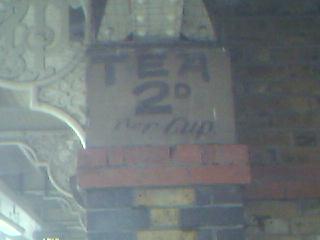
Submitted for your approval: a picture of a pillar at a tube station near where I live.
Despite the prevalence of coffee shops in London, it’s no longer possible to buy tea at this station, which I think is a shame, as 2 denarii for a cuppa seems very reasonable to me.
REVIEW: ‘Wodehouse – A Life’ by Robert McCrum
Whilst one might be sceptical about the praisesome quote on the front being derived from the Observer newspaper, and the author of this biography being the literary editor of that same newspaper, it has to be said that this is a very good biography.
I’m embarrassed to admit that I’ve only discovered Wodehouse in the last few years, perhaps put off by the setting of the majority of his stories – as with Jane Austen’s work, I rather suspected that Wodehouse’s fans were partly taken by the setting, a setting which (as with Austen) I fear never truly existed. But I was very wrong indeed - it’s the tightness of the plots, the sharpness of the dialogue and the sheer before-its-timeness of Wodehouse that makes it so loved; he seems to have written pretty much every sitcom scenario decades before the sitcom was invented – mistaken identities, people being drunk at inappropriate times, lovers who are too timid to say anything about it, people under financial pressure being in the thrall of capricious bosses or relatives, innocent remarks being misunderstood, minor events spiralling out of control, and so on. The man wrote them all, and with a lightness of touch as to make them seem effortless.
But as McCrum’s book makes clear, it wasn’t effortless – or, at least, not initially – and one of the key factors behind Wodehouse’s success appears to have been how prolific he was (having discovered the greatness of his work, I find myself daunted by the sheer number of books he wrote, though let’s face it, this is one of the better things to be daunted by in life).McCrum explains the circumstances in which Wodehouse wrote his many works, and the ups and downs of his life, though the man himself appears to have been as generally unflappable as one of his most famous creations, and to have weathered his personal storms with the same degree of calm.
One of the biggest elements of the biography - and of Wodehouse’s life – is that of the broadcasts which Wodehouse made whilst interned during World War II. McCrum seems convinced that this was a combination of naïveté and poor judgment on Wodehouse’s part, the act of a man determined to make the best of, and if possible find humour in, even the worst of situations. It wasn’t seen this way at the time, though, and McCrum spends a large amount of time both detailing the events themselves and the public reaction, fairly clearly from an apologist stance; this wasn’t a failing as far as I could see, and he makes a good case, but if anything he dwells on this subject so much and provides so much evidence that I felt he may have been ‘defending too much’, as it were, and it certainly went beyond the stage where I needed any more convincing. However, I’m sure there are many people whose feelings towards Wodehouse are quite different from mine, and the sheer weight of evidence presented in this book may well be enough to change a few minds, which is no doubt what McCrum was aiming for.
Overall, a very readable, and interesting, portrait of a man whose effect on humour and comedy – and of course literature generally – should not be underestimated. Most definitely recommended.
I’m embarrassed to admit that I’ve only discovered Wodehouse in the last few years, perhaps put off by the setting of the majority of his stories – as with Jane Austen’s work, I rather suspected that Wodehouse’s fans were partly taken by the setting, a setting which (as with Austen) I fear never truly existed. But I was very wrong indeed - it’s the tightness of the plots, the sharpness of the dialogue and the sheer before-its-timeness of Wodehouse that makes it so loved; he seems to have written pretty much every sitcom scenario decades before the sitcom was invented – mistaken identities, people being drunk at inappropriate times, lovers who are too timid to say anything about it, people under financial pressure being in the thrall of capricious bosses or relatives, innocent remarks being misunderstood, minor events spiralling out of control, and so on. The man wrote them all, and with a lightness of touch as to make them seem effortless.
But as McCrum’s book makes clear, it wasn’t effortless – or, at least, not initially – and one of the key factors behind Wodehouse’s success appears to have been how prolific he was (having discovered the greatness of his work, I find myself daunted by the sheer number of books he wrote, though let’s face it, this is one of the better things to be daunted by in life).McCrum explains the circumstances in which Wodehouse wrote his many works, and the ups and downs of his life, though the man himself appears to have been as generally unflappable as one of his most famous creations, and to have weathered his personal storms with the same degree of calm.
One of the biggest elements of the biography - and of Wodehouse’s life – is that of the broadcasts which Wodehouse made whilst interned during World War II. McCrum seems convinced that this was a combination of naïveté and poor judgment on Wodehouse’s part, the act of a man determined to make the best of, and if possible find humour in, even the worst of situations. It wasn’t seen this way at the time, though, and McCrum spends a large amount of time both detailing the events themselves and the public reaction, fairly clearly from an apologist stance; this wasn’t a failing as far as I could see, and he makes a good case, but if anything he dwells on this subject so much and provides so much evidence that I felt he may have been ‘defending too much’, as it were, and it certainly went beyond the stage where I needed any more convincing. However, I’m sure there are many people whose feelings towards Wodehouse are quite different from mine, and the sheer weight of evidence presented in this book may well be enough to change a few minds, which is no doubt what McCrum was aiming for.
Overall, a very readable, and interesting, portrait of a man whose effect on humour and comedy – and of course literature generally – should not be underestimated. Most definitely recommended.
About as much to do with Islam as football hooligans are to do with the game, I suspect
It’s been a while since my last post, and in that time the cartoon situation which I wrote about on 4 Feb 2006 (‘Sense and Censorship’) has escalated completely out of control – there have been riots, people killed, and embassies burned to the ground. And all because some people who claim to be followers of Islam are saying that they’re offended by the suggestion that there may be a connection between their professed religion and violence.
Let me just run that by you again in case the irony didn’t knock you to the floor: people are protesting against the alleged connection between their beliefs and violence, by behaving in a violent fashion.
And as if that wasn’t enough of a paradox, there’s a picture on page 6 of the current issue of Private Eye (cover dated 17 Feb – 2 Mar) of some protestors holding a placard reading “FREEDOM OF EXPRESSION GO TO HELL!!”
And they say we live in a ‘post-ironic’ age.
Let me just run that by you again in case the irony didn’t knock you to the floor: people are protesting against the alleged connection between their beliefs and violence, by behaving in a violent fashion.
And as if that wasn’t enough of a paradox, there’s a picture on page 6 of the current issue of Private Eye (cover dated 17 Feb – 2 Mar) of some protestors holding a placard reading “FREEDOM OF EXPRESSION GO TO HELL!!”
And they say we live in a ‘post-ironic’ age.
Tuesday, February 14, 2006
REVIEW : West Ham v Birmingham - Upton Park, 13 Feb 2006

Incredibly, this is the first football match I've ever attended. I know, I know, you're wondering how someone who's done so many remarkable things in his life can have got into his fourth decade on the planet without attending a football match. If pressed, I'd probably say it was because I moved to Sheffield when I was 10, whereupon if asked 'which team?' you stood a 1 in 2 chance of getting it wrong, and thus receiving abuse. But there may be other reasons.
Anyway, that's the background nonsense: what of the experience? Well, it was at West Ham's home ground, wonderfully close to my penthouse flat, and my attendance was kindly arranged by friends who felt it was appalling I live where I do and hadn't seen West Ham play, so I doff my imaginary claret and blue bobble hat in thanks to Chris and Sarah.
If, like me, your idea of football supporters is predominantly drawn from news coverage, Robert Carlyle's performance in 'Cracker', and Nick Hornby's 'Fever Pitch', you'd get the idea that the Dr Martens Stand at Upton Park would be a sea of waving scarves, clenched teeth and curled fists, all lovingly drizzled in testosterone and rage. Not the case at all, I'm pleased to report - people were welcoming and shook my hand as I was introduced round, and even at the more tense moments of the game there was perspective; someone to one side of me suggested that one of the Birmingham players was one of the (PG version here) less savoury persons on the planet, and without hesitation someone to the other side of me suggested that honour instead belonged to an internationally-known terrorist, and the first chap cheerfully conceded the point.
As with many subjects, I don't know much about football, but interestingly after about ten minutes, I found commentatoresque phrases springing to my mind, and then coming out of my mouth (though that lack of filter is not, in itself, unusual for me); terms like 'he didn't take the bounce off that ball', 'good hands' and 'looks a bit lively there' were amongst the turns of phrase which I used. Now, I have no idea about the accuracy or appropriateness of these comments, but I wasn't bothered, and I certainly didn't feel the need to rein myself in.
West Ham had a 1-0 lead at half-time, and there was a brief intermission during which we were treated to a gospel rendition of 'I'm Forever Blowing Bubbles' (the kids were trying hard, but it turned out to be as ropey an idea in practice as I felt it was in theory), and after that the Hammerettes, a group of young ladies wearing only slightly more in the way of fabric than the average Andrex puppy, danced for us. I know about as much about dancing as I do about football, really, so I couldn't tell you if it was good or bad on a technical level, though it must say something about my advancing years that my main thought was 'dear me, they must be cold dressed like that'.
The second half saw West Ham extend their lead to 3-0, despite some refereeing decisions which certainly went down badly with the people around me, but as the end approached, both teams seemed less into it and there was a bit of a feeling that they were both marking time until the end of the match. Which eventually came, and the West Ham fans went home happy, if perhaps slightly disappointed that the game had tailed off a bit - many had started to leave at around the 40 minute mark in the second half, presumably feeling the win was pretty much assured.
But I enjoyed myself, and the feeling that I've often had when I see bits of matches on TV - that it's 90 minutes of which only 5 or so prove to be interesting - doesn't prove to be true when you're actually there. And the sense of community was enjoyable too - I've often thought that one of the great things about standing atop a mountain, or gazing out to sea or up at a night sky that's painted with stars, is that sense of being reminded that you're part of something larger, small and yet part of that greater entity. I think there's something of that (in a social sense) in being a member of a football crowd, and I think I can see now why it appeals to so many people.
As ever, then, a new experience proved well worth doing, and if I have any regret at all about last night, it's simply that I didn't get the opportunity - or didn't make the opportunity - to watch a football match much earlier in my life, as I now feel that I understand something which I'd previously been a bit too content to be rather dismissive of.
Sunday, February 05, 2006
The ego has landed...
... and apparently started to nest in the Fortean Times review section.
Which is to say, if you want to see more of my writing, then Fortean Times issue 207, just hitting newsstands around the nation, contains another of my book reviews, on page 65.
Which is to say, if you want to see more of my writing, then Fortean Times issue 207, just hitting newsstands around the nation, contains another of my book reviews, on page 65.
Saturday, February 04, 2006
Sense and Censorship
There's an interesting situation which has arisen over the past week or so, and is prompting discussions about freedom of speech, a subject close to my heart ever since I worked in a Sheffield bookshop at the same time copies of The Satanic Verses were being burned in nearby Bradford. But that's context - I don't want to turn this post into one of those which uses anecdote or personal experience as evidence, as that would be doing an important issue something of a disservice.
To summarise; last September Jyllands-Posten, a Danish newspaper, published a series of cartoons depicting Mohammed, including one where he is shown wearing a bomb-shaped turban. Whilst I understand that depictions of the Prophet are not forbidden within the Koran, they’re not acceptable in practise to many Muslims, and obviously this depiction is hardly flattering. Following the publication of the cartoons, the offices of the newspaper in question received a bomb threat. Spanish, Italian, German and French newspapers picked up the story, and republished the cartoons, which has led to protests in the various countries, and here in the UK the Foreign Secretary has said that the decision to reprint the cartoons was disrespectful.
Okay, so let me make my position on this clear from the outset: people should be able to say anything they want, about anything they want. The only exception being where it strays into the realms of criminal actions. Other than that, people should be able to say what they want to say. Simple as that.
And if you don't like something that someone else says, tell them so, and debate the point. Tell them why you don't like it, and discuss it back and forth like the evolved people we claim to be. I don't care for the BNP's views at all, but they're perfectly entitled to express them, in exactly the same way I'm entitled to say why I think they're wrong.
Same goes for religion - if someone says something which is offensive to your religious beliefs, let's see some actual discussion about it, as opposed to threats of violence. Despite the insistence of men (and it is predominantly males, hence my use of that specific word) to reinterpret the words of their chosen deity to justify them committing violent acts against one another, I feel pretty damn confident in saying that no religion truly tells its followers to kill disbelievers. Just as the Crusades were a twisting of Christian teachings, the claims that Jihad is a part of Islam seem to have their origins in men telling other believers what the Prophet said, which is invariably a mistake, as men make mistakes. Because men are men, and not god, yes ?
I don't consider myself a religious person, but I'm fine with people who are, and those who actually have a relationship with their chosen deity and everything that entails, and as strongly as I hold to my various beliefs (life is sacred, we should strive to leave the world in a better state than that in which we entered it, etc), I'm absolutely fine if people want to knock them, and mock them, because - gasp - they're only beliefs. They're only ideas. I may cling to them and prize them, but I'm human and fallible, and just as I've come to believe different things as time's passed, so I suspect I'll shed opinions and hold others before I die. Because I'm only human, and it's all a learning process.
It's a mistake which certain religious factions appear to have made over time, and which the US government has made in recent times, to think that because you've silenced people who disagree with you, that you're eliminated all opposition. It's simply not true, and it's a mistake to equate silence with agreement or assent. Scaring people into thinking that the USA is brilliant or that Islam is a religion that you dare not say anything about is kind of like the school bully who twists his victim's arm until the victim agrees to say 'I smell' or similar; of course this doesn't actually mean that they actually smell, they're just doing what they think they have to in order to keep themselves safe. And of course there are parallels here between the early days of Christianity, if not most religions and other forms of belief.
It's truly unfortunate that Islam has had such a terrible reputation in recent years, because its tenets are fundamentally life-affirming, and have obviously given millions, if not billions, of people, a path in life which they find deeply meaningful, and which has made them happy; it's fair to say that Islamic countries were the cradle of civilisation, with artistic and scientific knowledge which was frankly staggering. But an unfortunate fringe of the religion has captured the headlines in recent years, killing people who they consider less than human and threatening people who disagree with them, making the religion seem to be synonymous with violence and hostility. It'd be like claiming that all Christians spend their whole time standing outside abortion clinics with placards, or shooting doctors. It's simply not reflective of the true nature of the religion, or of the people who practise it.
I drew a comparison above between the violent fringes of Islam and the US government, and this is entirely deliberate; ironically, whilst the US government has done its best in recent times to try to make Islam and Terrorism in some way seem to be one and the same, the self-proclaimedly Christian administration in Washington has tried to do much the same in terms of international policy, accusing the French of being cowards when they refused to join in the attacks on Iraq (for my money, the French have been stunningly gracious in their ideological victory, not yelling 'told you so' at every meeting of the UN), detaining people without charge for ... er, well, pretty much anything they fancy, it seems, and trying to stem any expressions of dissent. Does all this make people think that they're right ? No, of course not. If you're talking about something and someone tells you to shut up and refuses to let you speak, it doesn't make you think they have a point and reconsider your views, it merely entrenches your beliefs (especially if your ideological opponent, by their behaviour, seems to be the embodiment of wrongness). And the US administration, like the more violent elements of religious groups, is just acting to affirm its opponent's beliefs and prove them right.
So someone drew a cartoon which doesn't adhere to your beliefs. Or wrote a musical in which your messiah appears. These people clearly don't hold the same beliefs as you do, and if that bothers you so much, engage in some kind of dialogue with them - using the intellect and reason you believe your creator gave you - and see if you can figure out the points of difference between you. There may be more points of similarity than you'd like to think. But if not, and dialogue fails, well, it's quite the strange leap in thinking to then decide they should be killed.
After all, chances are you think that they're probably going to hell anyway, and why not use your energy and resources in a more profitable way, like... oh, I dunno, saving someone from dying of starvation? Somewhere in the world, someone dies that way every few seconds, and I would have thought that most deities - as the creator of life - would find that infinitely more blasphemous than someone having a belief that's not in line with their commandments, and then expressing it. That sounds less like a loving and forgiving deity to me, and more like a human approach to things, involving anger and a tendency to think that ideas or beliefs can be damaged from without.
Which simply isn't the case: if sincerely held, ideas and beliefs can be temporarily silenced, but not dented or extinguished. Of course, if someone holding a contrary belief offends and inflames you that much, it may well be that your beliefs aren't as sincerely rooted as you might proclaim or like to believe, and if that's the case, the solution is unlikely to be attempting to silence the voice of another person which questions what you think. Instead, it must be to listen to the voice within which dissents when you tell yourself what you believe.
To summarise; last September Jyllands-Posten, a Danish newspaper, published a series of cartoons depicting Mohammed, including one where he is shown wearing a bomb-shaped turban. Whilst I understand that depictions of the Prophet are not forbidden within the Koran, they’re not acceptable in practise to many Muslims, and obviously this depiction is hardly flattering. Following the publication of the cartoons, the offices of the newspaper in question received a bomb threat. Spanish, Italian, German and French newspapers picked up the story, and republished the cartoons, which has led to protests in the various countries, and here in the UK the Foreign Secretary has said that the decision to reprint the cartoons was disrespectful.
Okay, so let me make my position on this clear from the outset: people should be able to say anything they want, about anything they want. The only exception being where it strays into the realms of criminal actions. Other than that, people should be able to say what they want to say. Simple as that.
And if you don't like something that someone else says, tell them so, and debate the point. Tell them why you don't like it, and discuss it back and forth like the evolved people we claim to be. I don't care for the BNP's views at all, but they're perfectly entitled to express them, in exactly the same way I'm entitled to say why I think they're wrong.
Same goes for religion - if someone says something which is offensive to your religious beliefs, let's see some actual discussion about it, as opposed to threats of violence. Despite the insistence of men (and it is predominantly males, hence my use of that specific word) to reinterpret the words of their chosen deity to justify them committing violent acts against one another, I feel pretty damn confident in saying that no religion truly tells its followers to kill disbelievers. Just as the Crusades were a twisting of Christian teachings, the claims that Jihad is a part of Islam seem to have their origins in men telling other believers what the Prophet said, which is invariably a mistake, as men make mistakes. Because men are men, and not god, yes ?
I don't consider myself a religious person, but I'm fine with people who are, and those who actually have a relationship with their chosen deity and everything that entails, and as strongly as I hold to my various beliefs (life is sacred, we should strive to leave the world in a better state than that in which we entered it, etc), I'm absolutely fine if people want to knock them, and mock them, because - gasp - they're only beliefs. They're only ideas. I may cling to them and prize them, but I'm human and fallible, and just as I've come to believe different things as time's passed, so I suspect I'll shed opinions and hold others before I die. Because I'm only human, and it's all a learning process.
It's a mistake which certain religious factions appear to have made over time, and which the US government has made in recent times, to think that because you've silenced people who disagree with you, that you're eliminated all opposition. It's simply not true, and it's a mistake to equate silence with agreement or assent. Scaring people into thinking that the USA is brilliant or that Islam is a religion that you dare not say anything about is kind of like the school bully who twists his victim's arm until the victim agrees to say 'I smell' or similar; of course this doesn't actually mean that they actually smell, they're just doing what they think they have to in order to keep themselves safe. And of course there are parallels here between the early days of Christianity, if not most religions and other forms of belief.
It's truly unfortunate that Islam has had such a terrible reputation in recent years, because its tenets are fundamentally life-affirming, and have obviously given millions, if not billions, of people, a path in life which they find deeply meaningful, and which has made them happy; it's fair to say that Islamic countries were the cradle of civilisation, with artistic and scientific knowledge which was frankly staggering. But an unfortunate fringe of the religion has captured the headlines in recent years, killing people who they consider less than human and threatening people who disagree with them, making the religion seem to be synonymous with violence and hostility. It'd be like claiming that all Christians spend their whole time standing outside abortion clinics with placards, or shooting doctors. It's simply not reflective of the true nature of the religion, or of the people who practise it.
I drew a comparison above between the violent fringes of Islam and the US government, and this is entirely deliberate; ironically, whilst the US government has done its best in recent times to try to make Islam and Terrorism in some way seem to be one and the same, the self-proclaimedly Christian administration in Washington has tried to do much the same in terms of international policy, accusing the French of being cowards when they refused to join in the attacks on Iraq (for my money, the French have been stunningly gracious in their ideological victory, not yelling 'told you so' at every meeting of the UN), detaining people without charge for ... er, well, pretty much anything they fancy, it seems, and trying to stem any expressions of dissent. Does all this make people think that they're right ? No, of course not. If you're talking about something and someone tells you to shut up and refuses to let you speak, it doesn't make you think they have a point and reconsider your views, it merely entrenches your beliefs (especially if your ideological opponent, by their behaviour, seems to be the embodiment of wrongness). And the US administration, like the more violent elements of religious groups, is just acting to affirm its opponent's beliefs and prove them right.
So someone drew a cartoon which doesn't adhere to your beliefs. Or wrote a musical in which your messiah appears. These people clearly don't hold the same beliefs as you do, and if that bothers you so much, engage in some kind of dialogue with them - using the intellect and reason you believe your creator gave you - and see if you can figure out the points of difference between you. There may be more points of similarity than you'd like to think. But if not, and dialogue fails, well, it's quite the strange leap in thinking to then decide they should be killed.
After all, chances are you think that they're probably going to hell anyway, and why not use your energy and resources in a more profitable way, like... oh, I dunno, saving someone from dying of starvation? Somewhere in the world, someone dies that way every few seconds, and I would have thought that most deities - as the creator of life - would find that infinitely more blasphemous than someone having a belief that's not in line with their commandments, and then expressing it. That sounds less like a loving and forgiving deity to me, and more like a human approach to things, involving anger and a tendency to think that ideas or beliefs can be damaged from without.
Which simply isn't the case: if sincerely held, ideas and beliefs can be temporarily silenced, but not dented or extinguished. Of course, if someone holding a contrary belief offends and inflames you that much, it may well be that your beliefs aren't as sincerely rooted as you might proclaim or like to believe, and if that's the case, the solution is unlikely to be attempting to silence the voice of another person which questions what you think. Instead, it must be to listen to the voice within which dissents when you tell yourself what you believe.
Thursday, February 02, 2006
Student Prince or Strident Ponce? You decide.
Just to emphasis how very old I am, I was a student back in the days when they actually gave you a grant to go to college. Oh, sure, they looked at your parent's income to make sure you weren't the son of a gazillionaire, so it was kind of means-tested, but the principle at the time was that if you needed money to enable you to go to college, you could apply for it, and in theory receive it.
This does seem like a million years ago now, I know - today students have to take out sizable loans to pay to go to college (even if they're planning on doing a socially useful job like being a medic), whilst the taxpayers don't see any discernible drop in their taxes as a result of the money saved. And oddly enough, the present government were recipients of grants, but have whittled away at them, whilst simultaneously encouraging 18 year olds to go to college. I might think that their motivation was less 'I'm all right, pull the ladder up' or motivated by a wish to keep teenagers off the dole figures if, say, they offered to pay back the grants they were given, adjusted to allow for inflation and the RPI, but hey, what do I know about it ? I'm sure this is all part of the government's avowed agenda to emphasise 'education, education, education', and no doubt my puny little college-educated taxpaying brain isn't clever enough to understand all the complicated details.
Anyway. When I was a student, my grant came from Sheffield Council, as that was where I lived at the time. Whilst there was a lot of lamenting generally at college about the tardiness with which grant cheques were sent out or received, I think it's fair to say that my tale of woe may be among the front-runners: the grant cheque for the first term of my second year was (drum roll) a term late.
Yes, that's right. It was so late - well done, Sheffield Council, glad I moved away once I started earning so you didn't get any of my money in the form of Council Tax - that term had actually ended, and I had to travel back to college from home, pick up the cheque, and then put it in the bank. Pretty startling.
Actually, while I'm on the subject of student poverty - and it appears I am - I survived during that period because my parents sent me money (thanks, Mum and Dad), though I recall at one stage I lasted a day or so on a combination of tea, custard cream biscuits, and Superted multivitamin tablets.
And speaking of custard creams, my final tale of student woe: during my revision for my third year exams, I was - difficult as it may be to believe from the results - actually working pretty hard, doing several hours of revision before allowing myself a break of any kind. One afternoon, after an hour or so of revising some jolly law topic, I stopped to make myself a cup of tea, and as the kettle boiled, realised I had a custard cream biscuit left. Yum, I thought, that'll go well with the cuppa. I poured hot water onto the tea bag and left it to stew for a moment or so. Then I took a teaspoon, stirred the tea a bit more, fished out the tea bag, and picked up the biscuit. And threw the biscuit into the kitchen bin, and spooned the still-very-hot teabag into my mouth.
See? Told you I'd been working hard.
This does seem like a million years ago now, I know - today students have to take out sizable loans to pay to go to college (even if they're planning on doing a socially useful job like being a medic), whilst the taxpayers don't see any discernible drop in their taxes as a result of the money saved. And oddly enough, the present government were recipients of grants, but have whittled away at them, whilst simultaneously encouraging 18 year olds to go to college. I might think that their motivation was less 'I'm all right, pull the ladder up' or motivated by a wish to keep teenagers off the dole figures if, say, they offered to pay back the grants they were given, adjusted to allow for inflation and the RPI, but hey, what do I know about it ? I'm sure this is all part of the government's avowed agenda to emphasise 'education, education, education', and no doubt my puny little college-educated taxpaying brain isn't clever enough to understand all the complicated details.
Anyway. When I was a student, my grant came from Sheffield Council, as that was where I lived at the time. Whilst there was a lot of lamenting generally at college about the tardiness with which grant cheques were sent out or received, I think it's fair to say that my tale of woe may be among the front-runners: the grant cheque for the first term of my second year was (drum roll) a term late.
Yes, that's right. It was so late - well done, Sheffield Council, glad I moved away once I started earning so you didn't get any of my money in the form of Council Tax - that term had actually ended, and I had to travel back to college from home, pick up the cheque, and then put it in the bank. Pretty startling.
Actually, while I'm on the subject of student poverty - and it appears I am - I survived during that period because my parents sent me money (thanks, Mum and Dad), though I recall at one stage I lasted a day or so on a combination of tea, custard cream biscuits, and Superted multivitamin tablets.
And speaking of custard creams, my final tale of student woe: during my revision for my third year exams, I was - difficult as it may be to believe from the results - actually working pretty hard, doing several hours of revision before allowing myself a break of any kind. One afternoon, after an hour or so of revising some jolly law topic, I stopped to make myself a cup of tea, and as the kettle boiled, realised I had a custard cream biscuit left. Yum, I thought, that'll go well with the cuppa. I poured hot water onto the tea bag and left it to stew for a moment or so. Then I took a teaspoon, stirred the tea a bit more, fished out the tea bag, and picked up the biscuit. And threw the biscuit into the kitchen bin, and spooned the still-very-hot teabag into my mouth.
See? Told you I'd been working hard.
Wednesday, February 01, 2006
Though, of course, 'Bincompetent' wouldn't make as nifty a slogan on the protest banners
As the hundredth British army employee has just died in Iraq, I think this might be an appropriate point to state my feelings on this subject - or, more specifically, on the issue of what the Prime Minister knew, and how he came to decide that yes, a war in Iraq was a good idea.
I feel there are a number of possible ways it can be interpreted:
1. Blair knew there were no Weapons of Mass Destruction in Iraq all along
2. Blair genuinely believed that there were Ws of MD, and that the evidence was sufficient to prove it.
3. Blair wasn't sure there were Ws of MD in Iraq, but thought that either
a) the evidence would be found as a result of troops going in
Or
b) the premise of there being Ws of MD was just a cover, effectively justifying sending in the troops, and once the military action had started or was completed, then the original reason would be as good as forgotten.
Now, Option 1 is very popular, because it's nice and straightforward: Blair lied. And it's a very real possibility, suggesting he didn't really care about the reason that was given, and that sending in the troops was pretty much a fait accompli once the idea had been suggested. But Option 1 kind of makes Blair not only a liar, but something of a fool as well - a man whose concern for public perception and PR is minimal, and that doesn't seem to be true of him or his administration; they seem to be pathologically obsessed with the way things look, even at the cost of their substance. So this seems less likely to me, on balance.
Options 2 and 3, however, suggest less malevolence and intent to mislead, but instead spectacularly poor judgment, and to me, they seem more probable. Since the topic of war in Iraq has a history of tenting american trousers, I think it's fair to assume that there was a a lot of transatlantic pressure to go to war, and that Blair either sincerely believed (or simply hoped) that it would pan out in the long term, especially with the USA involved.
This combination of pressure, questionable belief, and hope appears to have been enough for Blair, which is why he felt justified in ignoring the holes in the evidence, the protests within Parliament and elsewhere (the largest co-ordinated protest march in record, wasn't it?), and decided to send in the troops. Which I think I can say without fear of contradiction - as it's what's technically known as a 'fact' - was a very bad decision indeed.
So, basically it boils down to one of two possibilities: either Blair's a liar, or his judgment is so poor that large numbers of people have died needlessly as a result.
Either of which, in most jobs, would almost certainly be grounds for dismissal.
I feel there are a number of possible ways it can be interpreted:
1. Blair knew there were no Weapons of Mass Destruction in Iraq all along
2. Blair genuinely believed that there were Ws of MD, and that the evidence was sufficient to prove it.
3. Blair wasn't sure there were Ws of MD in Iraq, but thought that either
a) the evidence would be found as a result of troops going in
Or
b) the premise of there being Ws of MD was just a cover, effectively justifying sending in the troops, and once the military action had started or was completed, then the original reason would be as good as forgotten.
Now, Option 1 is very popular, because it's nice and straightforward: Blair lied. And it's a very real possibility, suggesting he didn't really care about the reason that was given, and that sending in the troops was pretty much a fait accompli once the idea had been suggested. But Option 1 kind of makes Blair not only a liar, but something of a fool as well - a man whose concern for public perception and PR is minimal, and that doesn't seem to be true of him or his administration; they seem to be pathologically obsessed with the way things look, even at the cost of their substance. So this seems less likely to me, on balance.
Options 2 and 3, however, suggest less malevolence and intent to mislead, but instead spectacularly poor judgment, and to me, they seem more probable. Since the topic of war in Iraq has a history of tenting american trousers, I think it's fair to assume that there was a a lot of transatlantic pressure to go to war, and that Blair either sincerely believed (or simply hoped) that it would pan out in the long term, especially with the USA involved.
This combination of pressure, questionable belief, and hope appears to have been enough for Blair, which is why he felt justified in ignoring the holes in the evidence, the protests within Parliament and elsewhere (the largest co-ordinated protest march in record, wasn't it?), and decided to send in the troops. Which I think I can say without fear of contradiction - as it's what's technically known as a 'fact' - was a very bad decision indeed.
So, basically it boils down to one of two possibilities: either Blair's a liar, or his judgment is so poor that large numbers of people have died needlessly as a result.
Either of which, in most jobs, would almost certainly be grounds for dismissal.
Tuesday, January 31, 2006
TRAVEL: Two important travel tips, and an example of my insufferable smugness, all in one post
A number of years ago, I went on holiday to foreign climes with a young lady of my acquaintance (you know the routine, I don't name names).
After we'd flown out and checked into our hotel and all that kind of gubbins, it was lateish in the day, so we decided to go out for something to eat.
"Where are the passports?" she asked as we walked down the stairs to the hotel reception. "Have you got them?"
"No," I replied. "They're in the room."
She stopped walking, and looked at me in a very stern way.
"What?"
"They're in the room," I said again. "Not just left on the side or anything. I put them under a pillow on the bed - they're too bulky to fit in my jeans."
This was true.
"You do NOT leave passports in a hotel room," she said firmly, and as she'd travelled more than I, I had to assume this was a travel truism I wasn't aware of. "Go and get them. I'll put them in my bag."
"Okay," I said, "but please don't give me orders, or talk to me like that."
She said nothing to that, just folded her arms and made it clear she wasn't going anywhere. I went back up to the hotel room and got the passports, and handed them to her and she zipped them into her bag, and we went out for something to eat as planned.
The incident faded as the evening wore on, and then as the days passed and we had a good time, I'd pretty much forgotten it... until the last night of our holiday.
We were having a meal with a group of other people, and I was feeling strangely tired, though I suspect this was because I'd eaten a huge amount of the local food (in my defence, it was very tasty) and that every drop of blood in my body was diverting to my stomach to digest it. So I decided to turn in, and went back to the hotel room, and fell asleep almost immediately.
I was vaguely aware of some door-slamming noises in the early hours, but apart from that I pretty much slept through to the morning, and woke just in time to grab some breakfast. My companion was not in the mood for food, having ... well, let's say favoured the grape until the early hours, culminating in some sort of drinking contest at the bar next to the hotel's rooftop pool. So she stayed in bed while I went off to eat.
When I returned to the room, she was not only up and about, but was in a state of some distress.
"What's wrong?"
"The passports," she said, looking harried. "I can't find the passports."
This was quite a problem, as we had about ten minutes before a minibus would to take us to the airport.
"O..kay," I said levelly, and then, displaying the flair for logical deduction that has led so many to compare me to the famed London Consulting Detective, asked: "So where were they last?"
"In my bag," she said. "I had them last night, I remember at the restaurant I had them, and then..." She looked around for her bag. "... oh, hang on," she said, and went out of the room.
She came back a few minutes later, looking a bit red-faced, but not brandishing passports. Or her bag. Or anything else which a person might brandish, for that matter.
"I asked at reception," she said, out of breath from running up the stairs. "They said they'd have a look on the roof, maybe behind the bar."
"Right," I said as neutrally as I could.
"But we'd better get packing, and head down to reception," she added, and this was a good point - if the passports weren't on the roof, they could be in the room, and so packing might turn them up.
It didn't, though, and a touch under ten minutes later, we made our way down to reception.
"What if they don't find it?" She said, as we added our bags to the pile starting to accumulate near the hotel entrance. "What are we going t-"
And then she was interrupted by the man from reception, who came over and, with a smile, handed over her bag.
"It was on the roof," he said, "behind the bar."
She thanked him repeatedly, and gave him a generous tip, and we got on the coach to the airport, and caught the 'plane, and flew back to England, and so on.
I never said anything to her about it, either at the time or after the return to England; never suggested it was almost like justice for her being (what I considered to be) rude to me; I never said about how, if the passports had been in our hotel room that night they would actually have been safer than they turned out to be when left in her care, or even mentioned how it was, in its way, a perfect example of karma.
Because, in all honesty, at the time, I never felt particularly panicked about the situation; instead, I felt serenely unflustered by the turn of events - perhaps it was an almost Buddhist sense of calm brought on by the realisation that things would probably work out okay, or even if they didn't there'd always be another flight, or even if I had to live in a foreign land forever, would it really be that bad ? Okay, so I only spoke a handful of words in the native tongue, and the water didn't sit that well with my body's system, but it wouldn't be impossible to make a life for myself, after all.
And besides, any panicking on my part would have made my companion even more worried, and could by implication have appeared to have been me pointing the finger, which wouldn't have helped the situation or made the passports materialise.
Then again, maybe I was relaxed about it because I had, as per a tip she appeared not to have picked up in her travels, made a photocopy of the important pages of my passport, which was tucked into a side pocket of my bag.
After we'd flown out and checked into our hotel and all that kind of gubbins, it was lateish in the day, so we decided to go out for something to eat.
"Where are the passports?" she asked as we walked down the stairs to the hotel reception. "Have you got them?"
"No," I replied. "They're in the room."
She stopped walking, and looked at me in a very stern way.
"What?"
"They're in the room," I said again. "Not just left on the side or anything. I put them under a pillow on the bed - they're too bulky to fit in my jeans."
This was true.
"You do NOT leave passports in a hotel room," she said firmly, and as she'd travelled more than I, I had to assume this was a travel truism I wasn't aware of. "Go and get them. I'll put them in my bag."
"Okay," I said, "but please don't give me orders, or talk to me like that."
She said nothing to that, just folded her arms and made it clear she wasn't going anywhere. I went back up to the hotel room and got the passports, and handed them to her and she zipped them into her bag, and we went out for something to eat as planned.
The incident faded as the evening wore on, and then as the days passed and we had a good time, I'd pretty much forgotten it... until the last night of our holiday.
We were having a meal with a group of other people, and I was feeling strangely tired, though I suspect this was because I'd eaten a huge amount of the local food (in my defence, it was very tasty) and that every drop of blood in my body was diverting to my stomach to digest it. So I decided to turn in, and went back to the hotel room, and fell asleep almost immediately.
I was vaguely aware of some door-slamming noises in the early hours, but apart from that I pretty much slept through to the morning, and woke just in time to grab some breakfast. My companion was not in the mood for food, having ... well, let's say favoured the grape until the early hours, culminating in some sort of drinking contest at the bar next to the hotel's rooftop pool. So she stayed in bed while I went off to eat.
When I returned to the room, she was not only up and about, but was in a state of some distress.
"What's wrong?"
"The passports," she said, looking harried. "I can't find the passports."
This was quite a problem, as we had about ten minutes before a minibus would to take us to the airport.
"O..kay," I said levelly, and then, displaying the flair for logical deduction that has led so many to compare me to the famed London Consulting Detective, asked: "So where were they last?"
"In my bag," she said. "I had them last night, I remember at the restaurant I had them, and then..." She looked around for her bag. "... oh, hang on," she said, and went out of the room.
She came back a few minutes later, looking a bit red-faced, but not brandishing passports. Or her bag. Or anything else which a person might brandish, for that matter.
"I asked at reception," she said, out of breath from running up the stairs. "They said they'd have a look on the roof, maybe behind the bar."
"Right," I said as neutrally as I could.
"But we'd better get packing, and head down to reception," she added, and this was a good point - if the passports weren't on the roof, they could be in the room, and so packing might turn them up.
It didn't, though, and a touch under ten minutes later, we made our way down to reception.
"What if they don't find it?" She said, as we added our bags to the pile starting to accumulate near the hotel entrance. "What are we going t-"
And then she was interrupted by the man from reception, who came over and, with a smile, handed over her bag.
"It was on the roof," he said, "behind the bar."
She thanked him repeatedly, and gave him a generous tip, and we got on the coach to the airport, and caught the 'plane, and flew back to England, and so on.
I never said anything to her about it, either at the time or after the return to England; never suggested it was almost like justice for her being (what I considered to be) rude to me; I never said about how, if the passports had been in our hotel room that night they would actually have been safer than they turned out to be when left in her care, or even mentioned how it was, in its way, a perfect example of karma.
Because, in all honesty, at the time, I never felt particularly panicked about the situation; instead, I felt serenely unflustered by the turn of events - perhaps it was an almost Buddhist sense of calm brought on by the realisation that things would probably work out okay, or even if they didn't there'd always be another flight, or even if I had to live in a foreign land forever, would it really be that bad ? Okay, so I only spoke a handful of words in the native tongue, and the water didn't sit that well with my body's system, but it wouldn't be impossible to make a life for myself, after all.
And besides, any panicking on my part would have made my companion even more worried, and could by implication have appeared to have been me pointing the finger, which wouldn't have helped the situation or made the passports materialise.
Then again, maybe I was relaxed about it because I had, as per a tip she appeared not to have picked up in her travels, made a photocopy of the important pages of my passport, which was tucked into a side pocket of my bag.
Monday, January 30, 2006
Yes, it’s like that Bond film. But with more realistic dialogue. And no invisible car (well, as far as I could discern).

Continuing the ice theme from a couple of posts ago, this is the Ice Bar in London, which is – yes – made of ice. The bar, the walls, the sculpted bottle you can climb inside (I kid you not), all of it made of ice. An amusing experience, and given that it’s just off Regent Street, it feels strangely foreign, if not downright alien, for somewhere that's slap-bang in the middle of London.
A feeling which was amplified by a Jawa couple apparently being at the bar when I took the photo.
Liberal indeed
Maybe it’s just my imagination, but in the last couple of weeks, the Liberal Democrats appear to have become a bit confused about the way people perceive things, and seem to be falling over themselves to admit to things which have previously been seen as political liabilities; granted, they probably came clean to pre-empt press exposure, but in the last month or so their leader’s admitted to an alcohol problem, and two of the potential replacement candidates have been perhaps a tad more forthcoming than is entirely savoury about their previous homosexual activities.
Now, I have no problem with MPs having preferences for the same sex, a different sex, or even root vegetables, as long as it’s all friendly stuff, but I do think that the Lib Dems might need to remember that the way to capture votes is not, historically, to make the main focus of your media attention the amount of Glenmorangie you can put away, or the number of winkles you’ve had the pleasure of handling.
Or perhaps I’m just old-fashioned about these things.
Now, I have no problem with MPs having preferences for the same sex, a different sex, or even root vegetables, as long as it’s all friendly stuff, but I do think that the Lib Dems might need to remember that the way to capture votes is not, historically, to make the main focus of your media attention the amount of Glenmorangie you can put away, or the number of winkles you’ve had the pleasure of handling.
Or perhaps I’m just old-fashioned about these things.
Hillary ? More Clinton than Edmund, I fear

Herewith, a phone-camera picture of me climbing an indoor ice-wall-effect thing recently, with ice axes and boots with spikes on and everything. Not very elegant, I’ll freely admit, and I can only point out that climbing that way is not as easy as it looks.
And when I’m doing it, it doesn’t look even remotely easy.
Someone probably did tell me life was gonna be this way (but I didn’t listen)
One thing which I’ve never really become in any way used to in life, despite my extremely advanced years and startlingly wide and varied experience, is, I suppose, one of the sadder things: that of losing friends.
You can lose friends through time and distance driving a wedge between you until it’s just too far gone to be reeled back in, which is pretty much understandable - people change, after all – but a couple of times in the last few years, I’ve had situations where I’ve actually had to say ‘okay, that’s it, we’re over, this friendship is finished’ for whatever reason. And that feels downright odd when you’re meant to be a grown-up.
At school, friendships were paradoxically both prized and fluid; you were friends with someone one day, but could have a falling-out with them over the slightest thing and end up being sworn enemies after that, or you might be best friends on Monday, then not on Tuesday, but back to Best Pals on Wednesday.
But when you’re meant to be an adult, and skilled in communicating and sorting out things which should be small in comparison with the fact that the two of you are getting on (and this applies to other relationships as well, of course) and are friends, it feels rather disappointing that there are sometimes occasions when all the will to repair just won’t make it work again. It’s a sad thing.
I don’t have any lessons to offer or wise words on this, I’m afraid, though I guess for me it’s a reminder that sometimes, and particularly in terms of relationships, there are times when it doesn’t matter how hard you try, and how much you truly want it; sometimes there are things that just can’t be mended or won’t be attained, and in its way that feels like a kick in the mouth for my firmly-held and probably childish belief that it you want something badly enough, and do everything you can to get to it, then…
You can lose friends through time and distance driving a wedge between you until it’s just too far gone to be reeled back in, which is pretty much understandable - people change, after all – but a couple of times in the last few years, I’ve had situations where I’ve actually had to say ‘okay, that’s it, we’re over, this friendship is finished’ for whatever reason. And that feels downright odd when you’re meant to be a grown-up.
At school, friendships were paradoxically both prized and fluid; you were friends with someone one day, but could have a falling-out with them over the slightest thing and end up being sworn enemies after that, or you might be best friends on Monday, then not on Tuesday, but back to Best Pals on Wednesday.
But when you’re meant to be an adult, and skilled in communicating and sorting out things which should be small in comparison with the fact that the two of you are getting on (and this applies to other relationships as well, of course) and are friends, it feels rather disappointing that there are sometimes occasions when all the will to repair just won’t make it work again. It’s a sad thing.
I don’t have any lessons to offer or wise words on this, I’m afraid, though I guess for me it’s a reminder that sometimes, and particularly in terms of relationships, there are times when it doesn’t matter how hard you try, and how much you truly want it; sometimes there are things that just can’t be mended or won’t be attained, and in its way that feels like a kick in the mouth for my firmly-held and probably childish belief that it you want something badly enough, and do everything you can to get to it, then…
Thursday, January 19, 2006
Hmm...

I posted a favourable review of the first issue of ‘All Star Superman’ recently, and the second issue has just been released - the cover’s reproduced to the left.
For some reason, a lot of people are worried about the nature of what Superman’s actually up to in the illustration, but I’ll leave it to you to reach your own conclusions… you filthy beasts.
Wednesday, January 18, 2006
The hills are alive, with the sound of Stray Thoughts
1. Beware the person who claims to be sensitive, for they may well be sensitive only to their own suffering, and not too worried about yours.
2. You can buy a cheap watch for 99p, but when the battery runs out, it's usually something like £5 just to replace that. Huh?
3. Season One of 'Lost' didn't exactly have the best ending of all time, did it ? Oh, they've opened the hatch, but you're not going to see inside it. And Michael and Walt have sailed into the plot of Deliverance, apparently. Really unsure as to whether I'll bother tuning in when it returns, as it was all pretty much downhill after the excellent Locke-based episode early on (was it episode 3?) - written, if memory serves, by one of the writers of Buffy. Overall: hmph.
4. And on which theme, saw King Kong last week - that's three hours of my life I'm not going to get back. Not recommended at all, and some bits of it were frankly embarrassing (monkey on ice, Ann Darrow doing slapstick for Kong's benefit - ugh, it's like 'is it still raining?' in Four Weddings all over again).
5. Had a minor brush with being unwell recently, and as far as curatives go, I really do recommend the combination of a sofa, a stack of books/DVDs, and plentiful intake of tea. Daytime television, however, will weaken both your mental acuity and your ability to repel infection. Avoid it at all costs.
6. In its way, isn't ethical relativism a positive stance ?
7. After seeing Kill Bill part (NOT chapter) 2 and the episodes of CSI he wrote, I'm beginning to think Quentin Tarantino has a bit of a fear of premature burial.
8. I've often thought that Descartes' alleged 'Cogito ergo sum' is flawed both logically (it presupposes the existence of the thinker) and similarly on a linguistic level, as the conjugation of the verb to think there is in line with the first person singular, again presupposing the thinker. So whilst I'm intrigued to find out that his original Discourse on method didn't actually contain the phrase, I'm reassured to see that the original French phrase he used - "Je pense, donc je suis" contains pretty much the same seeds of its own undoing...
2. You can buy a cheap watch for 99p, but when the battery runs out, it's usually something like £5 just to replace that. Huh?
3. Season One of 'Lost' didn't exactly have the best ending of all time, did it ? Oh, they've opened the hatch, but you're not going to see inside it. And Michael and Walt have sailed into the plot of Deliverance, apparently. Really unsure as to whether I'll bother tuning in when it returns, as it was all pretty much downhill after the excellent Locke-based episode early on (was it episode 3?) - written, if memory serves, by one of the writers of Buffy. Overall: hmph.
4. And on which theme, saw King Kong last week - that's three hours of my life I'm not going to get back. Not recommended at all, and some bits of it were frankly embarrassing (monkey on ice, Ann Darrow doing slapstick for Kong's benefit - ugh, it's like 'is it still raining?' in Four Weddings all over again).
5. Had a minor brush with being unwell recently, and as far as curatives go, I really do recommend the combination of a sofa, a stack of books/DVDs, and plentiful intake of tea. Daytime television, however, will weaken both your mental acuity and your ability to repel infection. Avoid it at all costs.
6. In its way, isn't ethical relativism a positive stance ?
7. After seeing Kill Bill part (NOT chapter) 2 and the episodes of CSI he wrote, I'm beginning to think Quentin Tarantino has a bit of a fear of premature burial.
8. I've often thought that Descartes' alleged 'Cogito ergo sum' is flawed both logically (it presupposes the existence of the thinker) and similarly on a linguistic level, as the conjugation of the verb to think there is in line with the first person singular, again presupposing the thinker. So whilst I'm intrigued to find out that his original Discourse on method didn't actually contain the phrase, I'm reassured to see that the original French phrase he used - "Je pense, donc je suis" contains pretty much the same seeds of its own undoing...
Monday, January 09, 2006
REVIEW (eventually): The Godfather
Yes, yes, I know, this has been out for decades, how can John have lived so long and not seen it ? Well, I think it's due to a variety of factors, such as the length (it's nearly three hours), the whole mythos surrounding it (it's so hyped I felt I was better off not watching it for fear of being disappointed), and one main over-riding factor: I don't really like gangster films.
It may be because I have a childish and simplified view of the way the audience should identify with the main character, but I rarely feel comfortable when watching films where I'm asked to emotionally invest in characters who are criminals, murderers, or gangsters. I don't mind if the protagonists are troubled or unsure if they're doing the right thing or have shades of darkness about them, but fundamentally I want them to be decent and well-meaning. Gangster films are rarely as pleasant as this, and so I tend not to bother watching them as I find myself being uninvolved: "Oh, so Fat Louie's cutting off Big Tony's heroin business in Chinatown? Well, aren't they both drug dealers? Remind me why I should side with one over the other again, will you?”
But a friend lent me the film, so I gave it a go.
And I quite enjoyed it. Granted, it's rather overshadowed by the fact that parts of it are now pop-cultural currency - the horse's head, the puffed-out jowls, and some of the dialogue - but I thought it was a pretty decent film. It's oddly paced, though - the first third or so is all hats and guns and talk of disrespect, and then when Michael legs it to Sicily it looks like a european arthouse film for a while, and then we're back in the USA for the end again. This last bit didn't hold my attention as much as the other sections, though this may well be for the reasons mentioned above, as we gradually see Michael becoming his father - if not surpassing his father in terms of scheming and double-crossing. Which is unlikely to be my cup of tea.
But it's well directed and written, no question about it; the powerful opening scene comes back into play later in the film, I liked the way that Brando's offscreen for much of the film but nonetheless looms over proceedings, the talk of family and respect was done in a way that seemed convincing, and the violence was suitably unpleasant. And the cast was an ongoing case of 'wow, didn't realise THEY were in this too' for me, as well as providing solid performances.
So, a good film, and possibly a great gangster film, but to me that's kind of like a 'great western' - it's just not a genre I have a particular interest in - and I might even watch the first sequel (general consensus tends to be that the third one is to be missed at all costs). And who knows ? I might even do so before I'm 50.
It may be because I have a childish and simplified view of the way the audience should identify with the main character, but I rarely feel comfortable when watching films where I'm asked to emotionally invest in characters who are criminals, murderers, or gangsters. I don't mind if the protagonists are troubled or unsure if they're doing the right thing or have shades of darkness about them, but fundamentally I want them to be decent and well-meaning. Gangster films are rarely as pleasant as this, and so I tend not to bother watching them as I find myself being uninvolved: "Oh, so Fat Louie's cutting off Big Tony's heroin business in Chinatown? Well, aren't they both drug dealers? Remind me why I should side with one over the other again, will you?”
But a friend lent me the film, so I gave it a go.
And I quite enjoyed it. Granted, it's rather overshadowed by the fact that parts of it are now pop-cultural currency - the horse's head, the puffed-out jowls, and some of the dialogue - but I thought it was a pretty decent film. It's oddly paced, though - the first third or so is all hats and guns and talk of disrespect, and then when Michael legs it to Sicily it looks like a european arthouse film for a while, and then we're back in the USA for the end again. This last bit didn't hold my attention as much as the other sections, though this may well be for the reasons mentioned above, as we gradually see Michael becoming his father - if not surpassing his father in terms of scheming and double-crossing. Which is unlikely to be my cup of tea.
But it's well directed and written, no question about it; the powerful opening scene comes back into play later in the film, I liked the way that Brando's offscreen for much of the film but nonetheless looms over proceedings, the talk of family and respect was done in a way that seemed convincing, and the violence was suitably unpleasant. And the cast was an ongoing case of 'wow, didn't realise THEY were in this too' for me, as well as providing solid performances.
So, a good film, and possibly a great gangster film, but to me that's kind of like a 'great western' - it's just not a genre I have a particular interest in - and I might even watch the first sequel (general consensus tends to be that the third one is to be missed at all costs). And who knows ? I might even do so before I'm 50.
Saturday, January 07, 2006
Not enough for ya ?
If you feel the burning urge to see more of my words, you can do so by going to any decent newsagent (and probably some indecent ones as well) picking up the latest issue of the Fortean Times (issue 206), where one of my book reviews is on page 62. It’s the review I referred to in my entry of 29 November 2005.
See ? I’m not just making this stuff up as I go along.
Well, not all the time, anyway.
See ? I’m not just making this stuff up as I go along.
Well, not all the time, anyway.
Contrast and compare

... certainly goes against the traditional perception of the geisha as subservient, I have to say.
LIST: Initially, it appears to be a coincidence. However…
Jerry Siegel
Joe Shuster
Jack Skellington
Jerry Seinfeld
Jack Sparks
Jim Steinman
John Steed
John Shakespeare
Joe Shuster
Jack Skellington
Jerry Seinfeld
Jack Sparks
Jim Steinman
John Steed
John Shakespeare
A little bit of politics
Charles Kennedy, then, has admitted he's had a drink problem in recent times, and though he claims to have sorted it out now, he's declared a leadership contest will take part in the Liberal Democrats. And various Lib Dem MPs are calling for him just to resign.
However this plays out, I can't help but think that for a party with such a long history, the Lib Dems seem to learn little from previous events; their previous leader 'Paddy' Ashdown's real forename was Jeremy, a name which is hardly linked with positive associations for the Liberal party (as it used to be known), and as for their present leader... well, I would have thought it was one of history's most obvious lessons that things rarely end well if you elect someone with the surname Kennedy to high office.
Thankfully, though, MPs from other parties have been slow to take advantage of Kennedy's currently precarious position. Then again, that may be less because of some sense of decency or honour, and more because they realise that - even assuming the worst about his alcoholism - he may have been utterly rat-arsed on Glenmorangie during Commons debates on the subject, but Kennedy was still able to conclude that sending troops into Iraq was a very bad idea indeed; a fact which Labour and Conservative MPs alike appeared to be incapable of recognising.
Perhaps there's something to be said for the theory of people 'drinking themselves sober' after all.
However this plays out, I can't help but think that for a party with such a long history, the Lib Dems seem to learn little from previous events; their previous leader 'Paddy' Ashdown's real forename was Jeremy, a name which is hardly linked with positive associations for the Liberal party (as it used to be known), and as for their present leader... well, I would have thought it was one of history's most obvious lessons that things rarely end well if you elect someone with the surname Kennedy to high office.
Thankfully, though, MPs from other parties have been slow to take advantage of Kennedy's currently precarious position. Then again, that may be less because of some sense of decency or honour, and more because they realise that - even assuming the worst about his alcoholism - he may have been utterly rat-arsed on Glenmorangie during Commons debates on the subject, but Kennedy was still able to conclude that sending troops into Iraq was a very bad idea indeed; a fact which Labour and Conservative MPs alike appeared to be incapable of recognising.
Perhaps there's something to be said for the theory of people 'drinking themselves sober' after all.
Wednesday, January 04, 2006
I just got out my little black book

I discussed this with someone today, but didn’t get into great detail about it for fear of looking like a lunatic, but I’ll try to be lucid about it here…
I have a strange weakness for notebooks.
Not just your Silvine exercise books, mind you, I like a notebook which has a sense of permanence about it, and ideally a hard cover (see the photo for three examples – the floormost one is my currently-in-use notebook, whilst the other two are awaiting their turn). If we’re talking brand names, Moleskine – allegedly used by Hemingway and Matisse, though one should perhaps take that advertising claim with a dollop of salt – seem to have it about right for my tastes; hard cover, slightly off-white paper, pocket at the back to store items in, and a generally-hard-to-resist tactility. Check some out in a shop and you may see what I mean…
… or you may not. It might well be because I like writing, and want to write for a living, but I’ve found that comments like the above tend to fall on deaf ears. They’re only notebooks, after all – and I can’t disagree in rational terms. But still… there’s something about the appeal of a notebook – particularly a new one; as a friend of mine who did performance poetry (don’t snicker at the back; I went to see him once, and it was really rather good) perhaps summed up the appeal best, when he used one word, and a word which probably isn’t really a word at all, but anyway: Potentiality.
And he’s right – the appeal, if you like to write, of a new notebook (or a new pen, come to that, but that’s a topic for another time, I think) is that the pages are just crying out to be filled, and that’s where the potential lies: you could, in this notebook, end up writing a quick note which becomes a really sharp short story, or a couple of lines of dialogue between two characters which develops into the most important sequence in a novel, or maybe just an observation which you later use as a joke in a stand-up routine … the possibilities are almost endless, and that, I think, is pretty intoxicating. Granted, the practicality of it may well be that you end up writing barely-legible notes to yourself like ‘call Karen about Fri Nt’ and the like, but when you start out, it’s like Schrödinger’s notebook, it could turn out to be almost anything.
I used to feel a vaguely similar sense of hopefulness with new school exercise books when they were dished out – more on the lines of ‘maybe this will be the exercise book I keep tidy and get good marks in’, or something similarly swotty, I suspect – but they were local council standard issue, not items of choice, so it was hardly the same.
On consideration, however, I’m not entirely sure that this explanation’s fundamentally any less lunatic than the one I gave earlier on today, but at least I got in a quantum probability reference, and that makes me look clever - which is, of course, the important thing. Ahem.
Tuesday, January 03, 2006
The Magic Faraway Stray Thoughts
1. I received many fine Christmas gifts, but I like to think that I'm one of a very limited number of people who was equally pleased to receive Volume 1 of the recent translation of Marcel Proust's 'A La Recherche Du Temps Perdu' and the new Robbie Williams album.
2. There's an advert on TV at the moment for an insurance firm solely for female drivers, called 'Sheila's Wheels'. Whilst I'll acknowledge that the advert's deliberately kitsch and tacky looking, I think they may have misjudged it - particularly in relation to their arguments about overall safety - by showing three women sitting in the front of a car which is, for much of the advert, driving backwards on the wrong side of the road.
3. In case any of you were unsure of the restorative power of tea, I would direct your attention towards the Doctor Who Christmas Special, in which his regeneration was aided by a cuppa. And if you won't take a medical recommendation of that order, then … well, that's that, I guess.
4. Interesting to see that 'Life of Brian' was voted the top comedy film of all time in one of those end-of-year polls. When it came out, I recall it being seen as naughty and subversive as well as potentially blasphemous. May take the edge off it in a way, but I like to think it shows a certain intellectual development in social terms.
2. There's an advert on TV at the moment for an insurance firm solely for female drivers, called 'Sheila's Wheels'. Whilst I'll acknowledge that the advert's deliberately kitsch and tacky looking, I think they may have misjudged it - particularly in relation to their arguments about overall safety - by showing three women sitting in the front of a car which is, for much of the advert, driving backwards on the wrong side of the road.
3. In case any of you were unsure of the restorative power of tea, I would direct your attention towards the Doctor Who Christmas Special, in which his regeneration was aided by a cuppa. And if you won't take a medical recommendation of that order, then … well, that's that, I guess.
4. Interesting to see that 'Life of Brian' was voted the top comedy film of all time in one of those end-of-year polls. When it came out, I recall it being seen as naughty and subversive as well as potentially blasphemous. May take the edge off it in a way, but I like to think it shows a certain intellectual development in social terms.
At Last The 2006 Post
Hello, did you miss me ? Hmm? Yes I missed you t- oh, don't be like that, I did miss you, really I did. I know it's been a fortnight, but you mustn't take it so personally. It's been a frankly interesting couple of weeks, for a variety of reasons, and that's kept me away from the keyboard, but you know, I think it's better to be out there doing stuff than just sitting and writing about it, isn't it ? Yes, it is.
That said, I hope you had a cool Yule and that 2006 brings you many pleasant surprises, including at least one thing which you don't really deserve - because we all deserve that every now and then. If not more often.
I'd guess many people will be writing about New Year's Resolutions at present, and although I don't really make resolutions, I do make lists of things I'd like to do over the course of the coming year, and whilst 2005 saw some decent things getting ticked off (Everest Base Camp, for example), I did rather disappointingly only complete 13 of the 31 things in all. Not good enough, I agree, and so (as I frequently promised my parents when my school report had been read), I'll do better this year. May need nudging occasionally, though, particularly as I'll be attempting to be less cynical - as I mentioned recently, it's all too easy to mistake cynicism for sophistication, and it's a trait I'm growing tired of in myself (the cynicism, I mean; couldn't give up the sophistication, obviously). Your assistance is appreciated.
Right, so, into 2006. Who knows what it will hold ? Well, let's set about finding out, shall we ? I raise a mug of tea to you and the year, and what say we meet back here this time next year to compare notes, eh ? Excellent. See you then. But in the meantime -
That said, I hope you had a cool Yule and that 2006 brings you many pleasant surprises, including at least one thing which you don't really deserve - because we all deserve that every now and then. If not more often.
I'd guess many people will be writing about New Year's Resolutions at present, and although I don't really make resolutions, I do make lists of things I'd like to do over the course of the coming year, and whilst 2005 saw some decent things getting ticked off (Everest Base Camp, for example), I did rather disappointingly only complete 13 of the 31 things in all. Not good enough, I agree, and so (as I frequently promised my parents when my school report had been read), I'll do better this year. May need nudging occasionally, though, particularly as I'll be attempting to be less cynical - as I mentioned recently, it's all too easy to mistake cynicism for sophistication, and it's a trait I'm growing tired of in myself (the cynicism, I mean; couldn't give up the sophistication, obviously). Your assistance is appreciated.
Right, so, into 2006. Who knows what it will hold ? Well, let's set about finding out, shall we ? I raise a mug of tea to you and the year, and what say we meet back here this time next year to compare notes, eh ? Excellent. See you then. But in the meantime -
Tuesday, December 20, 2005
You may wonder if this has been trimmed for effect
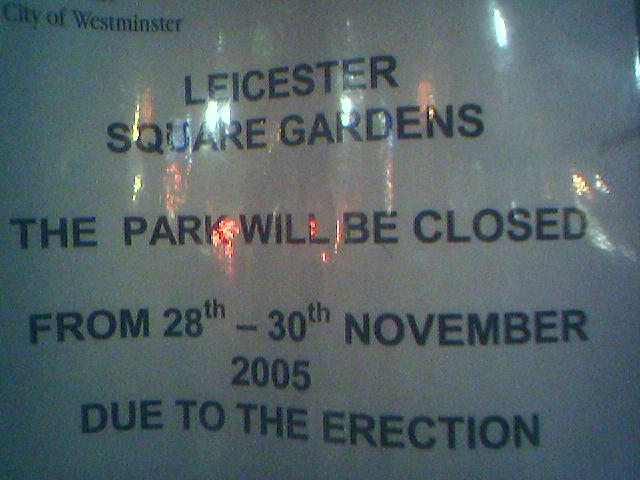
This is how Annie Leibowitz got started, you know. Oh yes.
Well, maybe.
Suburban Myths
Many years ago, I bought a video recorder, and somehow this came up in conversation with my then-flatmate's mother.
"What did you do with the box?" She asked.
"Er... I put it in the bin," was my honest reply."With the packaging and all that stuff - kept the instructions and the warranty card, though."
"Did you shred the box?"
"Um..."
"Or tear it up or put it into a bag inside the bin?"
"Well, no - I just put folded it up and put it into the outside bin."
"Ooh, no," she said, "you need to make sure you shred it or tear it up. Otherwise the bin men will see the box, see that you've bought a new video, then they'll go down the pub and tell their friends, who'll break in and steal your new video."
I don't remember what I said to this at the time, though the series of events that she detailed certainly struck me as implausible (about as unlikely as the chain of coincidences in the Bruce Willis storyline in 'Pulp Fiction', if you ask me), and there was something about it that left a rather unpleasant taste in the mouth, though at the time I couldn't exactly say what it was.
Fast-forward many years, to the almost-now; I'm working late, and one of my colleagues who's already left for the night rings from a payphone to ask me to look and see if she's left her mobile on her desk. I go and look, and indeed she has, so I retrieve it and go back to the phone and tell her this.
"Can you lock it in your desk, please?" she asks. "I don't want it to get nicked by the cleaner or something." For the record, I did lock it in my desk, and phone and owner were reunited and all was right with the world, but...
Well, maybe it's because of reading Mr O'Farrell's book (see REVIEW posted earlier today) recently in which he does a very good job of poking fun (and occasionally kicking fun) at the snobbery and class-system-ism that still lingers in the UK, but it's only in recent times that I've come to realise how often these kinds of comments get made; the cleaners are invariably responsible for pilfering things, be they watches from school changing rooms or mobile phones from office desks, and the men who empty my dustbin are only doing so as an excuse to check out the wrappings of my recent purchases. I mean, it's obvious.
It's bad enough that people who do vital jobs get paid ridiculously poorly (teachers, trainee nurses, sewer workers, etc) without white people from comfortable middle-class backgrounds acting as if they're all would-be criminals just waiting for the first hint of a slight chance of an opportunity to barge their way into their safe suburban lifestyles and steal away their not-so-hard-earned material luxuries.
For crying out loud, talk about adding insult to penury.
"What did you do with the box?" She asked.
"Er... I put it in the bin," was my honest reply."With the packaging and all that stuff - kept the instructions and the warranty card, though."
"Did you shred the box?"
"Um..."
"Or tear it up or put it into a bag inside the bin?"
"Well, no - I just put folded it up and put it into the outside bin."
"Ooh, no," she said, "you need to make sure you shred it or tear it up. Otherwise the bin men will see the box, see that you've bought a new video, then they'll go down the pub and tell their friends, who'll break in and steal your new video."
I don't remember what I said to this at the time, though the series of events that she detailed certainly struck me as implausible (about as unlikely as the chain of coincidences in the Bruce Willis storyline in 'Pulp Fiction', if you ask me), and there was something about it that left a rather unpleasant taste in the mouth, though at the time I couldn't exactly say what it was.
Fast-forward many years, to the almost-now; I'm working late, and one of my colleagues who's already left for the night rings from a payphone to ask me to look and see if she's left her mobile on her desk. I go and look, and indeed she has, so I retrieve it and go back to the phone and tell her this.
"Can you lock it in your desk, please?" she asks. "I don't want it to get nicked by the cleaner or something." For the record, I did lock it in my desk, and phone and owner were reunited and all was right with the world, but...
Well, maybe it's because of reading Mr O'Farrell's book (see REVIEW posted earlier today) recently in which he does a very good job of poking fun (and occasionally kicking fun) at the snobbery and class-system-ism that still lingers in the UK, but it's only in recent times that I've come to realise how often these kinds of comments get made; the cleaners are invariably responsible for pilfering things, be they watches from school changing rooms or mobile phones from office desks, and the men who empty my dustbin are only doing so as an excuse to check out the wrappings of my recent purchases. I mean, it's obvious.
It's bad enough that people who do vital jobs get paid ridiculously poorly (teachers, trainee nurses, sewer workers, etc) without white people from comfortable middle-class backgrounds acting as if they're all would-be criminals just waiting for the first hint of a slight chance of an opportunity to barge their way into their safe suburban lifestyles and steal away their not-so-hard-earned material luxuries.
For crying out loud, talk about adding insult to penury.
Baked beans are off
Well, I only just found out that they make this - Spam Lite, with 25% less fat and salt than regular Spam.
I mean, obviously, if you're the kind of person who eats Spam, then you're bound to be rather particular about the nutritional value of your food.
REVIEW: 'May Contain Nuts' by John O'Farrell
I've enjoyed O'Farrell's previous novels and appearances on various TV shows (haven't read any of his non-fiction), and so thought this might be a fun read. And indeed it was.
The book is told from the perspective of Alice, a rather harassed suburban mother who's so concerned to make sure her daughter gets into an ultra-competitive school that she and her husband decide to take the entrance exam for her. Okay, so maybe that's a bit of a dodgy plot premise, but really it's all just a hook for some very astute satire of modern parenting - the general social background and the specifics, such as the unspoken competition between parents.
O'Farrell's writing style is very straightforward and likeable, and the book zips along well. I'm no judge of these things really, but I think he does a pretty good job of writing from a female point of view without any patronising or obvious stuff slipping in. Granted, there are little moments where an idea is expanded upon in the way a stand- up comedian might extrapolate, but as these are frequently funny, this is forgivable.
O'Farrell also does a pretty decent job of making Alice an essentially sympathetic character, which is no mean feat as she's often acting in a frankly unhinged or shameless fashion. In all honesty, as more of my friends have kids and I see them justifying their own neurotic behaviour by pretending it's actually out of concern for their children, I can see how the Alice character rings true (if that observation seems unkind, just ignore it - I'm just jealous, obviously, my biological clock's ticking and all that).
The book's currently out in hardback (once again, I say hurrah for my local library), but I'd imagine that it'll be out in paperback in a few months. Certainly worth a look if you want to read some light modern fiction, but want more of a satirical edge to it.
The book is told from the perspective of Alice, a rather harassed suburban mother who's so concerned to make sure her daughter gets into an ultra-competitive school that she and her husband decide to take the entrance exam for her. Okay, so maybe that's a bit of a dodgy plot premise, but really it's all just a hook for some very astute satire of modern parenting - the general social background and the specifics, such as the unspoken competition between parents.
O'Farrell's writing style is very straightforward and likeable, and the book zips along well. I'm no judge of these things really, but I think he does a pretty good job of writing from a female point of view without any patronising or obvious stuff slipping in. Granted, there are little moments where an idea is expanded upon in the way a stand- up comedian might extrapolate, but as these are frequently funny, this is forgivable.
O'Farrell also does a pretty decent job of making Alice an essentially sympathetic character, which is no mean feat as she's often acting in a frankly unhinged or shameless fashion. In all honesty, as more of my friends have kids and I see them justifying their own neurotic behaviour by pretending it's actually out of concern for their children, I can see how the Alice character rings true (if that observation seems unkind, just ignore it - I'm just jealous, obviously, my biological clock's ticking and all that).
The book's currently out in hardback (once again, I say hurrah for my local library), but I'd imagine that it'll be out in paperback in a few months. Certainly worth a look if you want to read some light modern fiction, but want more of a satirical edge to it.
Monday, December 12, 2005
LIST : Everything I know about relationships I learned from R&B, rap and hip-hop videos
• All women are either honeys or skanky ho bitches. There is no middle ground.
• Similarly, all men are playaz or losers. No exceptions.
• When arguing with your partner, ensure you make wild arm gestures and look disbelieving. This is particularly important if they're singing at you while you're disagreeing. For full effect the argument should take place in a public place. If arguing at home, be sure to smash mirrors and throw items made of glass, as they will smash in slow motion. Items holding liquids, such as glasses of water, are particularly effective, as they will soar slowly through the air, leaving the liquid in the air behind them like a 'plane's trail. For true emphasis, however, you should side-swipe a photograph of the two of you off a shelf or table - when it falls to the floor and the glass shatters, you will stare at the broken symbol of your love and share a rueful look as the chorus kicks in.
• Men: nothing woos a woman like getting your friends to stand behind you with their arms crossed, nodding while you sing a ballad explaining how you want to get freaky with her like no other girl you ever seen before.
• Women: you don't need to do anything to woo a man, except perhaps line up some of your friends and sing a song about how unworthy the man is to engage in carnal activity with you. This chasteness is best emphasised by dressing in a thong and standing with your pelvis tilted forwards
• At a club, the DJ knows what song to play merely by you nodding at him or making a specific hand gesture. Do this at any time, and he will play your chosen record.
• If you're a man and see a woman you find attractive, you should stare at her - look her up and down slowly and lick your lips. Women love that.
• On a date, move through large bodies of people slowly, nodding and waving occasionally. The people around know who you are, and the crowd will part accordingly.
• If you’re a gentleman of more sizable build, hide this fact by wearing a lot of gold jewellery and a loose-fitting baseball shirt. Women will flock to you, and dance up against you slowly.
• The battle of the sexes is best resolved through a danceoff. In the street. Ideally near a broken fire hydrant which is spraying water.
• At a club or party, make sure to avoid the object of your affection for as long as possible, stealing occasional glances across the room, or looking at them meaningfully over the rim of your glass of Cristal. Only approach and smile knowingly at each other as the song starts to fade.
• It's perfectly acceptable to attract a woman's interest by shouting as you drive past in a convertible filled with your friends. Since you're only driving at about two miles an hour, if she's taken with your method of approach, she can walk over to your car and lean in and talk to you, sticking out her bottom. After less than ten words exchanged, and only one uncertain look, she will agree to get into the car with you and come back to your crib.
• When walking down the street, entering a bar or club or any other location with your friends, always, ALWAYS make sure you walk abreast. Ideally in slow motion.
• Date clothing: men should be aware that anything bearing the name or logo of an international sportswear manufacturer is acceptable, preferably that of a firm reputed to employ child labour. For women, a bikini top, tight shorts and high heels will be suitable, no matter what the occasion. Don't worry, it never rains.
• There's no need to queue to get into clubs. The doorman will unclip the velvet rope to let you and your partner in, to the envious glances of the people left outside.
• Etiquette tip: real gentlemen ensure that, at all times, one hand is on their crotch.
• Similarly, all men are playaz or losers. No exceptions.
• When arguing with your partner, ensure you make wild arm gestures and look disbelieving. This is particularly important if they're singing at you while you're disagreeing. For full effect the argument should take place in a public place. If arguing at home, be sure to smash mirrors and throw items made of glass, as they will smash in slow motion. Items holding liquids, such as glasses of water, are particularly effective, as they will soar slowly through the air, leaving the liquid in the air behind them like a 'plane's trail. For true emphasis, however, you should side-swipe a photograph of the two of you off a shelf or table - when it falls to the floor and the glass shatters, you will stare at the broken symbol of your love and share a rueful look as the chorus kicks in.
• Men: nothing woos a woman like getting your friends to stand behind you with their arms crossed, nodding while you sing a ballad explaining how you want to get freaky with her like no other girl you ever seen before.
• Women: you don't need to do anything to woo a man, except perhaps line up some of your friends and sing a song about how unworthy the man is to engage in carnal activity with you. This chasteness is best emphasised by dressing in a thong and standing with your pelvis tilted forwards
• At a club, the DJ knows what song to play merely by you nodding at him or making a specific hand gesture. Do this at any time, and he will play your chosen record.
• If you're a man and see a woman you find attractive, you should stare at her - look her up and down slowly and lick your lips. Women love that.
• On a date, move through large bodies of people slowly, nodding and waving occasionally. The people around know who you are, and the crowd will part accordingly.
• If you’re a gentleman of more sizable build, hide this fact by wearing a lot of gold jewellery and a loose-fitting baseball shirt. Women will flock to you, and dance up against you slowly.
• The battle of the sexes is best resolved through a danceoff. In the street. Ideally near a broken fire hydrant which is spraying water.
• At a club or party, make sure to avoid the object of your affection for as long as possible, stealing occasional glances across the room, or looking at them meaningfully over the rim of your glass of Cristal. Only approach and smile knowingly at each other as the song starts to fade.
• It's perfectly acceptable to attract a woman's interest by shouting as you drive past in a convertible filled with your friends. Since you're only driving at about two miles an hour, if she's taken with your method of approach, she can walk over to your car and lean in and talk to you, sticking out her bottom. After less than ten words exchanged, and only one uncertain look, she will agree to get into the car with you and come back to your crib.
• When walking down the street, entering a bar or club or any other location with your friends, always, ALWAYS make sure you walk abreast. Ideally in slow motion.
• Date clothing: men should be aware that anything bearing the name or logo of an international sportswear manufacturer is acceptable, preferably that of a firm reputed to employ child labour. For women, a bikini top, tight shorts and high heels will be suitable, no matter what the occasion. Don't worry, it never rains.
• There's no need to queue to get into clubs. The doorman will unclip the velvet rope to let you and your partner in, to the envious glances of the people left outside.
• Etiquette tip: real gentlemen ensure that, at all times, one hand is on their crotch.
Sunday, December 11, 2005
Two Stray Thoughts in a week / Bet you think that's pretty clever, don't you?
1. Unless I misheard the radio report on it, I gather that the USA delegates were so offended by remarks from the Canadian PM at a conference on the environment, that they're threatening not to reach an agreement on the issue of global warming. But if they're offended, wouldn't it suggest they feel that the remarks are without basis in fact ? In which case, shouldn't they sign ? Or do they want to prove right the person they're saying is wrong?
I hope I misheard.
2. In recent times, people seem strangely keen to use the word 'yourself' instead of the word 'you'. I'm guessing it's almost like a politeness thing, as the use of the second person singular can seem quite accusatory, but it's an odd thing, and I can do without it, really. Maybe yourself disagree.
3.I feel that Jeremy Clarkson and Brian Sewell share certain traits; both of them are men who have extremes of specialist knowledge in a particular field, but who have newspaper columns covering any old subject they fancy, despite the fact that their chosen approaches (Clarkson robust and manly in a teenage knee-jerk kind of way, Sewell artsy-farty in a chin-strokey BBC4 kind of way) don't entirely work when discussing issues such as immigration.
4. One of my favourite jokes:
Two men meet at a party.
First man : I'm writing a novel.
Second man: Really ? Neither am I.
5. Just arguing with myself in my head, and realising that point 3 above might smack of hypocrisy as the existence of my online stuff in itself suggests I see myself (not yourself - see 2, above) as some kind of expert on various matters. Such as the matter of whose opinions should be seen as valid ot not. Which is sort of true, but that's because I don't see why their opinions on subjects outside their area of expertise should be given the exposure they are as opposed to anyone else's. To which the voice in my head says 'ah well, Mr Clever, what's your area of expertise, then?' and to which I am forced to reply, after a pause, that it appears to be that of gainsaying my postulations, questioning my own ideas and motivations, and then admitting as much by writing up the internal dialogues, and what limited conclusions are reached as a result of this process.
And that, my friends, is not as easy as I make it sound.
I hope I misheard.
2. In recent times, people seem strangely keen to use the word 'yourself' instead of the word 'you'. I'm guessing it's almost like a politeness thing, as the use of the second person singular can seem quite accusatory, but it's an odd thing, and I can do without it, really. Maybe yourself disagree.
3.I feel that Jeremy Clarkson and Brian Sewell share certain traits; both of them are men who have extremes of specialist knowledge in a particular field, but who have newspaper columns covering any old subject they fancy, despite the fact that their chosen approaches (Clarkson robust and manly in a teenage knee-jerk kind of way, Sewell artsy-farty in a chin-strokey BBC4 kind of way) don't entirely work when discussing issues such as immigration.
4. One of my favourite jokes:
Two men meet at a party.
First man : I'm writing a novel.
Second man: Really ? Neither am I.
5. Just arguing with myself in my head, and realising that point 3 above might smack of hypocrisy as the existence of my online stuff in itself suggests I see myself (not yourself - see 2, above) as some kind of expert on various matters. Such as the matter of whose opinions should be seen as valid ot not. Which is sort of true, but that's because I don't see why their opinions on subjects outside their area of expertise should be given the exposure they are as opposed to anyone else's. To which the voice in my head says 'ah well, Mr Clever, what's your area of expertise, then?' and to which I am forced to reply, after a pause, that it appears to be that of gainsaying my postulations, questioning my own ideas and motivations, and then admitting as much by writing up the internal dialogues, and what limited conclusions are reached as a result of this process.
And that, my friends, is not as easy as I make it sound.
REVIEW : Flightplan
(Caution: may contain spoilers)
I often feel that Jodie Foster ends up in films which aren't really worthy of her - as if, as for Denzel Washington, there just aren't enough decent scripts being offered as possible projects. And so ho-hum ones end up getting accepted for whatever reason.
Which brings me to Flightplan. A bit of an airborne version of Panic Room (mother and daughter are in peril in an enclosed environment), this really is a curate's egg of a film. The first third is interesting, with civil engineer Kyle Pratt (Foster) and her daughter boarding a flight from Berlin to the USA, with the coffin containing her recently-deceased husband in the hold. This section of the film is quite watchable, as there are various fades in and out as we see Pratt reeling from her husband's death, and there's a quite well-established sense of uncertainty as to exactly what's real.
Onboard the plane, things take a strange twist when the daughter vanishes while her mother's sleeping, and yet no-one on the plane seems to have seen her at all, with the evidence suggesting she was never on board. Pratt's frantic attempts to search the plane are met with increasing disbelief, including a frankly rather odd performance from an onboard therapist who tries to convince Pratt that she's delusional - I say it's odd because it looks like every therapy cliché you could possibly think of; glasses removed thoughtfully, calming voice, that kind of thing.
As you'll probably have guessed, it's all a huge plot (though writing this a day or two later, I forget exactly why they needed to abduct the daughter to go through with it), and the revelation that this is so moves us into the second bit of the film, with a frankly terrible gearchange; almost every scene up until this point has featured or revolved around Pratt, as she acts as our 'viewpoint character', but at this stage one of the other characters walks away from Pratt, the camera follows, and the music takes on a menacing tone. This, you know, is the film's baddie, and the way in which this is revealed is a real mis-step. As is the expository dialogue between the conspirators, which is often on the lines of "You know the plan, we've been through this a thousand times..." and then they tell each other things they already know, purely for the benefit of the audience's understanding.
And the third bit of the film is when Pratt realises what's going on, and starts to fight back; at least this is semi-foreshadowed in her allotted job, as she needs to know where she can run around and hide. This last portion of the film is really at odds with the slow opening sequences, as if the interesting direction has been jetissoned in favour of a more straightforward action film approach. Fine in itself, but it makes the film feel like a patchwork, which means the joins are going to be visible...
The performances are perfectly adequate - Foster does what she can with some thin material, and Sean Bean as the captain is pretty decent, though I'm increasingly thinking he and Sean Pertwee are one and the same person - but after the attention-holding opening section, the premise needs to be explained and resolved, and it all feels like an inevitable slide towards the end titles, with some chasing and explosions on the way, and one or two horribly cheesey lines en route. And I've mentioned the therapist bit, which really is misjudged.
Flightplan's the kind of film you could rent and think 'that was okay', or you might even catch it on TV, in which case you'll probably be drawn in by the opening third or so, and then stick around to see how it pays off as you've watched that far.But I can't really suggest you bother with a trip to the cinema to see it. I paid half price for my ticket, but I still felt vaguely ripped off, which probably gives you an idea of how lukewarm my reaction is.
I often feel that Jodie Foster ends up in films which aren't really worthy of her - as if, as for Denzel Washington, there just aren't enough decent scripts being offered as possible projects. And so ho-hum ones end up getting accepted for whatever reason.
Which brings me to Flightplan. A bit of an airborne version of Panic Room (mother and daughter are in peril in an enclosed environment), this really is a curate's egg of a film. The first third is interesting, with civil engineer Kyle Pratt (Foster) and her daughter boarding a flight from Berlin to the USA, with the coffin containing her recently-deceased husband in the hold. This section of the film is quite watchable, as there are various fades in and out as we see Pratt reeling from her husband's death, and there's a quite well-established sense of uncertainty as to exactly what's real.
Onboard the plane, things take a strange twist when the daughter vanishes while her mother's sleeping, and yet no-one on the plane seems to have seen her at all, with the evidence suggesting she was never on board. Pratt's frantic attempts to search the plane are met with increasing disbelief, including a frankly rather odd performance from an onboard therapist who tries to convince Pratt that she's delusional - I say it's odd because it looks like every therapy cliché you could possibly think of; glasses removed thoughtfully, calming voice, that kind of thing.
As you'll probably have guessed, it's all a huge plot (though writing this a day or two later, I forget exactly why they needed to abduct the daughter to go through with it), and the revelation that this is so moves us into the second bit of the film, with a frankly terrible gearchange; almost every scene up until this point has featured or revolved around Pratt, as she acts as our 'viewpoint character', but at this stage one of the other characters walks away from Pratt, the camera follows, and the music takes on a menacing tone. This, you know, is the film's baddie, and the way in which this is revealed is a real mis-step. As is the expository dialogue between the conspirators, which is often on the lines of "You know the plan, we've been through this a thousand times..." and then they tell each other things they already know, purely for the benefit of the audience's understanding.
And the third bit of the film is when Pratt realises what's going on, and starts to fight back; at least this is semi-foreshadowed in her allotted job, as she needs to know where she can run around and hide. This last portion of the film is really at odds with the slow opening sequences, as if the interesting direction has been jetissoned in favour of a more straightforward action film approach. Fine in itself, but it makes the film feel like a patchwork, which means the joins are going to be visible...
The performances are perfectly adequate - Foster does what she can with some thin material, and Sean Bean as the captain is pretty decent, though I'm increasingly thinking he and Sean Pertwee are one and the same person - but after the attention-holding opening section, the premise needs to be explained and resolved, and it all feels like an inevitable slide towards the end titles, with some chasing and explosions on the way, and one or two horribly cheesey lines en route. And I've mentioned the therapist bit, which really is misjudged.
Flightplan's the kind of film you could rent and think 'that was okay', or you might even catch it on TV, in which case you'll probably be drawn in by the opening third or so, and then stick around to see how it pays off as you've watched that far.But I can't really suggest you bother with a trip to the cinema to see it. I paid half price for my ticket, but I still felt vaguely ripped off, which probably gives you an idea of how lukewarm my reaction is.
Thursday, December 08, 2005
If you're happy and you know it, think Stray Thoughts
1. I'm pleased to see that despite even the most recent of the material being over ten years old, the Bill Hicks book 'Love All The People' is shelved in the News and Current Affairs section of WHSmith in Victoria train station. I think it's what he would have wanted.
2. Despite the fanfare that accompanied its return to TV, no-one I know is watching Little Britain any more. Almost a shame, as I think the leads are very gifted comedy actors, but the scripts have become lazy and repetitive now to the extent that you can watch one episode and it's as if you've watched the whole series. Which is, of course, the danger with 'catchphrase comedy' or 'comedy characters'. As a non-watcher of the Catherine Tate show for just that reason, I wonder how long it'll be before the audience starts losing interest in the same way.
3. Since I seem to be discussing things entertainmental at the mo, I recommend Rebekka Bakken's CD 'Is that you?'. No of course you haven't heard of it, I'm a culture magpie whose eclecticity supply is never in danger of being cut off. Which is to say, she's not well-known, but if you want some late-night jazz-style music, it's spot on - for my money, the best track is 'Didn't I'.
4. The Conservative Party have elected David Cameron as their new leader. I think the degree of non-interest I have in this event is possibly the most interesting thing about it. It's like Teflon to my mind, no matter what angle I try to find to make my attention or concern adhere, it just slides right off.
5. Stephen Hawking has re-issued his bestselling book ' A Brief History of Time' in a new edition, supposedly easier to read (but no, I don't suppose we can get our money back if we bought the first edition). I didn't rate the book very highly in terms of readability, though I may be in a smallish percentage of people in that I've actually read it to the end. As presumptuous as it may be for li'l ol' me to disagree with the current holder of the Newton Chair at Cambridge, there was one bit which I thought Hawking was very wrong indeed about, and that related to the idea of the 'big crunch'.
Effectively this would be the opposite of the big bang, with everything in existence foldng back down to the single superdense point of time and space and matter that it came from (if you accept the big bang theory) - like a balloon deflating after being inflated. However, Hawking then does on to argue that if space effectively runs in reverse like this, then time will as well, with events happening in reverse, and the law of cause and effect as we understand it ceasing to work - you'd know the result of a horse race, he suggests, and then be able to bet on it.
Which sounds plausible, but for the fact that if the universe is running backwards and everything is undoing itself, this would also refer to the means by which we accumulate information - that is, the synapses and neural pathways of the brain creating the connections between subjects and events. So if everything is running backwards, your brain's connections would effectively be unravelling, and the information which Hawking's saying you could act on would be erased like a message wiped from a chalkboard.
I'd be interested to know if he's changed his stance on this side of things in recent times, but I don't intend on re-reading his book in its revised form, I have to say. If you read it, do feel free to let me know.
6. Whenever they refer to the ex-Prime Minister as 'Lady Thatcher' it makes me think of a depilatory product.
7. If Kurt Cobain hadn't killed himself, would the Foo Fighters exist ?
2. Despite the fanfare that accompanied its return to TV, no-one I know is watching Little Britain any more. Almost a shame, as I think the leads are very gifted comedy actors, but the scripts have become lazy and repetitive now to the extent that you can watch one episode and it's as if you've watched the whole series. Which is, of course, the danger with 'catchphrase comedy' or 'comedy characters'. As a non-watcher of the Catherine Tate show for just that reason, I wonder how long it'll be before the audience starts losing interest in the same way.
3. Since I seem to be discussing things entertainmental at the mo, I recommend Rebekka Bakken's CD 'Is that you?'. No of course you haven't heard of it, I'm a culture magpie whose eclecticity supply is never in danger of being cut off. Which is to say, she's not well-known, but if you want some late-night jazz-style music, it's spot on - for my money, the best track is 'Didn't I'.
4. The Conservative Party have elected David Cameron as their new leader. I think the degree of non-interest I have in this event is possibly the most interesting thing about it. It's like Teflon to my mind, no matter what angle I try to find to make my attention or concern adhere, it just slides right off.
5. Stephen Hawking has re-issued his bestselling book ' A Brief History of Time' in a new edition, supposedly easier to read (but no, I don't suppose we can get our money back if we bought the first edition). I didn't rate the book very highly in terms of readability, though I may be in a smallish percentage of people in that I've actually read it to the end. As presumptuous as it may be for li'l ol' me to disagree with the current holder of the Newton Chair at Cambridge, there was one bit which I thought Hawking was very wrong indeed about, and that related to the idea of the 'big crunch'.
Effectively this would be the opposite of the big bang, with everything in existence foldng back down to the single superdense point of time and space and matter that it came from (if you accept the big bang theory) - like a balloon deflating after being inflated. However, Hawking then does on to argue that if space effectively runs in reverse like this, then time will as well, with events happening in reverse, and the law of cause and effect as we understand it ceasing to work - you'd know the result of a horse race, he suggests, and then be able to bet on it.
Which sounds plausible, but for the fact that if the universe is running backwards and everything is undoing itself, this would also refer to the means by which we accumulate information - that is, the synapses and neural pathways of the brain creating the connections between subjects and events. So if everything is running backwards, your brain's connections would effectively be unravelling, and the information which Hawking's saying you could act on would be erased like a message wiped from a chalkboard.
I'd be interested to know if he's changed his stance on this side of things in recent times, but I don't intend on re-reading his book in its revised form, I have to say. If you read it, do feel free to let me know.
6. Whenever they refer to the ex-Prime Minister as 'Lady Thatcher' it makes me think of a depilatory product.
7. If Kurt Cobain hadn't killed himself, would the Foo Fighters exist ?
Wednesday, December 07, 2005
REVIEW: Kyro - Half Moon, Putney, 6 Dec 2005

Yes, that's right, I was out seeing live music last night - a school night, no less - while you were just sitting around at home. Envy me? Of course you do.
Anyway, full disclosure up front: Ian, the lead singer of Kyro, is a friend of mine, and an all-round good sort, but thankfully he - and the rest of the band - are very good indeed, so this review doesn't need to be overshadowed by that personal connection.
It's quite hard to categorise Kyro's style of music - it's rock with a pop aspect; the melodies are strong and almost feel somehow familiar (in the best way), and that reminded me at first listen of Teenage Fanclub, though the newer songs they played last night (Killer, You Say and Rockstar) had a harder rock edge to them, and put me more in mind of of the Foo Fighters. Which is definitely a good thing. Rockstar, in particular, has a number of really good guitar riffs which build up to a great rock-y climax.
They played about six songs in total, and the rest of the audience seemed to enjoy it as much as I did. Damned fine show.
If there's any justice, Kyro will get a goodly amount of success and recognition, as they're seriously talented and eminently listenable - in fact, you can hear for yourself by logging onto Napster, where tracks from 'The Kyro EP' are available to download. I think there's talk of them being available on iTunes soon (if they're not already) too. They also have a webpage at http://www.kyromusic.com/, where the pictures are of a far higher quality than the one hovering above and left of these words.
Summary: Kyro rock. Good stuff. Go listen.
Tuesday, December 06, 2005
The Stray Thoughts Strike Back
1. For those of you who've forgotten, we're all about to die of Avian Flu. Just like we were all about to die of SARS a year or so ago. And AIDS before that. If the terrorist sleeper cells don't get you, the infected bacteriological ones will, it seems. Welcome to the climate of fear. Welcome. None of this is exaggerated. Good lord, no.
2. Oh, and in case you missed the vote, George Best is now revered as a saint amongst men. Sorry, no, too late for you to cast your vote, he's already joined the pantheon of people who everyone had mixed feelings about until their death. The process is technically referred to as Di-ification.
3. She doesn't like to take off her clothes unless I turn off the bedside lamp, she feels too naked and exposed: the unlightable bareness of being.
4. For those of you who were worrying how the HSBC farrago referred to in my entry of Sunday 27 November has panned out, HSBC have apologised for the inconvenience and offered to give me a £75 compensatory gesture. Which would be nice if there wasn't a debit last week on my account for £75 which I can't account for, followed by two credits of £75 from HSBC Card Services later the same day. It might be me forgetting that I've arranged a debit, but the two payments in from HSBC look rather damning, I'd say. It rather looks as if they made an unauthorised debit of my account instead of compensating me, then paid it back, and then paid me the compensation amount… but, er, wouldn't that be kind of illegal ? Can't wait to see what they say to my letter (posted today) asking just that question. Can anyone recommend a decent bank ? Maybe one that does those offset mortgage thingies I've heard about ? Let me know. No, seriously.
2. Oh, and in case you missed the vote, George Best is now revered as a saint amongst men. Sorry, no, too late for you to cast your vote, he's already joined the pantheon of people who everyone had mixed feelings about until their death. The process is technically referred to as Di-ification.
3. She doesn't like to take off her clothes unless I turn off the bedside lamp, she feels too naked and exposed: the unlightable bareness of being.
4. For those of you who were worrying how the HSBC farrago referred to in my entry of Sunday 27 November has panned out, HSBC have apologised for the inconvenience and offered to give me a £75 compensatory gesture. Which would be nice if there wasn't a debit last week on my account for £75 which I can't account for, followed by two credits of £75 from HSBC Card Services later the same day. It might be me forgetting that I've arranged a debit, but the two payments in from HSBC look rather damning, I'd say. It rather looks as if they made an unauthorised debit of my account instead of compensating me, then paid it back, and then paid me the compensation amount… but, er, wouldn't that be kind of illegal ? Can't wait to see what they say to my letter (posted today) asking just that question. Can anyone recommend a decent bank ? Maybe one that does those offset mortgage thingies I've heard about ? Let me know. No, seriously.
Makes you wonder how the other half whizz
Unlike the plot-device unisex toilets of Ally McBeal, many places have toilet facilities which are divided along gender lines. As a result of this, my legions of female readers may not be aware that, for whatever reason, quite a few men spit whilst peeing into a urinal.
Not me, I hasten to add, and it mystifies me, as they usually lean forwards whilst urinating as if carefully aiming the saliva at the jet of urine. Are they contemptuous of their urine, and want to spit on it in disdain ? Or do they loathe the spit they've been carrying in their mouth up until this point so much they not only want to get it out of their mouth, and to immediately flush it away with urine as a symbol of how much they hate it ? I really don't know.
It's very odd, and it seems to be on the increase. As if standing next to another man urinating isn't fundamentally an odd enough situation, you're now quite likely to suddenly see them lean forward, as if trying to peer at their genitals whilst peeing, and then slowly let a bolus of spit drip from their mouth down into the whirlpool of widdle. Far from fun to be stood next to, and I can't imagine it's enormously enjoyable to do. Colour me puzzled.
And I won't get into the issue of those who, when they're done, are walkers and not washers… except to say that I've observed an inverse correlation between the position of a man in an organisation and the likelihood of him washing his hands after he's finished using the toilet. Which is something to always bear in mind when you're shaking hands with an MD or department head.
Not me, I hasten to add, and it mystifies me, as they usually lean forwards whilst urinating as if carefully aiming the saliva at the jet of urine. Are they contemptuous of their urine, and want to spit on it in disdain ? Or do they loathe the spit they've been carrying in their mouth up until this point so much they not only want to get it out of their mouth, and to immediately flush it away with urine as a symbol of how much they hate it ? I really don't know.
It's very odd, and it seems to be on the increase. As if standing next to another man urinating isn't fundamentally an odd enough situation, you're now quite likely to suddenly see them lean forward, as if trying to peer at their genitals whilst peeing, and then slowly let a bolus of spit drip from their mouth down into the whirlpool of widdle. Far from fun to be stood next to, and I can't imagine it's enormously enjoyable to do. Colour me puzzled.
And I won't get into the issue of those who, when they're done, are walkers and not washers… except to say that I've observed an inverse correlation between the position of a man in an organisation and the likelihood of him washing his hands after he's finished using the toilet. Which is something to always bear in mind when you're shaking hands with an MD or department head.
LIST: This week, I have mostly been watching...
A friend of mine recently asked me what I watch on television, and I ummed and ahhed, trying to think of the programmes I actively go to the effort of taping.
I very rarely just sit and see 'what's on', you see, as I invariably have a stack of films which I've bought but not yet seen. But at this moment in time, the only programmes I'm following are
· Lost (C4) - though it's beginning to lose my interest, as it feels as if the large cast dilutes the focus of the scripts, and there are plotlines which are going unresolved or as good as ignored for episodes on end. I'll probably give it until the end of this first series and then decide.
· Peep Show (C4) - one of the few-ish homegrown comedies on C4, this sitcom has managed to maintain a high standard even into series three
· Arrested Development (BBC2) - shunted round the schedules as much as Buffy or h&p@bbc.co.uk and constantly under threat of cancellation by its originating network in the USA, this is possibly one of the finest sitcoms in recent years; superdense with jokes, its 20-minute episodes just fly past. Great scripts and cast. But series two has just finished on BBC2 (after being dropped from BBC4 mid-series without any explanation:classy), so this probably shouldn't be here.
And … er, that’s pretty much it. If I remember, I'll watch QI (BBC2) The Daily Show with Jon Stewart (More4), or Have I Got News For You (BBC1), but I'm not that fussed.
Two observations on the above:
Firstly, I abhor the idea of the licence fee being abolished and the BBC having to operate in some other fashion. Though I find huge slices of their output to be dross, the BBC does some things very well indeed - documentaries like 'The Power of Nightmares', or my favourite TV drama of all time 'The Singing Detective' are worth the yearly £120 alone - and so I wouldn't see the situation changed. Especially as much of the motivation seems to be political (whichever party's in power invariably hates the BBC) or commercial (the Murdoch press seems to resent the BBC's historical media advantage). And I think if you look at the minimal amount I watch you can easily see that if they did change to a pay-per-view system I'd be at a considerable financial advantage.
Secondly, notice the absence of ITV programmes on the list ? There's a reason for that - ITV's output is almost entirely bilge, and I'd rather re-read the Da Vinci Code than watch any of their endless soaps, humourless sitcoms, tatty gameshows or moronic reality or celebrity programmes (and don't get me started on their celebrity reality schedule-fillers). ITV seem to tailor their programmes to the lowest common denominator, and then make sure that it's patronising even to them. Take a look at the line-up of programmes on ITV on any given night, and see if you can find anything that isn't just an insult to the intelligence.
And if you find it, let me know, because it's painfully clear to me I'm really not watching as much TV as the average person, and I'd hate to be different from everyone else.
I very rarely just sit and see 'what's on', you see, as I invariably have a stack of films which I've bought but not yet seen. But at this moment in time, the only programmes I'm following are
· Lost (C4) - though it's beginning to lose my interest, as it feels as if the large cast dilutes the focus of the scripts, and there are plotlines which are going unresolved or as good as ignored for episodes on end. I'll probably give it until the end of this first series and then decide.
· Peep Show (C4) - one of the few-ish homegrown comedies on C4, this sitcom has managed to maintain a high standard even into series three
· Arrested Development (BBC2) - shunted round the schedules as much as Buffy or h&p@bbc.co.uk and constantly under threat of cancellation by its originating network in the USA, this is possibly one of the finest sitcoms in recent years; superdense with jokes, its 20-minute episodes just fly past. Great scripts and cast. But series two has just finished on BBC2 (after being dropped from BBC4 mid-series without any explanation:classy), so this probably shouldn't be here.
And … er, that’s pretty much it. If I remember, I'll watch QI (BBC2) The Daily Show with Jon Stewart (More4), or Have I Got News For You (BBC1), but I'm not that fussed.
Two observations on the above:
Firstly, I abhor the idea of the licence fee being abolished and the BBC having to operate in some other fashion. Though I find huge slices of their output to be dross, the BBC does some things very well indeed - documentaries like 'The Power of Nightmares', or my favourite TV drama of all time 'The Singing Detective' are worth the yearly £120 alone - and so I wouldn't see the situation changed. Especially as much of the motivation seems to be political (whichever party's in power invariably hates the BBC) or commercial (the Murdoch press seems to resent the BBC's historical media advantage). And I think if you look at the minimal amount I watch you can easily see that if they did change to a pay-per-view system I'd be at a considerable financial advantage.
Secondly, notice the absence of ITV programmes on the list ? There's a reason for that - ITV's output is almost entirely bilge, and I'd rather re-read the Da Vinci Code than watch any of their endless soaps, humourless sitcoms, tatty gameshows or moronic reality or celebrity programmes (and don't get me started on their celebrity reality schedule-fillers). ITV seem to tailor their programmes to the lowest common denominator, and then make sure that it's patronising even to them. Take a look at the line-up of programmes on ITV on any given night, and see if you can find anything that isn't just an insult to the intelligence.
And if you find it, let me know, because it's painfully clear to me I'm really not watching as much TV as the average person, and I'd hate to be different from everyone else.
Cold, cold water surrounds me now

Given that winter's started to bite, and that my intelligence is notoriously high, I decided to spend last weekend diving near Portsmouth, on the South Coast of England. It was 6 degrees, for those of you who, unlike me, understand the numbers on thermometers. If the technical side of things work, there should be a picture of Horsea Island just next to these words - don't be fooled by the apparently placid look of the water, it was very cold and a lovely pea-green (perhaps that should be pee-green) colour, and you could see about ten feet at best. Lovely.
But the diving itself went pretty well, and the instructors and my fellow pupils were friendly types, perhaps partly because the shared experience of being so very cold so very much of the time brought out the James T Kirk spirit or something. At one point in the conversation, though, one of the divers referred to the Surface Support people (the folks who were staying on land and monitoring how long we'd been under, making sure we had enough remaining air, that kind of thing), saying they envied them. To which one of the Surface Supporters replied with something which sounds like an aphorism, though it was new on me: "Better to be in the water and wishing you were in the boat, than in the boat and wishing you were in the water".
A good point there, I think.
Oh, and I got to roll backwards out of a boat and into the water, like you see in films and TV. Which was, in itself, worth enduring the cold for.
REVIEW: 'Lunar Park' by Bret Easton Ellis
Ellis, author of American Psycho, veers into the metafictional and post-modernist realm, in this purportedly true story of the novelist Bret Easton Ellis finding himself and his family facing a variety of seemingly supernatural and formerly-fictional threats. The writer seems to be aiming for the 'peril in the suburban home' angle here, with interesting touches such as a man who may or may not be the embodiment of various characters from his earlier novels.
All quite ripe and interesting ideas, but in all honesty it just didn't gel for me, and I gave up just over halfway through; the 'author' comes over as a pretty hopeless case, popping pills and drinking constantly whilst trying to cheat on his wife, and the sense of mounting danger as Ellis finds elements of his past and his writings stalking him is frankly lacking - often the narrative talks about a sense of dread which I, the reader, simply didn't share. The back cover (well, of the hardback anyway) displays a single statement that it all actually happened, but it rings as true as the similar paragraph at the start of Dan Brown's 'Da Vinci Code' - ie not at all.
If you want to read a story about an author being haunted by his own inventions, you could do much worse than read Stephen King's 'The Dark Half', which does this so much better. In all honesty, and working purely on memory, I think that the film 'Wes Craven's New Nightmare' deals with this idea better as well, and I didn't feel that film really hit all its targets.
On a more positive note, the author's comments about his own previous writings are interesting (even if they might be just as untrue as the rest of the book), and there's some good commentary on suburbia, with all the kids at the local school having various forms of therapy and popping Ritalin tablets as if they're Smarties. At least, I hope this aspect of it is satire, if it's an accurate depiction of life in the USA's suburban areas, that's far more frightening than anything else in the book.
So, I didn't care for it, and gave up on it (moderately rare for me with a book, but I realised I didn't care, and that the idea of reading something else was very appealing). You might well feel differently, but I'm glad this was a library copy.
All quite ripe and interesting ideas, but in all honesty it just didn't gel for me, and I gave up just over halfway through; the 'author' comes over as a pretty hopeless case, popping pills and drinking constantly whilst trying to cheat on his wife, and the sense of mounting danger as Ellis finds elements of his past and his writings stalking him is frankly lacking - often the narrative talks about a sense of dread which I, the reader, simply didn't share. The back cover (well, of the hardback anyway) displays a single statement that it all actually happened, but it rings as true as the similar paragraph at the start of Dan Brown's 'Da Vinci Code' - ie not at all.
If you want to read a story about an author being haunted by his own inventions, you could do much worse than read Stephen King's 'The Dark Half', which does this so much better. In all honesty, and working purely on memory, I think that the film 'Wes Craven's New Nightmare' deals with this idea better as well, and I didn't feel that film really hit all its targets.
On a more positive note, the author's comments about his own previous writings are interesting (even if they might be just as untrue as the rest of the book), and there's some good commentary on suburbia, with all the kids at the local school having various forms of therapy and popping Ritalin tablets as if they're Smarties. At least, I hope this aspect of it is satire, if it's an accurate depiction of life in the USA's suburban areas, that's far more frightening than anything else in the book.
So, I didn't care for it, and gave up on it (moderately rare for me with a book, but I realised I didn't care, and that the idea of reading something else was very appealing). You might well feel differently, but I'm glad this was a library copy.
Christmas Market(ing)
Tis the season for office parties, as one look in clothes shop windows will reveal; they're awash with pictures of elegantly-dressed men and women, holding champagne flutes, and invariably laughing at something.
Maybe I've just led a sheltered life, but that's not my experience of Christmas Parties at all - the work ones tend to be in pubs or restaurants, or in odd places where the environment's more a hindrance than a novelty (case in point: an aquarium where the dancing took place in the foyer, utterly fogging the glass doors with sweat-condensation; ah, how festively romantic), and the ones held by friends (or friends of friends) tend to be more relaxed ones where you can wear anything you want (reindeer sweaters for example), because well, you know, it's a party and it's about having fun and not conforming to a particular dress code.
I don't wanna sound cynical or anything, but is it possible that the clothes shop displays are kind of misleading, and intended to make people feel a need to buy into something which isn't really happening ?
Maybe I've just led a sheltered life, but that's not my experience of Christmas Parties at all - the work ones tend to be in pubs or restaurants, or in odd places where the environment's more a hindrance than a novelty (case in point: an aquarium where the dancing took place in the foyer, utterly fogging the glass doors with sweat-condensation; ah, how festively romantic), and the ones held by friends (or friends of friends) tend to be more relaxed ones where you can wear anything you want (reindeer sweaters for example), because well, you know, it's a party and it's about having fun and not conforming to a particular dress code.
I don't wanna sound cynical or anything, but is it possible that the clothes shop displays are kind of misleading, and intended to make people feel a need to buy into something which isn't really happening ?
This is my blog, and it's ending one entry at a time
Well, it's been a week, and as someone recently told me they prefer the shorter entries, the non-existent ones were probably even more popular. But I'm back now. Oh yes.
The first time I saw the film Fight Club, I thought "meh" and wasn't too keen (I didn't really care for the 'twist'). Strangely, though, it stuck in my mind for a several weeks thereafter, and since then I've liked it more and more on each re-viewing, until I now think it's a very good, and possibly even an important film - and rather like 'Christie Malry's Own Double Entry' it's one I don't think would be made today.
Anyway, there's a scene in it where Brad Pitt and Edward Norton (using the actor's names for reasons which will be abundantly clear if you've watched the film) are walking down a street at night, using baseball bats to hit the bumpers of parked cars and set off their alarms. However, as they pass one car, Pitt stops Norton hitting it and says 'not this one'. Now, this line doesn't appear in either Chuck Palahniuk's original novel, or the screenplay for the film, and could well be a bit of stuff they came up with at the time… mind you, as we know in the film that Pitt knows which cars are likely to experience dangerous technical breakdowns, and that the cars in question are made by one of the major manufacturers, I can't help but wonder if it's reasonable to conclude that the suggestion is that the car might explode or similar if the bumper was hit with a baseball bat.
Maybe I'm looking for things that aren't there, it wouldn't be the first time… but if anyone can tell me what make of car it is, I'll try to make sure I don't buy one.
The first time I saw the film Fight Club, I thought "meh" and wasn't too keen (I didn't really care for the 'twist'). Strangely, though, it stuck in my mind for a several weeks thereafter, and since then I've liked it more and more on each re-viewing, until I now think it's a very good, and possibly even an important film - and rather like 'Christie Malry's Own Double Entry' it's one I don't think would be made today.
Anyway, there's a scene in it where Brad Pitt and Edward Norton (using the actor's names for reasons which will be abundantly clear if you've watched the film) are walking down a street at night, using baseball bats to hit the bumpers of parked cars and set off their alarms. However, as they pass one car, Pitt stops Norton hitting it and says 'not this one'. Now, this line doesn't appear in either Chuck Palahniuk's original novel, or the screenplay for the film, and could well be a bit of stuff they came up with at the time… mind you, as we know in the film that Pitt knows which cars are likely to experience dangerous technical breakdowns, and that the cars in question are made by one of the major manufacturers, I can't help but wonder if it's reasonable to conclude that the suggestion is that the car might explode or similar if the bumper was hit with a baseball bat.
Maybe I'm looking for things that aren't there, it wouldn't be the first time… but if anyone can tell me what make of car it is, I'll try to make sure I don't buy one.
Subscribe to:
Comments (Atom)

