Some years ago, I was attending a wedding – of an ex-girlfriend, no less, and before the big day came round, I was talking about it to a female friend, who was also going to be attending.
“Wouldn’t it be funny,” I said idly, “if, when they get to that bit about ‘speak now or forever hold your peace’, someone cleared their throat?”
This wasn’t, I hasten to point out, said with any kind of malice. It was just one of those what-if things.
“I suppose so,” she said, sounding less than convinced.
"I mean, I wouldn’t do it,” I said quickly. “It’d be kind of funny, I suppose, but it would take the attention off the bride and groom, and that’s not fair - it’s their day, after all.”
As cheesy as it may sound, this is actually the way my mind works – for this very same reason, several years later, I refused to get into a slanging match with an ex who was attending a wedding; it wasn’t about us, it was the couple’s day.
Anyway, the conversation moved on, and I didn’t think about this again, until the day of the wedding, when at the appointed time, my friend – sitting behind me in the church – did indeed cough as if she was just about to say something.
I looked round at her, and I wasn’t the only one in the surrounding pews to do so.
She didn’t say anything further, though, and the wedding ceremony was completed, and as far as I know, the bride and groom (and, perhaps more importantly, the vicar) never even heard her cough. But I had, and at the reception, I spoke to her about it.
“I can’t believe you did that,” I said, meaning it.
“What are you talking about?” She looked genuinely bemused. “You dared me to!”
“I didn’t dare you! I said it would be funny if, not that I thought you should do it!”
…it was probably at this point in my life that I first became interested in how people’s memories of events can vary, or be malleable or just plain wrong. It’s something that fascinates me still; how we rewrite events, often to meet the emotional or intellectual needs of the present as opposed to reflecting the past. I do, I know, and have a sneaking suspicion that I’m partly doing it even in this retelling… though I like to think the facts are as reported.
But of course, I would say that, wouldn’t I ?
(She may have been right to clear her throat, mind; they’re no longer married.)
Wednesday, April 26, 2006

REVIEW : Rude Kids – The Unfeasible Story of Viz by Chris Donald
(At least, that’s what the title page of the book says; the spine and front cover, oddly enough, call it ‘The Inside Story of Viz’. No idea why.)
This is the story of how Viz went from being a photocopied comic sold by Chris Donald in Newcastle pubs to the one of the best-selling publications in the UK (beaten only by far less funny magazines like the Reader’s Digest and Radio Times).
Donald’s prose style is conversational and witty, and he manages to make topics such as distribution and merchandising deals seem almost interesting. I felt the book was at its best, though, when he was describing the thought processes behind the actual creation of characters, and thus later chapters – after his involvement in the comic has reduced, and he enjoys his early retirement on the proceeds of its success – were less engaging; I wish him well, and he’s certainly earned his money, but I found it harder to relate to the problems he was having with the restaurant he set up than the earlier descriptions of trying to come up with something funny. In all fairness, though, even those chapters aren’t dull, thanks to the generally affable nature of the writing (and, one can’t help but conclude, his general outlook on life).
On a purely personal note, I was amused to see the coverage of the launch party for the Viz competitor/copycat ‘Oink!’, to which Donald and other Viz creators were invited (and where they stole the cake which had been made for the occasion – shades of Malcolm Hardee’s ‘I Stole Freddie Mercury’s Birthday Cake’, I thought). I wrote a couple of items for Oink in my teens (as, more significantly, did Charlie Brooker), and Donald’s assessment of that comic, as well as the other competitors which sprang up as Viz approached sales figures nearing a million per issue, was interesting to see.
Definitely recommended if you’ve ever laughed at anything in Viz, and if you’re interested in how comics or cartoons are made, as well as providing another example of how acclaim and being paid very well for doing something you love don’t necessarily bring you happiness. Though I guess most of us will never actually get to find out if that’s truly the case, and so would probably be willing to find out the hard way rather than taking other people’s word for it.
This is the story of how Viz went from being a photocopied comic sold by Chris Donald in Newcastle pubs to the one of the best-selling publications in the UK (beaten only by far less funny magazines like the Reader’s Digest and Radio Times).
Donald’s prose style is conversational and witty, and he manages to make topics such as distribution and merchandising deals seem almost interesting. I felt the book was at its best, though, when he was describing the thought processes behind the actual creation of characters, and thus later chapters – after his involvement in the comic has reduced, and he enjoys his early retirement on the proceeds of its success – were less engaging; I wish him well, and he’s certainly earned his money, but I found it harder to relate to the problems he was having with the restaurant he set up than the earlier descriptions of trying to come up with something funny. In all fairness, though, even those chapters aren’t dull, thanks to the generally affable nature of the writing (and, one can’t help but conclude, his general outlook on life).
On a purely personal note, I was amused to see the coverage of the launch party for the Viz competitor/copycat ‘Oink!’, to which Donald and other Viz creators were invited (and where they stole the cake which had been made for the occasion – shades of Malcolm Hardee’s ‘I Stole Freddie Mercury’s Birthday Cake’, I thought). I wrote a couple of items for Oink in my teens (as, more significantly, did Charlie Brooker), and Donald’s assessment of that comic, as well as the other competitors which sprang up as Viz approached sales figures nearing a million per issue, was interesting to see.
Definitely recommended if you’ve ever laughed at anything in Viz, and if you’re interested in how comics or cartoons are made, as well as providing another example of how acclaim and being paid very well for doing something you love don’t necessarily bring you happiness. Though I guess most of us will never actually get to find out if that’s truly the case, and so would probably be willing to find out the hard way rather than taking other people’s word for it.
Wednesday, April 19, 2006
This is the news. God, I wish it wasn’t…

Tonight’s Evening Standard headline board there.
Since there’s no mention of anyone else, I can only conclude that Mr Cruise has a fully functioning uterus. I guess this story’ll be covered in more detail in the New Scientist, so keep an eye out for that.
REVIEW: Kyro – Dingwalls, Camden, 18 April 2006
 Yes, I’m writing this within a couple of hours of seeing the gig. Creative and prolific, and on a school night no less.
Anyway: the third Kyro gig I’ve been to in recent months ( does this make me a groupie? I rather hope not) and I think this was probably the best yet. There was a real sense of energy and enthusiasm about the set, with singer Ian charging around the stage and singing as if his life depended on it during the opening number ‘Killer’, but then slowing down by the time they got to the third track ‘Crazy’. The other band members, I noticed, were grinning to each other at various stages during the set, and the sense of fun was infectious; the music’s really strong, and the band and the audience alike were having a good time.
There was a great lull towards the end of their closing track ‘Rockstar’, where it seemed that they were almost done, and Ian thanked the audience for coming, but then the guitars and drums crashed in again and the chorus was back, and it all felt natural and unforced, and most importantly it sounded damned good.
As I’ve said before – and I hope I’ll soon have little need to say many more times, as events really should make it unnecessary – Kyro are very good indeed. There’s not a weak link in the band, and all the songs have something to savour about them. If you haven’t already done so, go to Napster and download their recent EP, so that when they make it big (as they rightly should), you can irritate your friends by saying you were into them before everyone else.
Monday, April 17, 2006
TRAVEL: Oh, water night
Several years ago, in a tent high in the Himalayas, I woke to the sound of running water.
In itself, this wasn't strange, as my party of trekkers had camped next to a fast-flowing river. But this wasn't the gentle white-noise background of the river; it was something else.
I lay there in my sleeping bag, not moving, trying to figure out what it was... and realised what it reminded me of: the sound of a milk bottle being filled from a tap. You know that noise ? It's a kind of flat, glassy note, and as the bottle fills higher, so the note goes up the scale..
I opened my eyes and saw a vague, hunched form to my left, and guessed what it must be.
The man I was sharing a tent with was urinating into a bottle.
In the mountains, altitude sickness is a very real danger, and can make you do strange things.
As you get higher up and the oxygen level in the air around you decreases, so your lungs have to work harder to compensate, and red blood cell levels drop, and all sorts of other unpleasantness can hit you; sleepless nights due to a tightness in the chest or nightmares, headaches like a band of metal shrinking round your temples, constipation or diarrhoea, and of course the fatigue born of the fact that you're trekking for six or seven hours per day.
And this, in theory, is a holiday. Yes, yes, I know, why would a person do this when they could be a on a beach somewhere, sunning themself and reading chunky novels like everyone else ? Well, if you know me, you'll know that the idea of being like everyone else invariably makes me leap the other way. It's a kind of predictable rebellion, and I'm sure it's this belief that I'm so very different which makes me exactly the same as anyone else.
But I digress; we'd flown from Kathmandu to the small mountain town of Lukla late that morning. The small plane looked like the one from the start of Indiana Jones and the Temple of Doom (though to be fair, the nice folks from Yeti Airlines [no, I'm not kidding] did lay on barley sugars to help us keep our ears from popping as we flew into the mountains), but I have to say the landing was better than in the film. We touched down into the small Himalayan town of Lukla, essentially several dozen shops and lodges gathered around the landing strip which literally brings in most of the town's trade and tourism, and after receiving a warning about the dangers of altitude sickness (the importance of taking things at our own pace, not overdoing it and drinking at least four litres of water a day), we set off trekking.
We stopped and camped about four hours later, around teatime, and I was allocated a tent with a chap in his sixties. He was a nice chap, decent and friendly, and I admired the fact that he'd chosen to do this as a holiday - trekking for over a week in the mountains, to be rewarded with a fairly long-distance view of the peak of Everest, isn't everyone's cup of tea, after all.
Speaking of cups of tea, they were plentiful at the nearby lodge where we ate our evening meal before retiring to our tents; weak and milky and sugary, but the tea was always available, and the Sherpas would grin as they said the word 'tea' to us, perhaps knowing of my feelings towards it.
So we'd drunk several litres of water that day, and several cups of tea. I guess I can see why my tentmate decided to pee into a bottle instead of going out into the cold at 2am or so to the toilet tent. But it wasn't the way I would have chosen to be woken, and thinking about it now, the sound that woke me was more like a glass or metal bottle being filled than a plastic one, though I can only hope he wasn't caught so short that he decided to pee into his Sigg water bottle or similar... no, as I say, he was a decent chap, and I'm sure he wouldn't have lowered himself to do that... would he ?
As I say, altitude can make you do strange things.
In itself, this wasn't strange, as my party of trekkers had camped next to a fast-flowing river. But this wasn't the gentle white-noise background of the river; it was something else.
I lay there in my sleeping bag, not moving, trying to figure out what it was... and realised what it reminded me of: the sound of a milk bottle being filled from a tap. You know that noise ? It's a kind of flat, glassy note, and as the bottle fills higher, so the note goes up the scale..
I opened my eyes and saw a vague, hunched form to my left, and guessed what it must be.
The man I was sharing a tent with was urinating into a bottle.
In the mountains, altitude sickness is a very real danger, and can make you do strange things.
As you get higher up and the oxygen level in the air around you decreases, so your lungs have to work harder to compensate, and red blood cell levels drop, and all sorts of other unpleasantness can hit you; sleepless nights due to a tightness in the chest or nightmares, headaches like a band of metal shrinking round your temples, constipation or diarrhoea, and of course the fatigue born of the fact that you're trekking for six or seven hours per day.
And this, in theory, is a holiday. Yes, yes, I know, why would a person do this when they could be a on a beach somewhere, sunning themself and reading chunky novels like everyone else ? Well, if you know me, you'll know that the idea of being like everyone else invariably makes me leap the other way. It's a kind of predictable rebellion, and I'm sure it's this belief that I'm so very different which makes me exactly the same as anyone else.
But I digress; we'd flown from Kathmandu to the small mountain town of Lukla late that morning. The small plane looked like the one from the start of Indiana Jones and the Temple of Doom (though to be fair, the nice folks from Yeti Airlines [no, I'm not kidding] did lay on barley sugars to help us keep our ears from popping as we flew into the mountains), but I have to say the landing was better than in the film. We touched down into the small Himalayan town of Lukla, essentially several dozen shops and lodges gathered around the landing strip which literally brings in most of the town's trade and tourism, and after receiving a warning about the dangers of altitude sickness (the importance of taking things at our own pace, not overdoing it and drinking at least four litres of water a day), we set off trekking.
We stopped and camped about four hours later, around teatime, and I was allocated a tent with a chap in his sixties. He was a nice chap, decent and friendly, and I admired the fact that he'd chosen to do this as a holiday - trekking for over a week in the mountains, to be rewarded with a fairly long-distance view of the peak of Everest, isn't everyone's cup of tea, after all.
Speaking of cups of tea, they were plentiful at the nearby lodge where we ate our evening meal before retiring to our tents; weak and milky and sugary, but the tea was always available, and the Sherpas would grin as they said the word 'tea' to us, perhaps knowing of my feelings towards it.
So we'd drunk several litres of water that day, and several cups of tea. I guess I can see why my tentmate decided to pee into a bottle instead of going out into the cold at 2am or so to the toilet tent. But it wasn't the way I would have chosen to be woken, and thinking about it now, the sound that woke me was more like a glass or metal bottle being filled than a plastic one, though I can only hope he wasn't caught so short that he decided to pee into his Sigg water bottle or similar... no, as I say, he was a decent chap, and I'm sure he wouldn't have lowered himself to do that... would he ?
As I say, altitude can make you do strange things.
Anti-Sceptic
I consider myself a rational, intelligent type, not given to flights of insane fancy or making decisions based on spurious notions or beliefs.
And yet... I've read about Chaos Magick and sigilwork and dabbled in them to an extent, infrequently do tarot card readings on the deck I own, have a couple of different translations of the I Ching which I consult now and then, and was grateful to receive a Solar Return Reading which a good friend of mine, an astrologer, recently gave me as a birthday present.
Occasionally, these things influence the way I think and act, and I could (with little notice) provide tales of precognitive dreams or other experiences I've had, deja vu moments, and the like; most people I know are similarly sceptical, and yet could tell tales of things which have happened to them which fall in such categories, and which defy satisfactory explanation using logical or scientific method.
What, then, is the explanation for this ? Is it that the experience of living is just the tip of a vast iceberg of things which we don't yet have abilities to grasp, and that there is indeed 'something more' out there? Or is it that even the most rational of minds will occasionally fall prey to the belief that there is something paranormal or supernatural going on because, for whatever reason, there's a part of their mind that wants to think such things could be true, and is on occasion willing to over-estimate the evidence to make it appear so ? Or something else ?
I genuinely have no idea, and - as ever - invite your suggestions...
And yet... I've read about Chaos Magick and sigilwork and dabbled in them to an extent, infrequently do tarot card readings on the deck I own, have a couple of different translations of the I Ching which I consult now and then, and was grateful to receive a Solar Return Reading which a good friend of mine, an astrologer, recently gave me as a birthday present.
Occasionally, these things influence the way I think and act, and I could (with little notice) provide tales of precognitive dreams or other experiences I've had, deja vu moments, and the like; most people I know are similarly sceptical, and yet could tell tales of things which have happened to them which fall in such categories, and which defy satisfactory explanation using logical or scientific method.
What, then, is the explanation for this ? Is it that the experience of living is just the tip of a vast iceberg of things which we don't yet have abilities to grasp, and that there is indeed 'something more' out there? Or is it that even the most rational of minds will occasionally fall prey to the belief that there is something paranormal or supernatural going on because, for whatever reason, there's a part of their mind that wants to think such things could be true, and is on occasion willing to over-estimate the evidence to make it appear so ? Or something else ?
I genuinely have no idea, and - as ever - invite your suggestions...
REVIEW: V For Vendetta (original comic)
This graphic novel (aka big chunky comic) by Alan Moore and David Lloyd, despite being over a decade old, remains a perfect example of why anyone who maintains all comics are for children is, quite simply, wrong.
It's complex in its story and ideas, the art and colouring is a million miles from simple linework cartooning, and some of it is deeply moving (the Valerie chapter, for instance).
It's about ten or twelve quid to buy, but it's well worth the money, being the sort of thing you can return to over and over again, and find something new.
Recommended for anyone who says they like a good story, and isn't hidebound by limited notions of genre and/or medium limitations. Which, I would hope, is anyone reading these words.
It's complex in its story and ideas, the art and colouring is a million miles from simple linework cartooning, and some of it is deeply moving (the Valerie chapter, for instance).
It's about ten or twelve quid to buy, but it's well worth the money, being the sort of thing you can return to over and over again, and find something new.
Recommended for anyone who says they like a good story, and isn't hidebound by limited notions of genre and/or medium limitations. Which, I would hope, is anyone reading these words.
REVIEW : V For Vendetta (film)
It's been a few weeks since I saw this film, and I've been mulling over my reaction since. It's very much a mixed bag, really, and my feelings towards it are rather coloured by the fact that Alan Moore (the co-creator of the comic) has strongly expressed his distaste for the changes made in the transition between the page and the screen. It's tempting to make this review into a 'the good/the bad' semi-list, but I won't.
Oh, and here be spoilers, so look away now if you don't want to know the results.
There are fundamental problems in the film, many of them inevitable given that a comic of something like 200+ very dense pages has been reduced to a film of about two hours. There are huge leaps in the action which don't necessarily make sense, the character of Finch has been horribly reduced (would have loved to see his Larksmere visit filmed), and the character of V has been changes, as has Evey.
But... there are some bits of the film which work surprisingly well; the Valerie sequence is about as well filmed as it could be, and is really rather moving, and Stephen Fry's character, whilst very reliant on the likability that Fry as a person brings as welcome baggage to the screen, is effective in both plot terms and as a performance.
Speaking of performances, Weaving as V is pretty good, though the problem with having heard V's voice on and off in my head for nearly two decades inevitably means that that his voice isn't quite what I was expecting (oh yes, that sentence looks mad out of context, but you know what I mean). Natalie Portman's not bad as Evey either, though she's slightly less sympathetic as a result of plot changes such as during the scene with the Bishop where she tries to betray V.
The general consensus about the film is that the bits which are faithful to the comic work well, and that the newly invented bits don't, and whilst the former aspect of that is certainly true, the latter isn't entirely the case; the end sequence wiht the crowd and the barricades - despite its mob tendencies going rather against the anarchist principles of the original story - is quite effective, and the threaded together bits with the dominoes works pretty well. To my amusement, as well, I actually thought that it was Christopher Hitchens playing Lewis Protheroe, though I was (unsurprisingly) wrong (it was Roger Allam).
So, a not-bad film, though certainly not a great one, and for people who haven't read the original work it'll probably be pretty entertaining, though viewers familiar with the original will almost certainly spend a lot of time missing what's not there, and umm-ing and ahh-ing about the new material. And some of the ideas in the film remain timely, such as the line about how governments should be afraid of the people, and not vice versa...
Is this a cautious recommendation? I think it is. Maybe wait for it on rental if you're not sure.
Oh, and here be spoilers, so look away now if you don't want to know the results.
There are fundamental problems in the film, many of them inevitable given that a comic of something like 200+ very dense pages has been reduced to a film of about two hours. There are huge leaps in the action which don't necessarily make sense, the character of Finch has been horribly reduced (would have loved to see his Larksmere visit filmed), and the character of V has been changes, as has Evey.
But... there are some bits of the film which work surprisingly well; the Valerie sequence is about as well filmed as it could be, and is really rather moving, and Stephen Fry's character, whilst very reliant on the likability that Fry as a person brings as welcome baggage to the screen, is effective in both plot terms and as a performance.
Speaking of performances, Weaving as V is pretty good, though the problem with having heard V's voice on and off in my head for nearly two decades inevitably means that that his voice isn't quite what I was expecting (oh yes, that sentence looks mad out of context, but you know what I mean). Natalie Portman's not bad as Evey either, though she's slightly less sympathetic as a result of plot changes such as during the scene with the Bishop where she tries to betray V.
The general consensus about the film is that the bits which are faithful to the comic work well, and that the newly invented bits don't, and whilst the former aspect of that is certainly true, the latter isn't entirely the case; the end sequence wiht the crowd and the barricades - despite its mob tendencies going rather against the anarchist principles of the original story - is quite effective, and the threaded together bits with the dominoes works pretty well. To my amusement, as well, I actually thought that it was Christopher Hitchens playing Lewis Protheroe, though I was (unsurprisingly) wrong (it was Roger Allam).
So, a not-bad film, though certainly not a great one, and for people who haven't read the original work it'll probably be pretty entertaining, though viewers familiar with the original will almost certainly spend a lot of time missing what's not there, and umm-ing and ahh-ing about the new material. And some of the ideas in the film remain timely, such as the line about how governments should be afraid of the people, and not vice versa...
Is this a cautious recommendation? I think it is. Maybe wait for it on rental if you're not sure.
The bold and the beautiful
Came across a quote recently (attributed to Goethe, but I have the feeling it may originate elsewhere):
“Be bold, and mighty forces will come to your aid.”
Has been running through my mind recently - in a good way.
“Be bold, and mighty forces will come to your aid.”
Has been running through my mind recently - in a good way.
A flat of one's own
It's not necessarily something of note, but it occurs to me that this month marks four years since I moved into my flat in East London (I'd call it 'mine', but let's be honest and say that I have an amicablearrangement with the building society). A friend of mine cautioned me that as soon as I moved in, I'd “start to hemorrhage money”.
Kind of true, and I frequently find myself on the receiving end of bills or other charges which I wasn't expecting, but more often than not, I find myself sitting on my sofa, writing or reading or watching a film and sipping a cup of tea, and stopping for a moment; catching myself grinning at the way that the place feels like home, and how comfortable I am there.
And it seems like one of the best decisions I've ever made.
Kind of true, and I frequently find myself on the receiving end of bills or other charges which I wasn't expecting, but more often than not, I find myself sitting on my sofa, writing or reading or watching a film and sipping a cup of tea, and stopping for a moment; catching myself grinning at the way that the place feels like home, and how comfortable I am there.
And it seems like one of the best decisions I've ever made.
REVIEW: Cyrano by Geraldine McGaughrean
This novel - which I think is aimed at teenagers, though it's far from clear - is a straightforward prose retelling of Rostand's play Cyrano de Bergerac. I'm a fan of the original play, to the extent that I've watched various incarnations of it on stage and screen, have read the play in various translations (and even in the original French; yes, that's right, look impressed, and feel slightly aroused by my erudition), and have even listened to the opera.
So I know the story, and was looking forward to the novel. But I was very disappointed - the description of places and people is slight (I don't think it's made clear that Cyrano has a big nose until a page or two after his first appearance, when it's meant to be a defining feature of him in literal and figurative terms), and the expanded page count isn't matched by expanded detail in the scenes, or in the backhistory of the characters (explaining why De Guiche hates Cyrano so much, for example).
Perhaps the most notably absent element is that of the romance scenes; when Cyrano's standing beneath Roxane's window, speaking in place of Christian, and wooing her, we're told she starts to tremble and swoon, but the lines he's speaking just didn't seem substantial enough to me to elicit that effect. Maybe I just take a lot of seducing*, but I thought it seemed more like Roxane was being swept away by the words because the plot demanded it than due to the power of the words being said to her.
As I say, I have the idea that the novel may be aimed at teenagers (I found it in that section of the bookshop after a friend had alerted me to the existence of this prose version), but in all honesty I think they'd find it a bit unlikely as well; even when I was most awash with hormones and teen angst and uncertainty I doubt I would have been convinced by a lot of the stuff in this book, so I think it's definitely a wasted opportunity.
If you want to read Cyrano, I'd recommend the Christopher Fry translation; if you want to watch it on screen in its original period setting, the Depardieu portrayal is about as good as it gets, but the modernisation of it by Steve Martin in 'Roxanne' is impressive, not least because he writes and stars.
And when I think about it, I first saw the Steve Martin film version when I was in my teens, and it worked for me, while I'm certain McGaughrean's novel would have left me feeling distinctly unmoved.
*I'd love to put a footnote to this confirming or denying, but thinking about it I don't think I can be so conclusive in a couple of lines. Feel free to e-mail in your agreement or disagreement (this invitation applies to women only. Sorry chaps).
So I know the story, and was looking forward to the novel. But I was very disappointed - the description of places and people is slight (I don't think it's made clear that Cyrano has a big nose until a page or two after his first appearance, when it's meant to be a defining feature of him in literal and figurative terms), and the expanded page count isn't matched by expanded detail in the scenes, or in the backhistory of the characters (explaining why De Guiche hates Cyrano so much, for example).
Perhaps the most notably absent element is that of the romance scenes; when Cyrano's standing beneath Roxane's window, speaking in place of Christian, and wooing her, we're told she starts to tremble and swoon, but the lines he's speaking just didn't seem substantial enough to me to elicit that effect. Maybe I just take a lot of seducing*, but I thought it seemed more like Roxane was being swept away by the words because the plot demanded it than due to the power of the words being said to her.
As I say, I have the idea that the novel may be aimed at teenagers (I found it in that section of the bookshop after a friend had alerted me to the existence of this prose version), but in all honesty I think they'd find it a bit unlikely as well; even when I was most awash with hormones and teen angst and uncertainty I doubt I would have been convinced by a lot of the stuff in this book, so I think it's definitely a wasted opportunity.
If you want to read Cyrano, I'd recommend the Christopher Fry translation; if you want to watch it on screen in its original period setting, the Depardieu portrayal is about as good as it gets, but the modernisation of it by Steve Martin in 'Roxanne' is impressive, not least because he writes and stars.
And when I think about it, I first saw the Steve Martin film version when I was in my teens, and it worked for me, while I'm certain McGaughrean's novel would have left me feeling distinctly unmoved.
*I'd love to put a footnote to this confirming or denying, but thinking about it I don't think I can be so conclusive in a couple of lines. Feel free to e-mail in your agreement or disagreement (this invitation applies to women only. Sorry chaps).
It's your vote that counts
I didn't get a chance to post about it here last week, but many thanks to those of you who voted for me whilst I was one of the listed acts on http://www.yourcomedystars.tv. It's much appreciated.
I didn't make it through to the next round, but it was gratifying how many of you did take the trouble to vote, and also that the panel's comments (which, like my act, may well be archived somewhere on the site) all struck me as perfectly justified; I'll take them into account and get back on with booking myself to do more comedy in the immediate future. And of course I'll be sure to provide details of them here...
I didn't make it through to the next round, but it was gratifying how many of you did take the trouble to vote, and also that the panel's comments (which, like my act, may well be archived somewhere on the site) all struck me as perfectly justified; I'll take them into account and get back on with booking myself to do more comedy in the immediate future. And of course I'll be sure to provide details of them here...
Stray Thoughts, as Stray as the wind blows
1. This Easter, despite being a godless infidel heathen, I received eight large chocolate bars, two smaller bars, and an Easter egg. Is it any wonder that I was recently asked if I'd gained weight? I love my friends and family dearly, but they're being staggeringly literal in the way they're going about ensuring that they see more of me.
2. I don't normally watch soap operas, but have seen some whilst staying at my parents' house over Easter, and can't help but note that the dialogue in Coronation Street appears to be much better than in Emmerdale or EastEnders. By 'better', I particularly mean 'at least half-similar to the way people actually speak', as EastEnders is notable in how much fun the script writers and actors are clearly having with the lines, but is equally notable in how little it actually resembles real speech.
3. Free DVD alert: if you haven’t already seen it, Morgan Spurlock’s certainly-worth-a-watch ‘Supersize Me’ is free with The Guardian next Saturday.
2. I don't normally watch soap operas, but have seen some whilst staying at my parents' house over Easter, and can't help but note that the dialogue in Coronation Street appears to be much better than in Emmerdale or EastEnders. By 'better', I particularly mean 'at least half-similar to the way people actually speak', as EastEnders is notable in how much fun the script writers and actors are clearly having with the lines, but is equally notable in how little it actually resembles real speech.
3. Free DVD alert: if you haven’t already seen it, Morgan Spurlock’s certainly-worth-a-watch ‘Supersize Me’ is free with The Guardian next Saturday.
Late post
Well, once again I added a few more paving stones to the Road to Hell last week, for a variety of mundane reasons; mainly because I was away from an internet connection, but - obviously - I'm back now. And playing catchup, as you can see...
Saturday, April 08, 2006
A plague(-iarism) upon both your (random) houses*
Yesterday, the case by two of the three authors of ‘The Holy Blood and the Holy Grail’ against Random House, their publishers, alleging plagiarism in the novel ‘The Da Vinci Code’ (coincidentally published by the same people) was thrown out. The Judge, apparently, said there was no obvious or solid plot in HBHG which had been lifted for DVC.
That’s fairly accurate, I’d say, as – and yes, I have read both books – HBHG purports to be a work of historical investigation and revelation, and DVC purports to be a thriller. Neither is at all successful, to my mind – the ‘non-fiction’ book is highly spurious, its research and methods most definitely built upon a pyramid of sand and far too reliant on ‘is it not possible that..?’ thinking as opposed to ‘therefore it seems almost conclusive that…’, and the DVC is full of inaccuracies (the frontispage claims it’s accurate, when it simply isn’t), poor pacing (characters stop for long expositional chats when they’re being pursued by killers), and staggeringly bad dialogue and writing generally.
So I was faintly perplexed as to why the authors of HBHG would want to claim there’d been some lifting, as the ‘facts’ that appear to have been lifted have been pretty well debunked over the years (the Priory of Sion, for instance, is generally held to be a hoax created by Pierre Plantard and French journalists in the 1960s and 1970s). So if I’d been the authors of the book, I would have kept quiet about it – sure, they’ll get some sales out of it, but the association with Dan Brown’s inexplicably popular novel is certainly not going to be good for them in the long-term, and certainly won’t do their already in-question historian credentials much good.
A nice comment on it from Howard Jacobson in one of the papers today: “Charging Dan Brown with plagiarising your work is like arguing with the referee for not crediting you with an own-goal. There are some things you should be pleased to see another person get the plaudits for.” Very true.
And oddly enough, the report on the case in yesterday’s Evening Standard referred to Brown as the world’s richest author, which seems a bit of a speedy rise; I thought that Jackie Collins or Stephen King (or even the more recent Joanne Rowling) would be more likely to hold that position? I’m ready to be corrected, but I’m similarly ready to pit my gut feeling about this against the Evening Standard’s fact-checking skills.
*Oh, stop wincing, we both know you wish you'd thought of this first.
That’s fairly accurate, I’d say, as – and yes, I have read both books – HBHG purports to be a work of historical investigation and revelation, and DVC purports to be a thriller. Neither is at all successful, to my mind – the ‘non-fiction’ book is highly spurious, its research and methods most definitely built upon a pyramid of sand and far too reliant on ‘is it not possible that..?’ thinking as opposed to ‘therefore it seems almost conclusive that…’, and the DVC is full of inaccuracies (the frontispage claims it’s accurate, when it simply isn’t), poor pacing (characters stop for long expositional chats when they’re being pursued by killers), and staggeringly bad dialogue and writing generally.
So I was faintly perplexed as to why the authors of HBHG would want to claim there’d been some lifting, as the ‘facts’ that appear to have been lifted have been pretty well debunked over the years (the Priory of Sion, for instance, is generally held to be a hoax created by Pierre Plantard and French journalists in the 1960s and 1970s). So if I’d been the authors of the book, I would have kept quiet about it – sure, they’ll get some sales out of it, but the association with Dan Brown’s inexplicably popular novel is certainly not going to be good for them in the long-term, and certainly won’t do their already in-question historian credentials much good.
A nice comment on it from Howard Jacobson in one of the papers today: “Charging Dan Brown with plagiarising your work is like arguing with the referee for not crediting you with an own-goal. There are some things you should be pleased to see another person get the plaudits for.” Very true.
And oddly enough, the report on the case in yesterday’s Evening Standard referred to Brown as the world’s richest author, which seems a bit of a speedy rise; I thought that Jackie Collins or Stephen King (or even the more recent Joanne Rowling) would be more likely to hold that position? I’m ready to be corrected, but I’m similarly ready to pit my gut feeling about this against the Evening Standard’s fact-checking skills.
*Oh, stop wincing, we both know you wish you'd thought of this first.
Six Feet Under DVD Unlock Codes
For those of you who don’t know what I’m talking about, the post will mean precious little, but for those of you who DO know what I’m on about, it’ll hopefully perform a useful social service.
The unlock codes for the DVD given away with the Evening Standard are 347229 and 866314. Key them in and enjoy a healthy dose of Fisherly goodness.
And if you found this by Googling or similar: welcome. I’m John. How are you?
The unlock codes for the DVD given away with the Evening Standard are 347229 and 866314. Key them in and enjoy a healthy dose of Fisherly goodness.
And if you found this by Googling or similar: welcome. I’m John. How are you?
Truly a capital city
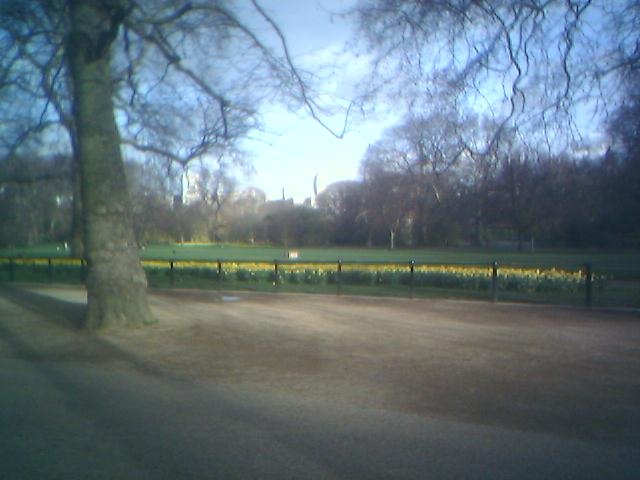
This was the view as I strolled across St James’s Park the other night.
The kind of sight that I almost take for granted, but which I recently realised that tourists pay large sums of money to enjoy for brief periods of time, whilst I see such things on a daily basis.
And people ask me why I like living in London.
These Stray Thoughts walk into a pub, and ...
- I recently finished reading the fifth book in Stephen King’s epic (and it well deserves that description; decades in the writing, and huge in scale) Dark Tower series. I enjoyed it, and some of the ideas in it are staggeringly imaginative, but … well, the thing is, King’s style has changed so much in the last decade or so that the last couple of DT books almost feel as if they could have been written by someone else. I’d hate to think that might be the case, and in fact I suspect it’s because I haven’t read many of SK’s books in the last seven years or so. The chances are high that his writing genuinely has become more elegant and impressive, and that I just haven’t seen the various stages of that evolution. Certainly hope that’s the case, as the DT series deserves to be seen as a classic of imaginative fiction, though as it’s fantasy, I’ll wager it’ll be ignored or overlooked on a critical and academic level.
- On the tube last night, there was an attractive woman; her facial appearance was a kind of mix of Joanne Whalley and Katie Holmes, though with a darker skin hue which suggested a foreign origin, and she was casually but stylishly dressed. But then she ruined all this by producing, and then starting to read, a celebrity gossip magazine. Tch.
- It suddenly occurred to me the other day that I lived in the South of England for 10 years, then the North for 12 years (off and on), and now I’m back in the South again. And I have to say that until I moved to the North, I was utterly unaware of the North-South divide in the way that it’s often perceived – after I moved to Sheffield, people were often keen to point out my southern origins to me, and a girlfriend’s father even made some remark to the effect of my family moving North to be richer, or to exploit some economic benefit, or similar nonsense. And it was often portrayed as if the South of England spends all its time thinking of ways to plot the demise of the North, and to find more ways to move everything to London. Not only is this simply not true, but the – equally unappealing – fact of the matter is that many people in the South of England don’t even think about the North; they’re utterly oblivious to it in terms of their everyday thinking. Whereas a startling number of people I met in Sheffield were actively anti-South almost as if it was a matter of personal pride. All very odd.
- I like Toblerone, but it’s one of those chocolate brands that I never think of in ‘everyday’ terms – it’s either offered at half price when I buy a magazine, or I’m buying it at an airport to get rid of local currency. It’s an international brand, and it’s been around for as long as I can remember, but it somehow always seems to be on the fringes of the chocolate market, for reasons I can’t adequately explain.
REVIEW : Kyro - Half Moon, Putney, 22nd March 2006
Once again, Kyro put on a great show, and their new bassist Max seemed like he’d been there for ages. Nary a bum note to be heard from any of the band, and the use of keyboards and samples is really coming into its own.
Five great songs in their criminally short set, any of which could easily be a single (and indeed they should be), and it would be insanely unfair if they didn’t see all their talent and hard work pay off.
And I won’t even mention the fact that Ian, their lead singer, was pogo-ing so energetically at one stage that he almost landed on top of the drum kit. He’s a good friend, and it would be unkind to bring it up.
Oh.
Men and women like different kinds of book shock!
Ladies first: http://books.guardian.co.uk/news/articles/0,,1369764,00.html
Second class male: http://books.guardian.co.uk/news/articles/0,,1747821,00.html
The general tenor of the news reports is a bit funny, I feel - dismissive of the male reading as pubertal, and somehow damning of the women's choices as if they should all be by Gloria Steinem... if anything, the results kind of suggest the gulf between academic and industry understanding of reader's tastes and the reality, I think.
Second class male: http://books.guardian.co.uk/news/articles/0,,1747821,00.html
The general tenor of the news reports is a bit funny, I feel - dismissive of the male reading as pubertal, and somehow damning of the women's choices as if they should all be by Gloria Steinem... if anything, the results kind of suggest the gulf between academic and industry understanding of reader's tastes and the reality, I think.
Did you miss me ?
Well, I’m back now. Several updates today, and at least three more planned in the next couple of days. Get yourself a cuppa, and read on.
And please keep the comments and e-mails coming in; it’s gratifying to know people are reading this stuff and taking the time to compose responses.
Certainly makes a pleasant change from the usual e-mails I seem to get offering me Viagra or penis enlargement methods… which I presume are the usual contents of spam e-mails, right ? I mean, it’s not just me who gets this stuff, surely…
And please keep the comments and e-mails coming in; it’s gratifying to know people are reading this stuff and taking the time to compose responses.
Certainly makes a pleasant change from the usual e-mails I seem to get offering me Viagra or penis enlargement methods… which I presume are the usual contents of spam e-mails, right ? I mean, it’s not just me who gets this stuff, surely…
Monday, March 27, 2006
It's always hardest when the end is in sight

Okay, so this will be the last post about this (probably, anyway); as you can see from the picture, I really did finish the Silverstone Half Marathon on Sunday 19th March, honest; my official time was 2h 04m 26s, which made me 3199th out of 5003 finishers (ahem). I’m not speedy over the longer distances, that much is clear, but I am steady…
Slightly alarmingly, I was under the impression that 7000 people started the race – did 2000 of them drop out as things went along ? I would have thought I would have noticed that many people falling by the wayside…
Anyway, if you’re impressed or appalled or simply flush for cash, please feel free to make a donation to my chosen charity, Radio Forest, by clicking the following link: http://www.givenow.org/charityprofile/radioforest
Once again, thanks.
REVIEW: Mirrormask
This was apparently commissioned by the Henson company when they realised just what strong sellers their films 'The Dark Crystal' and 'Labyrinth' had proven to be on sell-through video (and, more recently, DVD), so they approached Neil Gaiman (comic writer and novelist) and Dave McKean (artist, to put it mildly) to make a film. And this film is the result, telling the tale of Helena, who finds herself in another world and on a quest to find the Mirrormask, which – she’s told – will save both this dying otherworld, and her life in the world she’s used to.
It’s a very British-feeling film, both in terms of the cast, and the setting (until things go all otherworldly, that is), so in all honesty I don’t know how much of an international appeal it’ll prove to have. That aside, it looks great to see McKean’s style brought to life – I can only begin to imagine how much of a ‘wow’ it would elicit from someone who’s not familiar with his work, as it’s very distinctive.
The story relies perhaps a little bit too much on ‘dream logic’, but it’s ultimately nicely rounded off, and the playing by all the cast is strong, especially the young woman playing Helena. Oddly enough, even though I saw it at the ICA, where you’d expect the sound and vision to be pretty good, it came over as rather poppy and crackly, with the occasional jump in the film, though I guess there might not be too many copies of the film doing the theatrical rounds, so maybe this one was a bit tired?
Anyway, that’s all a side issue, as I’d guess the majority of people will watch it at home. And I’ll certainly do the same, as it feels as if it’d be something to return to. Definitely worth a look.
It’s a very British-feeling film, both in terms of the cast, and the setting (until things go all otherworldly, that is), so in all honesty I don’t know how much of an international appeal it’ll prove to have. That aside, it looks great to see McKean’s style brought to life – I can only begin to imagine how much of a ‘wow’ it would elicit from someone who’s not familiar with his work, as it’s very distinctive.
The story relies perhaps a little bit too much on ‘dream logic’, but it’s ultimately nicely rounded off, and the playing by all the cast is strong, especially the young woman playing Helena. Oddly enough, even though I saw it at the ICA, where you’d expect the sound and vision to be pretty good, it came over as rather poppy and crackly, with the occasional jump in the film, though I guess there might not be too many copies of the film doing the theatrical rounds, so maybe this one was a bit tired?
Anyway, that’s all a side issue, as I’d guess the majority of people will watch it at home. And I’ll certainly do the same, as it feels as if it’d be something to return to. Definitely worth a look.
It's clearly a case of con science
In relation to the issue of the war in Iraq, the Prime Minister recently said that, ultimately, the wisdom of his actions will judged by God.
Two thoughts on this:
1. He knows full well that God isn't registered to vote in the UK
2. Is it just me, or does that sound worryingly reminiscent of something that Annie Wilkes said in ‘Misery’?
Two thoughts on this:
1. He knows full well that God isn't registered to vote in the UK
2. Is it just me, or does that sound worryingly reminiscent of something that Annie Wilkes said in ‘Misery’?
Tuesday, March 21, 2006
REVIEW : Syriana
I'll freely admit that I didn't fully understand this film, but that was more to do with the fact I'd had a long day and this was a late showing than any real fault with the film.
As you may have heard, some of the cast of this film have come under fire (thankfully, only in figurative terms) for their involvement in this film, which seems a bit of an over-reaction to me, as the basic premise appears to be that people in business are often willing to ignore the law and human rights to make a profit, whether at a personal or corporate level. I can't really see why this suggestion would make some people get so angry (as, er, it's what's commonly known as a fact if you look at the history of the twentieth century), unless some people are particularly prickly because this film deals with corporate misbehaviour and governmental collusion in relation to oil. Though getting angry about that idea at the moment would be even more daft. So I don't understand that particular fuss.
Anyway, the film deals with the above, in a number of interweaving plotlines, where it's not always entirely clear what the nature of the characters' relationships may be - but in its way, this is quite pleasing, as it doesn't patronise you as a viewer by explaining everything to you as if you're simple, and you have to do a bit of work. Which is a nice change, really.
The quite impressive cast are good, and the dialogue, while a little exposition-heavy in places, is pretty solid. Not necessarily a fun film, and certainly not one I'd recommend to watch on a date, but certainly interesting, intelligent, and timely. I suspect it would repay repeated viewings (and not just because I was drifting in and out of consciousness at the end).
As you may have heard, some of the cast of this film have come under fire (thankfully, only in figurative terms) for their involvement in this film, which seems a bit of an over-reaction to me, as the basic premise appears to be that people in business are often willing to ignore the law and human rights to make a profit, whether at a personal or corporate level. I can't really see why this suggestion would make some people get so angry (as, er, it's what's commonly known as a fact if you look at the history of the twentieth century), unless some people are particularly prickly because this film deals with corporate misbehaviour and governmental collusion in relation to oil. Though getting angry about that idea at the moment would be even more daft. So I don't understand that particular fuss.
Anyway, the film deals with the above, in a number of interweaving plotlines, where it's not always entirely clear what the nature of the characters' relationships may be - but in its way, this is quite pleasing, as it doesn't patronise you as a viewer by explaining everything to you as if you're simple, and you have to do a bit of work. Which is a nice change, really.
The quite impressive cast are good, and the dialogue, while a little exposition-heavy in places, is pretty solid. Not necessarily a fun film, and certainly not one I'd recommend to watch on a date, but certainly interesting, intelligent, and timely. I suspect it would repay repeated viewings (and not just because I was drifting in and out of consciousness at the end).
And they're coming round the track to haunt me
I once heard a theory advanced that clouds repeat over a long period of time, like the way the background when Scooby and Shaggy are running at a high speed (this was in Grant Morrison's 'Invisibles' comic series, which I'd recommend as a good way to bend your brain out of shape - in the best possible way).
In the same fashion, over time, certain patterns occasionally seem to become evident in my life, and I had an instance of this recently, when on my birthday, I received a communication from a voice from the past. Ten years ago to the day, I'd received a letter from someone who I'd not expected to ever hear from again.
I'm intrigued to see what happens on my 45th birthday.
In the same fashion, over time, certain patterns occasionally seem to become evident in my life, and I had an instance of this recently, when on my birthday, I received a communication from a voice from the past. Ten years ago to the day, I'd received a letter from someone who I'd not expected to ever hear from again.
I'm intrigued to see what happens on my 45th birthday.
REVIEW: 'Cloud Atlas' by David Mitchell
This novel was recommended to me by a friend, and I'm glad I listened; at first glance it appears to be a book of short stories, but they're all interlinked, and run all the way from a historic seafaring journal to a tale of life in a post-apocalyptic future - and then back again.
There are running themes and images in the stories, and they're all written in different voices, and Mitchell does well to make them not only distinct, but also sufficiently interesting and involving that there's a sense of 'aw, I was just getting into that' when one story ends, though the interest is soon diverted to the new tale. The one I found least interesting was what might be seen as the 'central' chapter, but this proved worth persevering with as it paid off later.
Very well written indeed, and I gather Mitchell's written a couple of other novels, which I'll have to look out for. Recommended.
There are running themes and images in the stories, and they're all written in different voices, and Mitchell does well to make them not only distinct, but also sufficiently interesting and involving that there's a sense of 'aw, I was just getting into that' when one story ends, though the interest is soon diverted to the new tale. The one I found least interesting was what might be seen as the 'central' chapter, but this proved worth persevering with as it paid off later.
Very well written indeed, and I gather Mitchell's written a couple of other novels, which I'll have to look out for. Recommended.
Monday, March 20, 2006
The tedium of the long-distance runner
Well, despite my wish not to be seen as part of – or worse, to look as if I’m following – the herd, yesterday I did the Silverstone Half-Marathon along with some 7000 other people.
I was hoping to do it in two hours, but came in about four minutes later than that, though I’ll blame the winds we were running against, and the fact that I’m unaccustomed to public running… well, as part of such a large crowd, anyway.
It’s kind of difficult to describe the mental series of events I underwent yesterday; at first, the music I had playing distracted me nicely (particularly from the rather pedestrian MOR stuff that Fox FM was so kindly pumping through loudspeakers at various points along the course), but after about mile 7, when I started to see people stopping running and walking instead, or just stopping entirely, I became rather aware of the rhythm of both my breathing and my running, to the point where it was less of a reflex or routine and needed me to focus on it a bit… which of course meant that I was all too able to spot every little twinge or feel of reluctance on my part.
In the final third or so, after about mile 10, it felt as if the end was in sight, so that was more a case of just getting on with it, and getting the last bit done – being 10/13 of the way through, it would have been a shame to stop or walk or whatever, so I just ignored any ideas of stopping, and got on with it. And when I was done, felt pretty pleased with myself, even if I was a few minutes over the target I’d set myself.
I guess that the above may or may not make sense at all, depending on whether you’ve done some task which involved prolonged concentration or effort or whatever, though I’ll wager that there are already many books on the shelves about the ways in which psychology varies in such situations; whether people start off gritting their teeth and trying to get through it, or whether they start off hopeful and that optimism fades with time, or whatever. There may indeed be some kind of extrapolation to be made about one’s general attitude to challenges or problems or the like, but that’s something that’s probably best left to other people, I guess.
Of particular note, though: the chap I saw who was running barefoot, and another chap with a vest marked ‘Blind Runner’, both of whom certainly make me feel suitably humbled.
Still, if you’re even vaguely impressed – or appalled, or any other kind of emotional reaction – in relation to me completing the half-marathon, you can always manifest that in financial terms at http://www.givenow.org/charityprofile/radioforest...
Ta!
I was hoping to do it in two hours, but came in about four minutes later than that, though I’ll blame the winds we were running against, and the fact that I’m unaccustomed to public running… well, as part of such a large crowd, anyway.
It’s kind of difficult to describe the mental series of events I underwent yesterday; at first, the music I had playing distracted me nicely (particularly from the rather pedestrian MOR stuff that Fox FM was so kindly pumping through loudspeakers at various points along the course), but after about mile 7, when I started to see people stopping running and walking instead, or just stopping entirely, I became rather aware of the rhythm of both my breathing and my running, to the point where it was less of a reflex or routine and needed me to focus on it a bit… which of course meant that I was all too able to spot every little twinge or feel of reluctance on my part.
In the final third or so, after about mile 10, it felt as if the end was in sight, so that was more a case of just getting on with it, and getting the last bit done – being 10/13 of the way through, it would have been a shame to stop or walk or whatever, so I just ignored any ideas of stopping, and got on with it. And when I was done, felt pretty pleased with myself, even if I was a few minutes over the target I’d set myself.
I guess that the above may or may not make sense at all, depending on whether you’ve done some task which involved prolonged concentration or effort or whatever, though I’ll wager that there are already many books on the shelves about the ways in which psychology varies in such situations; whether people start off gritting their teeth and trying to get through it, or whether they start off hopeful and that optimism fades with time, or whatever. There may indeed be some kind of extrapolation to be made about one’s general attitude to challenges or problems or the like, but that’s something that’s probably best left to other people, I guess.
Of particular note, though: the chap I saw who was running barefoot, and another chap with a vest marked ‘Blind Runner’, both of whom certainly make me feel suitably humbled.
Still, if you’re even vaguely impressed – or appalled, or any other kind of emotional reaction – in relation to me completing the half-marathon, you can always manifest that in financial terms at http://www.givenow.org/charityprofile/radioforest...
Ta!
The best lack all conviction, while the worst are full of Stray Thoughts
1. Unless I’m missing the point quite dramatically, the aim of trailers at the cinema is to make you want to see the film, yes ? Taking that as the case, then I can’t see many people (and certainly not me) racing to see the film ‘Basic Instinct 2’ on the basis of the trailer, which makes it look like a re-made for British TV version of the original film, and appears about as ill-advised as ‘American Psycho 2’ (I’m not making that one up, it does exist). If ‘Basic Instinct’ had anything going for it, I’d guess it was the high-sheen production, the twisty Eszterhaus script, and Verhoeven’s directing, as well as the sheen of the setting and the leads (Michael Douglas’s pullover aside). But this latest film looks … well, it looks rather on the dull side, at best, and the sequel element of it looks marginal; only one member of the original cast, it seems, plus a different writer (writing team, no less), and director, making it more like (to give two examples) ‘Grease 2’ than ‘Blade 2’. And as a friend of mine pointed out, the poster of Sharon Stone sitting backwards on a chair has the unfortunate effect of looking rather as if she’s got some kind of down-pointing metal male genitalia. Which is different from the original film, I guess, but still…
2. The present government is currently facing criticism for allegedly taking ‘loans’ from people who later received honours. Leaving aside the fact that this may not be against parliamentary rules but is obviously not in line with the spirit of those rules, I guess I can partly see why the present administration aren’t really seeming too ruffled; when you’ve managed to get re-elected after going to war against a foreign power without any proper justification, you probably feel that you can get away with pretty much anything.
3. Had an interesting experience recently when I suddenly had cause to think ‘what if I died tomorrow? What would I want to have resolved before then?’, and this led to a phone call to someone I’d become distanced from. I’d recommend mulling over things in this light occasionally, as you may find – as I have – that you can recover or repair something you may have lost for a bad reason.
4. At my recent birthday gathering, I was touched not only by the turnout and the generosity of my friends in terms of presents, but also by the fact that the vast majority of them used the word ‘mountainporn’ in relation to pictures of mountains and the like. Warmed the heart of my cockles, it truly did.
5. Speaking of such things, it’s Mother’s Day on Sunday. You still have a few days to get something and look like a good son/daughter/non-gender-specific child. Just trying to help out here.
2. The present government is currently facing criticism for allegedly taking ‘loans’ from people who later received honours. Leaving aside the fact that this may not be against parliamentary rules but is obviously not in line with the spirit of those rules, I guess I can partly see why the present administration aren’t really seeming too ruffled; when you’ve managed to get re-elected after going to war against a foreign power without any proper justification, you probably feel that you can get away with pretty much anything.
3. Had an interesting experience recently when I suddenly had cause to think ‘what if I died tomorrow? What would I want to have resolved before then?’, and this led to a phone call to someone I’d become distanced from. I’d recommend mulling over things in this light occasionally, as you may find – as I have – that you can recover or repair something you may have lost for a bad reason.
4. At my recent birthday gathering, I was touched not only by the turnout and the generosity of my friends in terms of presents, but also by the fact that the vast majority of them used the word ‘mountainporn’ in relation to pictures of mountains and the like. Warmed the heart of my cockles, it truly did.
5. Speaking of such things, it’s Mother’s Day on Sunday. You still have a few days to get something and look like a good son/daughter/non-gender-specific child. Just trying to help out here.
Tuesday, March 14, 2006
Day of rest, my increasingly well-toned posterior...
As I may well have mentioned, this Sunday (19th March), I’m doing the Adidas London Half-Marathon, which for reasons best known to Adidas, is being held this year at Silverstone (yes, the race track in Northamptonshire). I know - it IS odd, isn’t it?
Anyhow, I’d be very grateful if you’d sponsor me – not for my own benefit, however; I’m running to raise money for Radio Forest, the hospital radio station who have been kind enough to let me use their record library and equipment on Tuesday nights for… ooh, must be a couple of years now. Radio Forest is a registered charity, and runs two channels, which are on 24 hours a day. As this is all done voluntarily, I’m sure you can imagine it’s far from cheap to run (not least because of the number of chocolate biscuits and cups of tea I demand as a backstage perk before I’ll even think about putting on a show).
So if you’d like to sponsor me for doing the 13.1 miles (that’s 21 kilometres in new money, I gather) this weekend, I’d be very grateful. A couple of people have said that they felt faintly uncomfortable about entering their details on online sponsor forms I’ve set up in the past, so you’ll be relieved to know that the arrangement this time doesn’t necessitate having your name or amount in any way displayed online, but instead allows you to go straight to a page which lets you donate to Radio Forest – of course, if you’d prefer to wait until I’ve actually done the running, and for me to let you know how long it took and how much it hurt me, I’ll be happy to let you know about that too. Though just to set some kind of baseline – and here’s where I make a rod for my own back – I’m hoping to complete it in less than two hours… still, we’ll see.
Anyway, if you’d like to donate/sponsor, the following link will take you to the appropriate webpage, which also gives more information about Radio Forest: http://www.givenow.org/charityprofile/radioforest
Thanks – please feel free to get in touch with me if you have any questions about any of this!
Anyhow, I’d be very grateful if you’d sponsor me – not for my own benefit, however; I’m running to raise money for Radio Forest, the hospital radio station who have been kind enough to let me use their record library and equipment on Tuesday nights for… ooh, must be a couple of years now. Radio Forest is a registered charity, and runs two channels, which are on 24 hours a day. As this is all done voluntarily, I’m sure you can imagine it’s far from cheap to run (not least because of the number of chocolate biscuits and cups of tea I demand as a backstage perk before I’ll even think about putting on a show).
So if you’d like to sponsor me for doing the 13.1 miles (that’s 21 kilometres in new money, I gather) this weekend, I’d be very grateful. A couple of people have said that they felt faintly uncomfortable about entering their details on online sponsor forms I’ve set up in the past, so you’ll be relieved to know that the arrangement this time doesn’t necessitate having your name or amount in any way displayed online, but instead allows you to go straight to a page which lets you donate to Radio Forest – of course, if you’d prefer to wait until I’ve actually done the running, and for me to let you know how long it took and how much it hurt me, I’ll be happy to let you know about that too. Though just to set some kind of baseline – and here’s where I make a rod for my own back – I’m hoping to complete it in less than two hours… still, we’ll see.
Anyway, if you’d like to donate/sponsor, the following link will take you to the appropriate webpage, which also gives more information about Radio Forest: http://www.givenow.org/charityprofile/radioforest
Thanks – please feel free to get in touch with me if you have any questions about any of this!
Monday, March 06, 2006
A brief website from my labours
Many months after it was promised, my website finally has samples available for reading, downloading, and even printing, at http://www.johnsoanes.co.uk/samples.htm . Rather embarrassed about the delays, but I'd be genuinely interested in your comments on the stuff that's there - there are the opening chapters from my first novel, a short story, and a non-fiction journalistic piece, so I like to think there's something for everyone. Let me know what you make of it.
And I may soon be able to share a link to a bit of stand-up I did the other day which was filmed for possible online streaming (ooh, get me with the techie jargon; shame I'm not entirely sure that's the right term, but still). But I'm not sure at this point whether it will be available online. Should that be the case, though, I'll be sure to let you know (or, as the more astute amongst you will translate that phrase, 'to continue with my egocentric and self-absorbed policy of wanton hype and self-promotion').
And I may soon be able to share a link to a bit of stand-up I did the other day which was filmed for possible online streaming (ooh, get me with the techie jargon; shame I'm not entirely sure that's the right term, but still). But I'm not sure at this point whether it will be available online. Should that be the case, though, I'll be sure to let you know (or, as the more astute amongst you will translate that phrase, 'to continue with my egocentric and self-absorbed policy of wanton hype and self-promotion').
Thursday, March 02, 2006
Why nerds read comics
As I write this, both the major american comic publishers are publishing lengthy and involved cross-overs. For those of you who are unfamiliar with this phenomenon - and it's one which is pretty much standard in the shared universes which are so rife in comics, but less frequent in other media - this means that there are stories being told which run through a number of separate comics, but which, when read in sequence, should create the sense of one big story.
This is moderately rare in other media, but comics have been doing it for decades; in the 1980s, when Marvel released 'Marvel Superheroes Secret Wars', all the major Marvel comic characters (including Spider-Man, the Hulk, the X-Men, and all the other heroes and villains alike) were whisked to another world where they... er, well, as I understand it, pretty much fought for a series of 12 issues. There were a number of related issues of other comics published featuring the ramifications of what happened during the 'Secret Wars', perhaps the most notable of which was that Spider-Man got a new costume (which I always thought was pretty spiffy, but let's face it, it was unlikely to stick around for marketing reasons if nothing else).
In 1985, DC Comics (publishers of Superman, Batman, and Wonder Woman) published a series called Crisis on Infinite Earths. For DC, this was as much a house-clearing exercise as it was an event, or gimmick to sell more copies. For a long time, DC had tried to explain the fact that many of their characters had been superheroes for so long (Superman fought Nazis in WWII, after all) by saying that the characters existed on a number of parallel earths within the DC Universe. So the Superman who fought in the war was in fact from Earth-2, and as such he had white hair. If memory serves, the Batman of Earth-2 was retired and married to the Catwoman of that alternate, but I could well be wrong. I never really understood the way the alternate earths worked in DC continuity, and looking at it now, whilst I can see a lot of people went to a lot of trouble to make the situation make some kind of sense, howsoever convoluted, to my mind it looks like the kind of world-building that suggests creators in danger of falling in love with the creations. Which is rarely good for subsequent creativity, I feel.
Anyway, DC merged all their earths into one, bumping off a substantial number of alternate earth versions of their heroes (such as the aforementioned elderly Superman), and thus providing themselves with the perfect opportunity to 'reboot' some of their characters and modernise them. Perhaps the most visible example of this would be the fate of Jonathan and Martha Kent, who died when Clark was young in the pre-Crisis era, and thus in the Superman film starring Christopher Reeve, but who are alive and living in the post-Crisis reboot of Superman, and thus are on hand to provide advice etc in the 'Lois and Clark' and 'Smallville' TV shows.
With me so far ? I can understand if not. The thing is, both Marvel and DC found these cross-overs to be extremely lucrative; the completist mentality is a prevalent strand in many comic readers, and so large numbers of comics were sold by virtue of being 'tied in' to the event in question. Over the next decade or so, both companies (and many less well known ones) ran cross-overs, despite them being pretty blatantly a sales ploy more than anything else: Secret Wars II, Legends, Millennium, the X-tinction Agenda, DC One Million, Underworld Unleashed, the Children's Crusade, Total Eclipse, the Age of Apocalypse, and many, MANY more. All pretty difficult to follow unless you bought all the component parts, and not necessarily much more coherent if you did, and damned expensive to do so, as you were effectively committing to buying the vast majority of a publisher's output for a month or more (USA comics are published monthly on the whole, but ship in different weeks, so you could buy the Superman tie-in in week one of a month, the Batman tie-in in week two, and so on).
As I say, both publishers are currently in the process of running large cross-overs; DC found considerable success with a mini-series (that is, limited to a number of issues - 6, I believe) called Identity Crisis written by novelist Brad Meltzer, which gained coverage in the mainstream press for its dark story elements. This led to a number of associated mini-series (the Rann-Thanagar War, Villains United, the OMAC Project), which led into the frankly bewilderingly-titled Infinite Crisis, which is being published as I type this, and will in itself lead to a whole slew of follow-on stories and spin-off series.
Marvel, for their part, have recently finished a series called House of M (a semi-alternate world story in which Magneto, the X-men villain, rules the world), which - as far as I can understand it - had led into more crossovers, called Decimation and the like.
I sound vague about all this, don't I? Well, the simple reason is that I'm not reading any of them. I like only a handful of superhero comics, and though I go to my local comic shop pretty much each week, there are fewer and fewer comics which I feel the inclination to buy. As much as I may like the character of Batman, I'm not going to buy a copy of the monthly comic if it's the 13th tie-in chapter to a much bigger story which will necessitate my buying more stuff. I'm stupid, but I'm not made of money. So I end up buying collected editions (in which I'll get a complete story) or trying new stuff, which is probably healthy.
But what appears to be going on is that the major US comics publishers have decided not to try to reach out to new readers or expand their dwindling marketplace in any fashion, but instead to run a series of stories which are designed to wring every last penny out of their current readership. This happened in the 80s and 90s, and whilst it provided a short-term infusion of cash, it was ultimately unsustainable, and did little if anything to provoke any kind of increase in overall readership. Instead it's appealing to a completist mentality, one which has both money and time enough to fixate on whether the new continuity allows for the idea that Beppo the Supermonkey might still live somewhere in Superman's Fortress of Solitude. It's a mentality which probably medically borders on Asperger's syndrome, and socially is known as nerdy at best, and whilst I could debate the ethics of the publishers shamelessly exploiting the customers with endless cross-overs, I think the worst aspect of it is that it has to be a short-term thing, both for the readers ("What comes after 'Infinite Crisis'?" asks the fanboy, to which the correct answer is probably "Shaving") and for the publishers ("No, I don't buy comics any more" and the like).
This, then, is the reason for the provocative heading to this post. I'm not saying that ONLY nerds read comics, but the publishers have recently started to aggressively target their most obsessive and completist readers, to the exclusion of other readers ... readers like me (meanwhile, manga grows in popularity, stocked and sold out in real bookshops, no less).
You'll also notice that I refer solely to the US publishers here. The main reason being that the mainstream UK comics industry is very limited indeed, essentially being comprised of a handful of comics aimed at young children, 2000AD and Judge Dredd comics, and Viz. A depressingly small number of titles overall, and thus with limited cross-over potential. Though I'd probably pay good money to see a Tweenies-Judge Dredd-Buster Gonad team-up.
This is moderately rare in other media, but comics have been doing it for decades; in the 1980s, when Marvel released 'Marvel Superheroes Secret Wars', all the major Marvel comic characters (including Spider-Man, the Hulk, the X-Men, and all the other heroes and villains alike) were whisked to another world where they... er, well, as I understand it, pretty much fought for a series of 12 issues. There were a number of related issues of other comics published featuring the ramifications of what happened during the 'Secret Wars', perhaps the most notable of which was that Spider-Man got a new costume (which I always thought was pretty spiffy, but let's face it, it was unlikely to stick around for marketing reasons if nothing else).
In 1985, DC Comics (publishers of Superman, Batman, and Wonder Woman) published a series called Crisis on Infinite Earths. For DC, this was as much a house-clearing exercise as it was an event, or gimmick to sell more copies. For a long time, DC had tried to explain the fact that many of their characters had been superheroes for so long (Superman fought Nazis in WWII, after all) by saying that the characters existed on a number of parallel earths within the DC Universe. So the Superman who fought in the war was in fact from Earth-2, and as such he had white hair. If memory serves, the Batman of Earth-2 was retired and married to the Catwoman of that alternate, but I could well be wrong. I never really understood the way the alternate earths worked in DC continuity, and looking at it now, whilst I can see a lot of people went to a lot of trouble to make the situation make some kind of sense, howsoever convoluted, to my mind it looks like the kind of world-building that suggests creators in danger of falling in love with the creations. Which is rarely good for subsequent creativity, I feel.
Anyway, DC merged all their earths into one, bumping off a substantial number of alternate earth versions of their heroes (such as the aforementioned elderly Superman), and thus providing themselves with the perfect opportunity to 'reboot' some of their characters and modernise them. Perhaps the most visible example of this would be the fate of Jonathan and Martha Kent, who died when Clark was young in the pre-Crisis era, and thus in the Superman film starring Christopher Reeve, but who are alive and living in the post-Crisis reboot of Superman, and thus are on hand to provide advice etc in the 'Lois and Clark' and 'Smallville' TV shows.
With me so far ? I can understand if not. The thing is, both Marvel and DC found these cross-overs to be extremely lucrative; the completist mentality is a prevalent strand in many comic readers, and so large numbers of comics were sold by virtue of being 'tied in' to the event in question. Over the next decade or so, both companies (and many less well known ones) ran cross-overs, despite them being pretty blatantly a sales ploy more than anything else: Secret Wars II, Legends, Millennium, the X-tinction Agenda, DC One Million, Underworld Unleashed, the Children's Crusade, Total Eclipse, the Age of Apocalypse, and many, MANY more. All pretty difficult to follow unless you bought all the component parts, and not necessarily much more coherent if you did, and damned expensive to do so, as you were effectively committing to buying the vast majority of a publisher's output for a month or more (USA comics are published monthly on the whole, but ship in different weeks, so you could buy the Superman tie-in in week one of a month, the Batman tie-in in week two, and so on).
As I say, both publishers are currently in the process of running large cross-overs; DC found considerable success with a mini-series (that is, limited to a number of issues - 6, I believe) called Identity Crisis written by novelist Brad Meltzer, which gained coverage in the mainstream press for its dark story elements. This led to a number of associated mini-series (the Rann-Thanagar War, Villains United, the OMAC Project), which led into the frankly bewilderingly-titled Infinite Crisis, which is being published as I type this, and will in itself lead to a whole slew of follow-on stories and spin-off series.
Marvel, for their part, have recently finished a series called House of M (a semi-alternate world story in which Magneto, the X-men villain, rules the world), which - as far as I can understand it - had led into more crossovers, called Decimation and the like.
I sound vague about all this, don't I? Well, the simple reason is that I'm not reading any of them. I like only a handful of superhero comics, and though I go to my local comic shop pretty much each week, there are fewer and fewer comics which I feel the inclination to buy. As much as I may like the character of Batman, I'm not going to buy a copy of the monthly comic if it's the 13th tie-in chapter to a much bigger story which will necessitate my buying more stuff. I'm stupid, but I'm not made of money. So I end up buying collected editions (in which I'll get a complete story) or trying new stuff, which is probably healthy.
But what appears to be going on is that the major US comics publishers have decided not to try to reach out to new readers or expand their dwindling marketplace in any fashion, but instead to run a series of stories which are designed to wring every last penny out of their current readership. This happened in the 80s and 90s, and whilst it provided a short-term infusion of cash, it was ultimately unsustainable, and did little if anything to provoke any kind of increase in overall readership. Instead it's appealing to a completist mentality, one which has both money and time enough to fixate on whether the new continuity allows for the idea that Beppo the Supermonkey might still live somewhere in Superman's Fortress of Solitude. It's a mentality which probably medically borders on Asperger's syndrome, and socially is known as nerdy at best, and whilst I could debate the ethics of the publishers shamelessly exploiting the customers with endless cross-overs, I think the worst aspect of it is that it has to be a short-term thing, both for the readers ("What comes after 'Infinite Crisis'?" asks the fanboy, to which the correct answer is probably "Shaving") and for the publishers ("No, I don't buy comics any more" and the like).
This, then, is the reason for the provocative heading to this post. I'm not saying that ONLY nerds read comics, but the publishers have recently started to aggressively target their most obsessive and completist readers, to the exclusion of other readers ... readers like me (meanwhile, manga grows in popularity, stocked and sold out in real bookshops, no less).
You'll also notice that I refer solely to the US publishers here. The main reason being that the mainstream UK comics industry is very limited indeed, essentially being comprised of a handful of comics aimed at young children, 2000AD and Judge Dredd comics, and Viz. A depressingly small number of titles overall, and thus with limited cross-over potential. Though I'd probably pay good money to see a Tweenies-Judge Dredd-Buster Gonad team-up.
Wednesday, March 01, 2006
REVIEW: Aeon Flux
Whilst I’m sure that a large number of people will be drawn to see this film by the presence of Charlize Theron in an array of skimpy and skin-tight outfits, as a sophisticated and knowledgeable type, my interest stemmed from an appreciation of the original animated short features. As bizarre in terms of story as they were in unusual in appearance, the second series suffered somewhat from the absence of creator Peter Chung, but was nonetheless still interesting.
Chung doesn’t seem to have had much of a hand in the live-action version, which sets up Flux as an acrobatically-skilled assassin fighting against an oppressive future regime. So far, so standard, but after about 40 minutes, things start unravelling, the status quo proves not to be what either side had really believed it to be, and the film reveals some story ideas which are arguably more interesting than you’d necessarily expect.
However, the film felt like a lot of it was missing, perhaps trimmed to get it down to a multiplex-friendly 90-odd minutes, and I was reminded of the film Event Horizon, where a lot of the plot appeared to be either taking place off-screen or in expository dialogue. This throws the plotting somewhat, and leads to the feeling that certain of the plot holes would have been patched up if the whole film had been up there on the screen.
The performances are all perfectly fine, and the stunts and special effects are pretty good, but there’s a lurking feeling that even though the film’s better than you might have expected, there’s nonetheless a slightly more interesting film lying beneath the surface.
Overall, then, a perfectly serviceable film, and a smidgin above the level I anticipated, though not as interesting as the original cartoons. Still, if you’re going to see it with the more limited expectation that it’ll feature Ms Theron in various states of limited dress and undress, you’ll probably feel you’ve got your money’s worth. I know I certainly did.
Damn. I nearly got away with that, didn’t I? Ah well.
Chung doesn’t seem to have had much of a hand in the live-action version, which sets up Flux as an acrobatically-skilled assassin fighting against an oppressive future regime. So far, so standard, but after about 40 minutes, things start unravelling, the status quo proves not to be what either side had really believed it to be, and the film reveals some story ideas which are arguably more interesting than you’d necessarily expect.
However, the film felt like a lot of it was missing, perhaps trimmed to get it down to a multiplex-friendly 90-odd minutes, and I was reminded of the film Event Horizon, where a lot of the plot appeared to be either taking place off-screen or in expository dialogue. This throws the plotting somewhat, and leads to the feeling that certain of the plot holes would have been patched up if the whole film had been up there on the screen.
The performances are all perfectly fine, and the stunts and special effects are pretty good, but there’s a lurking feeling that even though the film’s better than you might have expected, there’s nonetheless a slightly more interesting film lying beneath the surface.
Overall, then, a perfectly serviceable film, and a smidgin above the level I anticipated, though not as interesting as the original cartoons. Still, if you’re going to see it with the more limited expectation that it’ll feature Ms Theron in various states of limited dress and undress, you’ll probably feel you’ve got your money’s worth. I know I certainly did.
Damn. I nearly got away with that, didn’t I? Ah well.
C for Cover-up
As the film’s due to be released in a couple of weeks, it feels like an appropriate time to talk about ‘V for Vendetta’.
V (as I’ll call it from here onwards, though I know that invites confusion with the TV series starring the humanoid lizards with the pseudo-swastika emblem) is something I’ve been a fan of for the best part of twenty years. I first discovered it in black and white in the ground-breaking British comic Warrior, where it was initially published, though when Warrior was cancelled (leaving the story on possibly one of the most startling and reader-tormenting cliffhangers possible), I had to wait for the colour reprint-and-completion by DC Comics in the USA.
It was worth the wait, as despite being a little dated now (events in the story are set in 1997), it’s a remarkable feat of storytelling – the art’s utterly different from the vast majority of comics, the writing’s literate and intelligent, and the story’s one which is arguably even more important in the current political climate. All this, without using any sound effects or thought bubbles.
My fondness hasn’t dimmed over time – lines from the story ring in my mind on a regular basis, I hold that ‘Valerie’ remains one of the most powerful bits of comic work I’ve ever seen, and I’m proud to say that I have an original V sketch (which co-creator David Lloyd did for me) framed and on the wall above my desk as I type this.
So you’re getting the general idea that I like V the comic. How I feel about the film is… well, complicated, I guess. Whilst I like the idea that it might make more people seek out the original work, and that the film might retain even a handful of the 1984ish elements which make the comic so powerful, the general likelihood is that it’ll be diluted in favour of action sequences and the like, and if there’s any truth to the rumours about the ending – which certainly seemed to be evinced by the standee I saw in a cinema last week – then the adaptation by the Wachowski brothers appears likely to have missed the whole point of what V’s anarchy is all about.
The writer of the original comic (and, if I haven’t mentioned it before, possibly one of the finest writers working in any medium), Alan Moore, was sent a copy of the screenplay, and was not impressed, and said so. Despite this, it was claimed by the producer that he’d supported the project. As a result of this blatant untruth on the part of the filmmakers, Moore asked that no future projects based on comics he’s written should bear his name, and that his share of any money should be given to the other creators.
With this in mind, last year, when I heard that production on V had finished shooting in Europe and was moving to the UK, I was curious to see where that was going to take place. As I worked in Westminster at the time, and saw a sign up stating that between midnight and 5am certain areas would be closed (Whitehall and Parliament Square), I guessed that this was probably the location. But I couldn’t help feeling there was a certain hypocrisy to the London authorities decrying terrorism one minute, and permitting the shooting of a film in which a masked anarchist blows up various landmarks in London the next. It smacked of saying something and only meaning it as long as it wasn’t jeopardising some money. And Mr Moore’s comments and treatment struck me as a rather poor show too.
So I called up various authorities in London, my finely-honed but underused journalistic skills telling me there could be a story angle in this. Perhaps appropriately enough, given the transport-related nature of things, I was given the runaround; the local council, road maintenance, and planning people all claimed they didn’t know anything about it, and suggested I called London Transport. When I did so, and explained my question as to whether V was being filmed there, the woman on the line said ‘I can’t tell you that’, and other angles proved equally fruitless. I felt I was being stonewalled, but since I had neither a commission to expend money or effort on the story, and checking it out would being at Westminster at midnight when I had a day job, I let it go.
A few days after the period of road closure, I saw a report in the Evening Standard about, yes, the filming of ‘V for Vendetta’ in Parliament Square, accompanied by pictures of tanks rolling along the London streets, and an ending-spoiling image. The reports referred to V as a ‘revolutionary’, I noted, not a terrorist. So I couldn’t help but wonder if there was a limit on the coverage relating to it, possibly even limited to the Evening Standard so as to woo them – the Standard’s a startlingly kneejerk and insular paper which campaigned against Cronenberg’s ‘Crash’, and which devotes more time than is healthy to coverage of tube delays and the doings of the current mayor. So I wonder if they were given exclusive access or something to pre-empt a negative reaction, especially as it could quite easily have focussed on the terrorist angle. But that’s speculation based on my sense of being stonewalled, I guess.
I’ll probably go and see the film (and if I do, I’ll almost undoubtedly review it here) – if nothing else, I’ll be curious to see if the tales about the ‘Valerie’ sequence being retained are true – though I don’t expect it in any way to have the depth or resonance of the original comic. I am, in the meantime, feeling a weird frisson every time I see an advert for it on the side of a London bus, as V’s been a part of my life for over fifteen years, and suddenly seeing it in the public arena generates a smug sense of ‘knew it was of interest all along’, as well as that slightly regrettable sense that one’s secret pleasure has been discovered by a mass audience.
V (as I’ll call it from here onwards, though I know that invites confusion with the TV series starring the humanoid lizards with the pseudo-swastika emblem) is something I’ve been a fan of for the best part of twenty years. I first discovered it in black and white in the ground-breaking British comic Warrior, where it was initially published, though when Warrior was cancelled (leaving the story on possibly one of the most startling and reader-tormenting cliffhangers possible), I had to wait for the colour reprint-and-completion by DC Comics in the USA.
It was worth the wait, as despite being a little dated now (events in the story are set in 1997), it’s a remarkable feat of storytelling – the art’s utterly different from the vast majority of comics, the writing’s literate and intelligent, and the story’s one which is arguably even more important in the current political climate. All this, without using any sound effects or thought bubbles.
My fondness hasn’t dimmed over time – lines from the story ring in my mind on a regular basis, I hold that ‘Valerie’ remains one of the most powerful bits of comic work I’ve ever seen, and I’m proud to say that I have an original V sketch (which co-creator David Lloyd did for me) framed and on the wall above my desk as I type this.
So you’re getting the general idea that I like V the comic. How I feel about the film is… well, complicated, I guess. Whilst I like the idea that it might make more people seek out the original work, and that the film might retain even a handful of the 1984ish elements which make the comic so powerful, the general likelihood is that it’ll be diluted in favour of action sequences and the like, and if there’s any truth to the rumours about the ending – which certainly seemed to be evinced by the standee I saw in a cinema last week – then the adaptation by the Wachowski brothers appears likely to have missed the whole point of what V’s anarchy is all about.
The writer of the original comic (and, if I haven’t mentioned it before, possibly one of the finest writers working in any medium), Alan Moore, was sent a copy of the screenplay, and was not impressed, and said so. Despite this, it was claimed by the producer that he’d supported the project. As a result of this blatant untruth on the part of the filmmakers, Moore asked that no future projects based on comics he’s written should bear his name, and that his share of any money should be given to the other creators.
With this in mind, last year, when I heard that production on V had finished shooting in Europe and was moving to the UK, I was curious to see where that was going to take place. As I worked in Westminster at the time, and saw a sign up stating that between midnight and 5am certain areas would be closed (Whitehall and Parliament Square), I guessed that this was probably the location. But I couldn’t help feeling there was a certain hypocrisy to the London authorities decrying terrorism one minute, and permitting the shooting of a film in which a masked anarchist blows up various landmarks in London the next. It smacked of saying something and only meaning it as long as it wasn’t jeopardising some money. And Mr Moore’s comments and treatment struck me as a rather poor show too.
So I called up various authorities in London, my finely-honed but underused journalistic skills telling me there could be a story angle in this. Perhaps appropriately enough, given the transport-related nature of things, I was given the runaround; the local council, road maintenance, and planning people all claimed they didn’t know anything about it, and suggested I called London Transport. When I did so, and explained my question as to whether V was being filmed there, the woman on the line said ‘I can’t tell you that’, and other angles proved equally fruitless. I felt I was being stonewalled, but since I had neither a commission to expend money or effort on the story, and checking it out would being at Westminster at midnight when I had a day job, I let it go.
A few days after the period of road closure, I saw a report in the Evening Standard about, yes, the filming of ‘V for Vendetta’ in Parliament Square, accompanied by pictures of tanks rolling along the London streets, and an ending-spoiling image. The reports referred to V as a ‘revolutionary’, I noted, not a terrorist. So I couldn’t help but wonder if there was a limit on the coverage relating to it, possibly even limited to the Evening Standard so as to woo them – the Standard’s a startlingly kneejerk and insular paper which campaigned against Cronenberg’s ‘Crash’, and which devotes more time than is healthy to coverage of tube delays and the doings of the current mayor. So I wonder if they were given exclusive access or something to pre-empt a negative reaction, especially as it could quite easily have focussed on the terrorist angle. But that’s speculation based on my sense of being stonewalled, I guess.
I’ll probably go and see the film (and if I do, I’ll almost undoubtedly review it here) – if nothing else, I’ll be curious to see if the tales about the ‘Valerie’ sequence being retained are true – though I don’t expect it in any way to have the depth or resonance of the original comic. I am, in the meantime, feeling a weird frisson every time I see an advert for it on the side of a London bus, as V’s been a part of my life for over fifteen years, and suddenly seeing it in the public arena generates a smug sense of ‘knew it was of interest all along’, as well as that slightly regrettable sense that one’s secret pleasure has been discovered by a mass audience.
REVIEW :’The Wild Highway’ by Bill Drummond and Mark Manning
This book is the second part of a projected trilogy by Drummond (also known as King Boy D of The KLF) and Manning (better known as Zodiac Mindwarp of the band Zodiac Mindwarp and the Love Reaction). The first book, ‘Bad Wisdom’, was published in 1996 or so.
Relevant flashback: as I was travelling on the tube one Friday morning in 1996 or so, I was reading ‘Bad Wisdom’. An Australian woman asked me what I was reading, and if it was any good. My reply was that it was kind of a travel book, but written by two authors, and one of them was totally unreliable, so you didn’t know how much to believe. This was true, but the reality of the situation was that the woman was friendly and pretty, and I didn’t want to alienate her by telling her the full truth, which is that Bad Wisdom was without a doubt one of the most insane and filthy books I’d ever read in my life.
And that’s the case with the follow-up too; as Drummond and Manning write of their journey up the Congo to perform a Punch and Judy show for the President in an attempt to win back their souls from the Devil (see, told you it was mad), pretty much every taboo is on show: racism, sexism, murder, homophobia, rape, cannibalism, paedophilia, and just about every scatological variation you could think of.
The two authors alternate their sections, though even that’s questionable, as it becomes clear partway through that Manning’s added fictionalised events under Drummond’s name. Drummond, on the whole, tries to give a linear version of events – or at least as linear as can be, given that we’re possibly dealing with a journey which may not have taken place in anything like the form depicted – whilst Manning’s sections are (at least I hope) utter fiction: depicting himself as a serial killer in league with a sexually depraved murderous BBC international reporter, sexual predator and alcoholic, Manning’s sections are at first fairly shocking, and then after a while amusing in so far as he does seem able to keep coming up with scenarios which are more and more designed to shock. It’s pretty obvious that he’s doing it for effect – though quite what effect he’s hoping to achieve, I’m at a bit of a loss to ascertain – and there’s a funny section where Drummond asks the reader why they think Manning writes the stuff he does. It almost suggests a degree of despair at his co-writer, as the gross imagery does tend to overwhelm the insights which lurk within Drummond’s sections.
The book’s about twice the length of its predecessor, and Drummond admits on the penultimate page that a reader would need to be pretty dedicated to have made it that far, and he’s not wrong, really; it feels a bit like a wade in every conceivable kind of filth, so it might be seen as something of an endurance test, but having finished it, I feel it was worthwhile, though I can’t quite tell you why. Whether it’s merely because I feel vaguely as if I’ve read something which could legitimately be classified as ‘obscene’, and have therefore put one over on ‘the man’, or whether I’ve just become so inured to the horror on show in the book and have effectively made myself slightly less sensitised, I couldn’t really say. But it felt worth reading, and I suspect that if the third volume ever sees print (I have some doubts – the first volume was published by Penguin, and the second by the smaller Creation Books, apparently on the grounds that the racism on display, however feigned, put Penguin off), I’ll be back to read that.
Despite some concern about what new obscenities Manning will once again commit to the page, and how much (or how little) they might startle me.
Relevant flashback: as I was travelling on the tube one Friday morning in 1996 or so, I was reading ‘Bad Wisdom’. An Australian woman asked me what I was reading, and if it was any good. My reply was that it was kind of a travel book, but written by two authors, and one of them was totally unreliable, so you didn’t know how much to believe. This was true, but the reality of the situation was that the woman was friendly and pretty, and I didn’t want to alienate her by telling her the full truth, which is that Bad Wisdom was without a doubt one of the most insane and filthy books I’d ever read in my life.
And that’s the case with the follow-up too; as Drummond and Manning write of their journey up the Congo to perform a Punch and Judy show for the President in an attempt to win back their souls from the Devil (see, told you it was mad), pretty much every taboo is on show: racism, sexism, murder, homophobia, rape, cannibalism, paedophilia, and just about every scatological variation you could think of.
The two authors alternate their sections, though even that’s questionable, as it becomes clear partway through that Manning’s added fictionalised events under Drummond’s name. Drummond, on the whole, tries to give a linear version of events – or at least as linear as can be, given that we’re possibly dealing with a journey which may not have taken place in anything like the form depicted – whilst Manning’s sections are (at least I hope) utter fiction: depicting himself as a serial killer in league with a sexually depraved murderous BBC international reporter, sexual predator and alcoholic, Manning’s sections are at first fairly shocking, and then after a while amusing in so far as he does seem able to keep coming up with scenarios which are more and more designed to shock. It’s pretty obvious that he’s doing it for effect – though quite what effect he’s hoping to achieve, I’m at a bit of a loss to ascertain – and there’s a funny section where Drummond asks the reader why they think Manning writes the stuff he does. It almost suggests a degree of despair at his co-writer, as the gross imagery does tend to overwhelm the insights which lurk within Drummond’s sections.
The book’s about twice the length of its predecessor, and Drummond admits on the penultimate page that a reader would need to be pretty dedicated to have made it that far, and he’s not wrong, really; it feels a bit like a wade in every conceivable kind of filth, so it might be seen as something of an endurance test, but having finished it, I feel it was worthwhile, though I can’t quite tell you why. Whether it’s merely because I feel vaguely as if I’ve read something which could legitimately be classified as ‘obscene’, and have therefore put one over on ‘the man’, or whether I’ve just become so inured to the horror on show in the book and have effectively made myself slightly less sensitised, I couldn’t really say. But it felt worth reading, and I suspect that if the third volume ever sees print (I have some doubts – the first volume was published by Penguin, and the second by the smaller Creation Books, apparently on the grounds that the racism on display, however feigned, put Penguin off), I’ll be back to read that.
Despite some concern about what new obscenities Manning will once again commit to the page, and how much (or how little) they might startle me.
LIST: My list of five, like in that Friends episode
In the Friends episode ‘The One With Frank Junior’ (series 3, episode 5), there’s a plotline about the characters having a list of five famous people who … well, you know, you would. When this episode first went out in the UK in about 1996 or 1997, it was back in the days when it wasn’t seen as twee to talk about Friends (though this was before the show had stopped being a comedy in favour of being more like a soap opera, so there may well be a link between quality and conversational-acceptability there).
Anyway, there was quite a lot of discussion of this at the time amongst people I knew (of both sexes), with various lists being drawn up. As we approach something like ten years since that time, I’m pathetically proud of the fact that my list has not changed at all, so thought I’d share it. So, in hypothetical order (and with the inevitable explanations), here are the details of the five women who I feel have a certain, indefinable…
1. Janeane Garofalo – if you’ve seen her in ‘The Truth About Cats And Dogs’, you’ll understand the appeal, I’m sure. Sharp-witted and equally sharp-tongued, I’m led to believe she sometimes doesn’t get mainstream film work because of a refusal to lose weight, or to go along with corporate thinking. Which makes her all the more attractive, to my mind.
2. Isabella Rossellini – amusingly enough, was almost on Ross Geller’s list, and appears briefly, in the Friends episode in question. Obviously, she resembles her mother, but without the slightly glacial quality which I find rather off-putting. For a long time she was perhaps best known for her modelling work (and if there’s any truth to the persistent rumour that Lancome cancelled her contract because they felt she was too old, then colour me appalled), but she’s actually a rather good actress – her performances in Blue Velvet and Fearless are solid, for example.
3. Thandie Newton –winner of the BAFTA for Best Supporting Actress a couple of weeks ago, but I first saw her in the film ‘Flirting’ and thought ‘cripes ablimey, she’s rather fetching’. And I am still not wrong. Suffers to my mind from frequently being in films which don’t really showcase her ability (M:I-2 would be a perfect example). And I gather she interrupted her acting career to do a degree at Cambridge, so she’s clearly as clever as she is attractive.
4. Gabrielle Reece – is an Olympic beach volleyball player and model, and is over six feet tall. In interviews, she comes across as rather bright, but I must admit the immediate and profoundly shallow appeal for me is the idea of a woman who’s taller than me, and as fit as Ms Reece clearly is, in a physical situation.
5. Sherilyn Fenn – has troubled me since I saw her in Twin Peaks, which is one of my favourite TV programmes ever. Is there a connection? I don’t know, and it’s not relevant here. Suffice it to say I find Ms Fenn most alluring, not least because of her striking smile, and the way the mole to the side of her eyebrow makes it look like a reclining exclamation mark (trust me on this).
Don’t know who any of these women are ? I recommend a Google Search. And why not tell me YOUR chosen five ? I’d be interested to know, and if nothing else it would make me feel like this blog entry isn’t the shallowest thing I’ve ever taken the trouble to type. Still, as I say, it’s coming on for ten years now, and the list remains unchanged, which I think speaks well of my taste.
Anyway, there was quite a lot of discussion of this at the time amongst people I knew (of both sexes), with various lists being drawn up. As we approach something like ten years since that time, I’m pathetically proud of the fact that my list has not changed at all, so thought I’d share it. So, in hypothetical order (and with the inevitable explanations), here are the details of the five women who I feel have a certain, indefinable…
1. Janeane Garofalo – if you’ve seen her in ‘The Truth About Cats And Dogs’, you’ll understand the appeal, I’m sure. Sharp-witted and equally sharp-tongued, I’m led to believe she sometimes doesn’t get mainstream film work because of a refusal to lose weight, or to go along with corporate thinking. Which makes her all the more attractive, to my mind.
2. Isabella Rossellini – amusingly enough, was almost on Ross Geller’s list, and appears briefly, in the Friends episode in question. Obviously, she resembles her mother, but without the slightly glacial quality which I find rather off-putting. For a long time she was perhaps best known for her modelling work (and if there’s any truth to the persistent rumour that Lancome cancelled her contract because they felt she was too old, then colour me appalled), but she’s actually a rather good actress – her performances in Blue Velvet and Fearless are solid, for example.
3. Thandie Newton –winner of the BAFTA for Best Supporting Actress a couple of weeks ago, but I first saw her in the film ‘Flirting’ and thought ‘cripes ablimey, she’s rather fetching’. And I am still not wrong. Suffers to my mind from frequently being in films which don’t really showcase her ability (M:I-2 would be a perfect example). And I gather she interrupted her acting career to do a degree at Cambridge, so she’s clearly as clever as she is attractive.
4. Gabrielle Reece – is an Olympic beach volleyball player and model, and is over six feet tall. In interviews, she comes across as rather bright, but I must admit the immediate and profoundly shallow appeal for me is the idea of a woman who’s taller than me, and as fit as Ms Reece clearly is, in a physical situation.
5. Sherilyn Fenn – has troubled me since I saw her in Twin Peaks, which is one of my favourite TV programmes ever. Is there a connection? I don’t know, and it’s not relevant here. Suffice it to say I find Ms Fenn most alluring, not least because of her striking smile, and the way the mole to the side of her eyebrow makes it look like a reclining exclamation mark (trust me on this).
Don’t know who any of these women are ? I recommend a Google Search. And why not tell me YOUR chosen five ? I’d be interested to know, and if nothing else it would make me feel like this blog entry isn’t the shallowest thing I’ve ever taken the trouble to type. Still, as I say, it’s coming on for ten years now, and the list remains unchanged, which I think speaks well of my taste.
Saturday, February 25, 2006
“So…”
(Please note all names in the following have been changed. But the events unfolded pretty much as depicted.)
One Sunday afternoon some years ago, I went with my then-girlfriend and her Mum to see the college she’d been accepted at, to look at the general area the Halls of residence were in, that sort of thing.
I can understand why they did this – when I’d first visited Wolverhampton with my parents to try to find some digs, it had been a Saturday (meaning the various landlords we called tended not to be there), the few places we looked at were both grotty and costly, and the rain was hurtling down from a depressing grey sky. I seriously reconsidered the whole idea of going to college, I have to admit.
Anyway. It was a sunny Sunday afternoon as the three of us walked around the out-of-town area which contained the Halls of residence, and there were trees and patches of greenery all round. It seemed very pleasant, and everyone said as much.
As we skulked outside the general grounds of the Halls, not really feeling entirely comfortable with the idea of going in as we weren’t entirely legitimate visitors, a woman and a teenage girl came along and joined us in peering in, and trying to get the general feel of the place.
“Are… are you coming here too?” my girlfriend’s mother asked them.
“Yes, that’s right,” said the woman, clearly the girl’s mother. “ Starting in September.”
“Mmm, Sarah’s starting here then too,” said my girlfriend’s mum. “It looks nice – I’m glad, we weren’t quite sure about it, but, well, she did a bit better than predicted in her exams, so…”
“Oh yes,” said the other mother, “Kelly did too, so…”
The conversation dried up at that moment, and I recall distinctly the sound; it lasted only a second or two, but as the back-and-forth ended and the five of us stood there faintly awkwardly, I could hear the sound of cars a few streets away, a distant rumble, but closer, the chirping of birds in the trees. And as we stood there, the two proud and hopeful parents starting to play the comparison game, I realised that the sudden silence, born of sentences which weren’t really designed to further the conversation but instead to express the polite rivalry prevalent between so many parents – that silence, I suddenly thought, made a lie of the old song.
That sudden lull in the conversation, I knew, was truly the sound of the suburbs.
One Sunday afternoon some years ago, I went with my then-girlfriend and her Mum to see the college she’d been accepted at, to look at the general area the Halls of residence were in, that sort of thing.
I can understand why they did this – when I’d first visited Wolverhampton with my parents to try to find some digs, it had been a Saturday (meaning the various landlords we called tended not to be there), the few places we looked at were both grotty and costly, and the rain was hurtling down from a depressing grey sky. I seriously reconsidered the whole idea of going to college, I have to admit.
Anyway. It was a sunny Sunday afternoon as the three of us walked around the out-of-town area which contained the Halls of residence, and there were trees and patches of greenery all round. It seemed very pleasant, and everyone said as much.
As we skulked outside the general grounds of the Halls, not really feeling entirely comfortable with the idea of going in as we weren’t entirely legitimate visitors, a woman and a teenage girl came along and joined us in peering in, and trying to get the general feel of the place.
“Are… are you coming here too?” my girlfriend’s mother asked them.
“Yes, that’s right,” said the woman, clearly the girl’s mother. “ Starting in September.”
“Mmm, Sarah’s starting here then too,” said my girlfriend’s mum. “It looks nice – I’m glad, we weren’t quite sure about it, but, well, she did a bit better than predicted in her exams, so…”
“Oh yes,” said the other mother, “Kelly did too, so…”
The conversation dried up at that moment, and I recall distinctly the sound; it lasted only a second or two, but as the back-and-forth ended and the five of us stood there faintly awkwardly, I could hear the sound of cars a few streets away, a distant rumble, but closer, the chirping of birds in the trees. And as we stood there, the two proud and hopeful parents starting to play the comparison game, I realised that the sudden silence, born of sentences which weren’t really designed to further the conversation but instead to express the polite rivalry prevalent between so many parents – that silence, I suddenly thought, made a lie of the old song.
That sudden lull in the conversation, I knew, was truly the sound of the suburbs.
Tuesday, February 21, 2006
REVIEW : New World
This film was written and directed by Terence Malick, who I understand was much-lauded for the film The Thin Red Line, but as I haven’t seen it, that’s just a point of reference and not any kind of comparison, as I did not like New World at all, for a variety of reasons.
Put simply, the film tells the story of Captain John Smith and Pocahontas, who, as the words of the song ‘Fever’ tell us, had a very mad affair. Except in this film, they don’t really, because the pivotal love story utterly failed to convince me – Colin Farrell inevitably brings an Irish accent to the part, but little else, playing Smith as a doe-eyed simpleton whose wooing of a member of a complex and evolved tribe appears mainly to have been accomplished by flicking of leaves and water at her. Smooth.
The film features voice-overs from the characters at various points, apparently designed to inject some feeling of depth into their relationship, but it’s a simplistic, Hallmark-card kind of romance, and I couldn’t help but wonder if it was an attempt to salvage the film in the edit; I can all too easily imagine the film-maker’s dismay on realising that what’s meant to be a compelling and believable love story consists mainly of people staring at each other with all the emotional depth of a Maestro transaction, and thus bringing the cast back in to add some voice-overs.
I’m guessing at that, but the film just didn’t work for me in other ways too; the pacing was askew – loads of shots of the happy couple making dopey eyes at each other, and then when the British send more settlers, we’re informed in a voice-over that ‘the British returned in force and soon won the battle’ (I paraphrase), which seems a pretty direct contravention of the old ‘show, don’t tell’ maxim about film-making. One of the people I saw it with remarked that ‘he does interesting things with pacing’ but I think that the example I just gave was more an example of budgetary constraints.
It was a couple of hours long, but felt a lot longer to me; Christopher Plummer and Christian Bale are kind of watchable in it, but it feels as if they’re trying their best with a bad script (and some of the dialogue is very wonky indeed, and oddly hard to understand sometimes on an audibility level), and so I really can’t recommend it at all – the most interesting elements were the lengthy shots of the natural world (but nature documentaries do that much better), and the music, which I believe was by James Newton Howard, though it was frequently reminiscent of Wagner – to my untrained ear, parts of Gotterdammerung, though I could be wrong.
Anyway, I didn’t enjoy it at all. You might, but if you watch it and don’t like it, hey, I warned ya.
Put simply, the film tells the story of Captain John Smith and Pocahontas, who, as the words of the song ‘Fever’ tell us, had a very mad affair. Except in this film, they don’t really, because the pivotal love story utterly failed to convince me – Colin Farrell inevitably brings an Irish accent to the part, but little else, playing Smith as a doe-eyed simpleton whose wooing of a member of a complex and evolved tribe appears mainly to have been accomplished by flicking of leaves and water at her. Smooth.
The film features voice-overs from the characters at various points, apparently designed to inject some feeling of depth into their relationship, but it’s a simplistic, Hallmark-card kind of romance, and I couldn’t help but wonder if it was an attempt to salvage the film in the edit; I can all too easily imagine the film-maker’s dismay on realising that what’s meant to be a compelling and believable love story consists mainly of people staring at each other with all the emotional depth of a Maestro transaction, and thus bringing the cast back in to add some voice-overs.
I’m guessing at that, but the film just didn’t work for me in other ways too; the pacing was askew – loads of shots of the happy couple making dopey eyes at each other, and then when the British send more settlers, we’re informed in a voice-over that ‘the British returned in force and soon won the battle’ (I paraphrase), which seems a pretty direct contravention of the old ‘show, don’t tell’ maxim about film-making. One of the people I saw it with remarked that ‘he does interesting things with pacing’ but I think that the example I just gave was more an example of budgetary constraints.
It was a couple of hours long, but felt a lot longer to me; Christopher Plummer and Christian Bale are kind of watchable in it, but it feels as if they’re trying their best with a bad script (and some of the dialogue is very wonky indeed, and oddly hard to understand sometimes on an audibility level), and so I really can’t recommend it at all – the most interesting elements were the lengthy shots of the natural world (but nature documentaries do that much better), and the music, which I believe was by James Newton Howard, though it was frequently reminiscent of Wagner – to my untrained ear, parts of Gotterdammerung, though I could be wrong.
Anyway, I didn’t enjoy it at all. You might, but if you watch it and don’t like it, hey, I warned ya.
Of course, this applies to many other artists as well
One thing which I think rather gets lost when people study Shakespeare, is that at the time he was working, he wasn’t expecting his writings to be subjected to kind of analysis which we know today.
At the time, Shaky was a travelling player, along with Burbage and the other members of his troupe, writing plays which he hoped would appeal. Now, sometimes this means that there are bits which don’t sit very comfortably with us, 400 years down the line – the portrayal of Shylock, or the bit in A Midsummer Night’s Dream where Francis Flute goes on about Bottom earning tuppence a day – but this is inevitable if you bear in mind how the plays were written and performed.
He was a populist, trying to ensure his work was enjoyed by as many people as possible. He had no – could not possibly have had any – idea that he’d later be feted as the greatest playwright of all time, and so (unlike modern-day writers) didn’t deliberately load his works with symbolism and leitmotifs in the hope that it would be scrutinised by his audience, as the majority of his plays were written to be performed (which is why learning about Shaky by reading his plays in a classroom is missing the point).
And to my mind, this is what makes his work all the more remarkable – when he used the image of gardens, and a poor gardener, in Richard II, he wasn’t doing it in the hope that the analogy with Richard’s bad kingship would be studied by me in a classroom in the 1980s, he was doing it because it served the plot, and it seemed to fit, and said what he wanted to say.
Which is, of course, what creativity, art and expression ultimately boils down to – finding a way to express what you want to express, in a way which you hope other people will relate to. Those artists who create works which are predominantly designed to be picked apart with academic rigour may well enjoy some success within the confines of the world of academia and critical analysis (and I’m particularly thinking of modern art as an example of this), but I think it unlikely that they’ll enjoy the same broad appeal, in as many variations, as the work of Shakespeare has over so many centuries.
At the time, Shaky was a travelling player, along with Burbage and the other members of his troupe, writing plays which he hoped would appeal. Now, sometimes this means that there are bits which don’t sit very comfortably with us, 400 years down the line – the portrayal of Shylock, or the bit in A Midsummer Night’s Dream where Francis Flute goes on about Bottom earning tuppence a day – but this is inevitable if you bear in mind how the plays were written and performed.
He was a populist, trying to ensure his work was enjoyed by as many people as possible. He had no – could not possibly have had any – idea that he’d later be feted as the greatest playwright of all time, and so (unlike modern-day writers) didn’t deliberately load his works with symbolism and leitmotifs in the hope that it would be scrutinised by his audience, as the majority of his plays were written to be performed (which is why learning about Shaky by reading his plays in a classroom is missing the point).
And to my mind, this is what makes his work all the more remarkable – when he used the image of gardens, and a poor gardener, in Richard II, he wasn’t doing it in the hope that the analogy with Richard’s bad kingship would be studied by me in a classroom in the 1980s, he was doing it because it served the plot, and it seemed to fit, and said what he wanted to say.
Which is, of course, what creativity, art and expression ultimately boils down to – finding a way to express what you want to express, in a way which you hope other people will relate to. Those artists who create works which are predominantly designed to be picked apart with academic rigour may well enjoy some success within the confines of the world of academia and critical analysis (and I’m particularly thinking of modern art as an example of this), but I think it unlikely that they’ll enjoy the same broad appeal, in as many variations, as the work of Shakespeare has over so many centuries.
The Fall and Rise of Stray Thoughts
- Am I the only one who thinks that there’s a joke to be made about the fact that George Bush Senior had a Vice President called Quayle, and the current V-P shooting someone whilst out on a Quail hunt? I haven’t seen anyone else comment on it, so feel free to work up the exact details of the joke yourself and drop it into conversation. No need to credit me.
- There’s a lot of talk at the moment about the ‘death of the sitcom’, probably part-fuelled by the fact that the US Networks are having a hard time finding something which proves to have the broad appeal of Friends or Seinfeld. But it’s discussed a lot in the UK too, and there are constant references to the fact that in the 1970s, sitcoms would get huge ratings, the like of which could barely be dreamed of now. Um, everyone’s remembering that there were only three TV channels in those days, right? The maths is fairly simple, even if you only apply it to terrestrial channels: 30m ÷ 5 = 6m (if you’re lucky), and so on…
- One of the greatest nonsenses and least impressive comebacks of all time has to be ‘Takes one to know one’. It’s so weak as to be meaningless to my mind, and effectively says ‘I have no reply to that, have a cliché’, in which case silence would surely be the better option?
- Twice that I know of, people have noted down the title of the book I’ve been reading on the tube, presumably to see about buying a copy later if it proves their sort of thing. The first time it happened was a year or two ago, when I was reading a book about the life of Aleister Crowley. The second time was this morning, reading a quite insane travel-type book (I’ll review it here soon, as there’s a startling amount I have to say about it), when I became aware that the man next to me was scribbling the name of the book on a piece of card he’d retrieved from his pocket. I looked back to the book, where, a line or three later, the author started to recount a meeting he claimed he’d had with … Aleister Crowley. Hmm.
Oh, how I love my tea
Submitted for your approval: a picture of a pillar at a tube station near where I live.
Despite the prevalence of coffee shops in London, it’s no longer possible to buy tea at this station, which I think is a shame, as 2 denarii for a cuppa seems very reasonable to me.
REVIEW: ‘Wodehouse – A Life’ by Robert McCrum
Whilst one might be sceptical about the praisesome quote on the front being derived from the Observer newspaper, and the author of this biography being the literary editor of that same newspaper, it has to be said that this is a very good biography.
I’m embarrassed to admit that I’ve only discovered Wodehouse in the last few years, perhaps put off by the setting of the majority of his stories – as with Jane Austen’s work, I rather suspected that Wodehouse’s fans were partly taken by the setting, a setting which (as with Austen) I fear never truly existed. But I was very wrong indeed - it’s the tightness of the plots, the sharpness of the dialogue and the sheer before-its-timeness of Wodehouse that makes it so loved; he seems to have written pretty much every sitcom scenario decades before the sitcom was invented – mistaken identities, people being drunk at inappropriate times, lovers who are too timid to say anything about it, people under financial pressure being in the thrall of capricious bosses or relatives, innocent remarks being misunderstood, minor events spiralling out of control, and so on. The man wrote them all, and with a lightness of touch as to make them seem effortless.
But as McCrum’s book makes clear, it wasn’t effortless – or, at least, not initially – and one of the key factors behind Wodehouse’s success appears to have been how prolific he was (having discovered the greatness of his work, I find myself daunted by the sheer number of books he wrote, though let’s face it, this is one of the better things to be daunted by in life).McCrum explains the circumstances in which Wodehouse wrote his many works, and the ups and downs of his life, though the man himself appears to have been as generally unflappable as one of his most famous creations, and to have weathered his personal storms with the same degree of calm.
One of the biggest elements of the biography - and of Wodehouse’s life – is that of the broadcasts which Wodehouse made whilst interned during World War II. McCrum seems convinced that this was a combination of naïveté and poor judgment on Wodehouse’s part, the act of a man determined to make the best of, and if possible find humour in, even the worst of situations. It wasn’t seen this way at the time, though, and McCrum spends a large amount of time both detailing the events themselves and the public reaction, fairly clearly from an apologist stance; this wasn’t a failing as far as I could see, and he makes a good case, but if anything he dwells on this subject so much and provides so much evidence that I felt he may have been ‘defending too much’, as it were, and it certainly went beyond the stage where I needed any more convincing. However, I’m sure there are many people whose feelings towards Wodehouse are quite different from mine, and the sheer weight of evidence presented in this book may well be enough to change a few minds, which is no doubt what McCrum was aiming for.
Overall, a very readable, and interesting, portrait of a man whose effect on humour and comedy – and of course literature generally – should not be underestimated. Most definitely recommended.
I’m embarrassed to admit that I’ve only discovered Wodehouse in the last few years, perhaps put off by the setting of the majority of his stories – as with Jane Austen’s work, I rather suspected that Wodehouse’s fans were partly taken by the setting, a setting which (as with Austen) I fear never truly existed. But I was very wrong indeed - it’s the tightness of the plots, the sharpness of the dialogue and the sheer before-its-timeness of Wodehouse that makes it so loved; he seems to have written pretty much every sitcom scenario decades before the sitcom was invented – mistaken identities, people being drunk at inappropriate times, lovers who are too timid to say anything about it, people under financial pressure being in the thrall of capricious bosses or relatives, innocent remarks being misunderstood, minor events spiralling out of control, and so on. The man wrote them all, and with a lightness of touch as to make them seem effortless.
But as McCrum’s book makes clear, it wasn’t effortless – or, at least, not initially – and one of the key factors behind Wodehouse’s success appears to have been how prolific he was (having discovered the greatness of his work, I find myself daunted by the sheer number of books he wrote, though let’s face it, this is one of the better things to be daunted by in life).McCrum explains the circumstances in which Wodehouse wrote his many works, and the ups and downs of his life, though the man himself appears to have been as generally unflappable as one of his most famous creations, and to have weathered his personal storms with the same degree of calm.
One of the biggest elements of the biography - and of Wodehouse’s life – is that of the broadcasts which Wodehouse made whilst interned during World War II. McCrum seems convinced that this was a combination of naïveté and poor judgment on Wodehouse’s part, the act of a man determined to make the best of, and if possible find humour in, even the worst of situations. It wasn’t seen this way at the time, though, and McCrum spends a large amount of time both detailing the events themselves and the public reaction, fairly clearly from an apologist stance; this wasn’t a failing as far as I could see, and he makes a good case, but if anything he dwells on this subject so much and provides so much evidence that I felt he may have been ‘defending too much’, as it were, and it certainly went beyond the stage where I needed any more convincing. However, I’m sure there are many people whose feelings towards Wodehouse are quite different from mine, and the sheer weight of evidence presented in this book may well be enough to change a few minds, which is no doubt what McCrum was aiming for.
Overall, a very readable, and interesting, portrait of a man whose effect on humour and comedy – and of course literature generally – should not be underestimated. Most definitely recommended.
About as much to do with Islam as football hooligans are to do with the game, I suspect
It’s been a while since my last post, and in that time the cartoon situation which I wrote about on 4 Feb 2006 (‘Sense and Censorship’) has escalated completely out of control – there have been riots, people killed, and embassies burned to the ground. And all because some people who claim to be followers of Islam are saying that they’re offended by the suggestion that there may be a connection between their professed religion and violence.
Let me just run that by you again in case the irony didn’t knock you to the floor: people are protesting against the alleged connection between their beliefs and violence, by behaving in a violent fashion.
And as if that wasn’t enough of a paradox, there’s a picture on page 6 of the current issue of Private Eye (cover dated 17 Feb – 2 Mar) of some protestors holding a placard reading “FREEDOM OF EXPRESSION GO TO HELL!!”
And they say we live in a ‘post-ironic’ age.
Let me just run that by you again in case the irony didn’t knock you to the floor: people are protesting against the alleged connection between their beliefs and violence, by behaving in a violent fashion.
And as if that wasn’t enough of a paradox, there’s a picture on page 6 of the current issue of Private Eye (cover dated 17 Feb – 2 Mar) of some protestors holding a placard reading “FREEDOM OF EXPRESSION GO TO HELL!!”
And they say we live in a ‘post-ironic’ age.
Tuesday, February 14, 2006
REVIEW : West Ham v Birmingham - Upton Park, 13 Feb 2006

Incredibly, this is the first football match I've ever attended. I know, I know, you're wondering how someone who's done so many remarkable things in his life can have got into his fourth decade on the planet without attending a football match. If pressed, I'd probably say it was because I moved to Sheffield when I was 10, whereupon if asked 'which team?' you stood a 1 in 2 chance of getting it wrong, and thus receiving abuse. But there may be other reasons.
Anyway, that's the background nonsense: what of the experience? Well, it was at West Ham's home ground, wonderfully close to my penthouse flat, and my attendance was kindly arranged by friends who felt it was appalling I live where I do and hadn't seen West Ham play, so I doff my imaginary claret and blue bobble hat in thanks to Chris and Sarah.
If, like me, your idea of football supporters is predominantly drawn from news coverage, Robert Carlyle's performance in 'Cracker', and Nick Hornby's 'Fever Pitch', you'd get the idea that the Dr Martens Stand at Upton Park would be a sea of waving scarves, clenched teeth and curled fists, all lovingly drizzled in testosterone and rage. Not the case at all, I'm pleased to report - people were welcoming and shook my hand as I was introduced round, and even at the more tense moments of the game there was perspective; someone to one side of me suggested that one of the Birmingham players was one of the (PG version here) less savoury persons on the planet, and without hesitation someone to the other side of me suggested that honour instead belonged to an internationally-known terrorist, and the first chap cheerfully conceded the point.
As with many subjects, I don't know much about football, but interestingly after about ten minutes, I found commentatoresque phrases springing to my mind, and then coming out of my mouth (though that lack of filter is not, in itself, unusual for me); terms like 'he didn't take the bounce off that ball', 'good hands' and 'looks a bit lively there' were amongst the turns of phrase which I used. Now, I have no idea about the accuracy or appropriateness of these comments, but I wasn't bothered, and I certainly didn't feel the need to rein myself in.
West Ham had a 1-0 lead at half-time, and there was a brief intermission during which we were treated to a gospel rendition of 'I'm Forever Blowing Bubbles' (the kids were trying hard, but it turned out to be as ropey an idea in practice as I felt it was in theory), and after that the Hammerettes, a group of young ladies wearing only slightly more in the way of fabric than the average Andrex puppy, danced for us. I know about as much about dancing as I do about football, really, so I couldn't tell you if it was good or bad on a technical level, though it must say something about my advancing years that my main thought was 'dear me, they must be cold dressed like that'.
The second half saw West Ham extend their lead to 3-0, despite some refereeing decisions which certainly went down badly with the people around me, but as the end approached, both teams seemed less into it and there was a bit of a feeling that they were both marking time until the end of the match. Which eventually came, and the West Ham fans went home happy, if perhaps slightly disappointed that the game had tailed off a bit - many had started to leave at around the 40 minute mark in the second half, presumably feeling the win was pretty much assured.
But I enjoyed myself, and the feeling that I've often had when I see bits of matches on TV - that it's 90 minutes of which only 5 or so prove to be interesting - doesn't prove to be true when you're actually there. And the sense of community was enjoyable too - I've often thought that one of the great things about standing atop a mountain, or gazing out to sea or up at a night sky that's painted with stars, is that sense of being reminded that you're part of something larger, small and yet part of that greater entity. I think there's something of that (in a social sense) in being a member of a football crowd, and I think I can see now why it appeals to so many people.
As ever, then, a new experience proved well worth doing, and if I have any regret at all about last night, it's simply that I didn't get the opportunity - or didn't make the opportunity - to watch a football match much earlier in my life, as I now feel that I understand something which I'd previously been a bit too content to be rather dismissive of.
Sunday, February 05, 2006
The ego has landed...
... and apparently started to nest in the Fortean Times review section.
Which is to say, if you want to see more of my writing, then Fortean Times issue 207, just hitting newsstands around the nation, contains another of my book reviews, on page 65.
Which is to say, if you want to see more of my writing, then Fortean Times issue 207, just hitting newsstands around the nation, contains another of my book reviews, on page 65.
Saturday, February 04, 2006
Sense and Censorship
There's an interesting situation which has arisen over the past week or so, and is prompting discussions about freedom of speech, a subject close to my heart ever since I worked in a Sheffield bookshop at the same time copies of The Satanic Verses were being burned in nearby Bradford. But that's context - I don't want to turn this post into one of those which uses anecdote or personal experience as evidence, as that would be doing an important issue something of a disservice.
To summarise; last September Jyllands-Posten, a Danish newspaper, published a series of cartoons depicting Mohammed, including one where he is shown wearing a bomb-shaped turban. Whilst I understand that depictions of the Prophet are not forbidden within the Koran, they’re not acceptable in practise to many Muslims, and obviously this depiction is hardly flattering. Following the publication of the cartoons, the offices of the newspaper in question received a bomb threat. Spanish, Italian, German and French newspapers picked up the story, and republished the cartoons, which has led to protests in the various countries, and here in the UK the Foreign Secretary has said that the decision to reprint the cartoons was disrespectful.
Okay, so let me make my position on this clear from the outset: people should be able to say anything they want, about anything they want. The only exception being where it strays into the realms of criminal actions. Other than that, people should be able to say what they want to say. Simple as that.
And if you don't like something that someone else says, tell them so, and debate the point. Tell them why you don't like it, and discuss it back and forth like the evolved people we claim to be. I don't care for the BNP's views at all, but they're perfectly entitled to express them, in exactly the same way I'm entitled to say why I think they're wrong.
Same goes for religion - if someone says something which is offensive to your religious beliefs, let's see some actual discussion about it, as opposed to threats of violence. Despite the insistence of men (and it is predominantly males, hence my use of that specific word) to reinterpret the words of their chosen deity to justify them committing violent acts against one another, I feel pretty damn confident in saying that no religion truly tells its followers to kill disbelievers. Just as the Crusades were a twisting of Christian teachings, the claims that Jihad is a part of Islam seem to have their origins in men telling other believers what the Prophet said, which is invariably a mistake, as men make mistakes. Because men are men, and not god, yes ?
I don't consider myself a religious person, but I'm fine with people who are, and those who actually have a relationship with their chosen deity and everything that entails, and as strongly as I hold to my various beliefs (life is sacred, we should strive to leave the world in a better state than that in which we entered it, etc), I'm absolutely fine if people want to knock them, and mock them, because - gasp - they're only beliefs. They're only ideas. I may cling to them and prize them, but I'm human and fallible, and just as I've come to believe different things as time's passed, so I suspect I'll shed opinions and hold others before I die. Because I'm only human, and it's all a learning process.
It's a mistake which certain religious factions appear to have made over time, and which the US government has made in recent times, to think that because you've silenced people who disagree with you, that you're eliminated all opposition. It's simply not true, and it's a mistake to equate silence with agreement or assent. Scaring people into thinking that the USA is brilliant or that Islam is a religion that you dare not say anything about is kind of like the school bully who twists his victim's arm until the victim agrees to say 'I smell' or similar; of course this doesn't actually mean that they actually smell, they're just doing what they think they have to in order to keep themselves safe. And of course there are parallels here between the early days of Christianity, if not most religions and other forms of belief.
It's truly unfortunate that Islam has had such a terrible reputation in recent years, because its tenets are fundamentally life-affirming, and have obviously given millions, if not billions, of people, a path in life which they find deeply meaningful, and which has made them happy; it's fair to say that Islamic countries were the cradle of civilisation, with artistic and scientific knowledge which was frankly staggering. But an unfortunate fringe of the religion has captured the headlines in recent years, killing people who they consider less than human and threatening people who disagree with them, making the religion seem to be synonymous with violence and hostility. It'd be like claiming that all Christians spend their whole time standing outside abortion clinics with placards, or shooting doctors. It's simply not reflective of the true nature of the religion, or of the people who practise it.
I drew a comparison above between the violent fringes of Islam and the US government, and this is entirely deliberate; ironically, whilst the US government has done its best in recent times to try to make Islam and Terrorism in some way seem to be one and the same, the self-proclaimedly Christian administration in Washington has tried to do much the same in terms of international policy, accusing the French of being cowards when they refused to join in the attacks on Iraq (for my money, the French have been stunningly gracious in their ideological victory, not yelling 'told you so' at every meeting of the UN), detaining people without charge for ... er, well, pretty much anything they fancy, it seems, and trying to stem any expressions of dissent. Does all this make people think that they're right ? No, of course not. If you're talking about something and someone tells you to shut up and refuses to let you speak, it doesn't make you think they have a point and reconsider your views, it merely entrenches your beliefs (especially if your ideological opponent, by their behaviour, seems to be the embodiment of wrongness). And the US administration, like the more violent elements of religious groups, is just acting to affirm its opponent's beliefs and prove them right.
So someone drew a cartoon which doesn't adhere to your beliefs. Or wrote a musical in which your messiah appears. These people clearly don't hold the same beliefs as you do, and if that bothers you so much, engage in some kind of dialogue with them - using the intellect and reason you believe your creator gave you - and see if you can figure out the points of difference between you. There may be more points of similarity than you'd like to think. But if not, and dialogue fails, well, it's quite the strange leap in thinking to then decide they should be killed.
After all, chances are you think that they're probably going to hell anyway, and why not use your energy and resources in a more profitable way, like... oh, I dunno, saving someone from dying of starvation? Somewhere in the world, someone dies that way every few seconds, and I would have thought that most deities - as the creator of life - would find that infinitely more blasphemous than someone having a belief that's not in line with their commandments, and then expressing it. That sounds less like a loving and forgiving deity to me, and more like a human approach to things, involving anger and a tendency to think that ideas or beliefs can be damaged from without.
Which simply isn't the case: if sincerely held, ideas and beliefs can be temporarily silenced, but not dented or extinguished. Of course, if someone holding a contrary belief offends and inflames you that much, it may well be that your beliefs aren't as sincerely rooted as you might proclaim or like to believe, and if that's the case, the solution is unlikely to be attempting to silence the voice of another person which questions what you think. Instead, it must be to listen to the voice within which dissents when you tell yourself what you believe.
To summarise; last September Jyllands-Posten, a Danish newspaper, published a series of cartoons depicting Mohammed, including one where he is shown wearing a bomb-shaped turban. Whilst I understand that depictions of the Prophet are not forbidden within the Koran, they’re not acceptable in practise to many Muslims, and obviously this depiction is hardly flattering. Following the publication of the cartoons, the offices of the newspaper in question received a bomb threat. Spanish, Italian, German and French newspapers picked up the story, and republished the cartoons, which has led to protests in the various countries, and here in the UK the Foreign Secretary has said that the decision to reprint the cartoons was disrespectful.
Okay, so let me make my position on this clear from the outset: people should be able to say anything they want, about anything they want. The only exception being where it strays into the realms of criminal actions. Other than that, people should be able to say what they want to say. Simple as that.
And if you don't like something that someone else says, tell them so, and debate the point. Tell them why you don't like it, and discuss it back and forth like the evolved people we claim to be. I don't care for the BNP's views at all, but they're perfectly entitled to express them, in exactly the same way I'm entitled to say why I think they're wrong.
Same goes for religion - if someone says something which is offensive to your religious beliefs, let's see some actual discussion about it, as opposed to threats of violence. Despite the insistence of men (and it is predominantly males, hence my use of that specific word) to reinterpret the words of their chosen deity to justify them committing violent acts against one another, I feel pretty damn confident in saying that no religion truly tells its followers to kill disbelievers. Just as the Crusades were a twisting of Christian teachings, the claims that Jihad is a part of Islam seem to have their origins in men telling other believers what the Prophet said, which is invariably a mistake, as men make mistakes. Because men are men, and not god, yes ?
I don't consider myself a religious person, but I'm fine with people who are, and those who actually have a relationship with their chosen deity and everything that entails, and as strongly as I hold to my various beliefs (life is sacred, we should strive to leave the world in a better state than that in which we entered it, etc), I'm absolutely fine if people want to knock them, and mock them, because - gasp - they're only beliefs. They're only ideas. I may cling to them and prize them, but I'm human and fallible, and just as I've come to believe different things as time's passed, so I suspect I'll shed opinions and hold others before I die. Because I'm only human, and it's all a learning process.
It's a mistake which certain religious factions appear to have made over time, and which the US government has made in recent times, to think that because you've silenced people who disagree with you, that you're eliminated all opposition. It's simply not true, and it's a mistake to equate silence with agreement or assent. Scaring people into thinking that the USA is brilliant or that Islam is a religion that you dare not say anything about is kind of like the school bully who twists his victim's arm until the victim agrees to say 'I smell' or similar; of course this doesn't actually mean that they actually smell, they're just doing what they think they have to in order to keep themselves safe. And of course there are parallels here between the early days of Christianity, if not most religions and other forms of belief.
It's truly unfortunate that Islam has had such a terrible reputation in recent years, because its tenets are fundamentally life-affirming, and have obviously given millions, if not billions, of people, a path in life which they find deeply meaningful, and which has made them happy; it's fair to say that Islamic countries were the cradle of civilisation, with artistic and scientific knowledge which was frankly staggering. But an unfortunate fringe of the religion has captured the headlines in recent years, killing people who they consider less than human and threatening people who disagree with them, making the religion seem to be synonymous with violence and hostility. It'd be like claiming that all Christians spend their whole time standing outside abortion clinics with placards, or shooting doctors. It's simply not reflective of the true nature of the religion, or of the people who practise it.
I drew a comparison above between the violent fringes of Islam and the US government, and this is entirely deliberate; ironically, whilst the US government has done its best in recent times to try to make Islam and Terrorism in some way seem to be one and the same, the self-proclaimedly Christian administration in Washington has tried to do much the same in terms of international policy, accusing the French of being cowards when they refused to join in the attacks on Iraq (for my money, the French have been stunningly gracious in their ideological victory, not yelling 'told you so' at every meeting of the UN), detaining people without charge for ... er, well, pretty much anything they fancy, it seems, and trying to stem any expressions of dissent. Does all this make people think that they're right ? No, of course not. If you're talking about something and someone tells you to shut up and refuses to let you speak, it doesn't make you think they have a point and reconsider your views, it merely entrenches your beliefs (especially if your ideological opponent, by their behaviour, seems to be the embodiment of wrongness). And the US administration, like the more violent elements of religious groups, is just acting to affirm its opponent's beliefs and prove them right.
So someone drew a cartoon which doesn't adhere to your beliefs. Or wrote a musical in which your messiah appears. These people clearly don't hold the same beliefs as you do, and if that bothers you so much, engage in some kind of dialogue with them - using the intellect and reason you believe your creator gave you - and see if you can figure out the points of difference between you. There may be more points of similarity than you'd like to think. But if not, and dialogue fails, well, it's quite the strange leap in thinking to then decide they should be killed.
After all, chances are you think that they're probably going to hell anyway, and why not use your energy and resources in a more profitable way, like... oh, I dunno, saving someone from dying of starvation? Somewhere in the world, someone dies that way every few seconds, and I would have thought that most deities - as the creator of life - would find that infinitely more blasphemous than someone having a belief that's not in line with their commandments, and then expressing it. That sounds less like a loving and forgiving deity to me, and more like a human approach to things, involving anger and a tendency to think that ideas or beliefs can be damaged from without.
Which simply isn't the case: if sincerely held, ideas and beliefs can be temporarily silenced, but not dented or extinguished. Of course, if someone holding a contrary belief offends and inflames you that much, it may well be that your beliefs aren't as sincerely rooted as you might proclaim or like to believe, and if that's the case, the solution is unlikely to be attempting to silence the voice of another person which questions what you think. Instead, it must be to listen to the voice within which dissents when you tell yourself what you believe.
Thursday, February 02, 2006
Student Prince or Strident Ponce? You decide.
Just to emphasis how very old I am, I was a student back in the days when they actually gave you a grant to go to college. Oh, sure, they looked at your parent's income to make sure you weren't the son of a gazillionaire, so it was kind of means-tested, but the principle at the time was that if you needed money to enable you to go to college, you could apply for it, and in theory receive it.
This does seem like a million years ago now, I know - today students have to take out sizable loans to pay to go to college (even if they're planning on doing a socially useful job like being a medic), whilst the taxpayers don't see any discernible drop in their taxes as a result of the money saved. And oddly enough, the present government were recipients of grants, but have whittled away at them, whilst simultaneously encouraging 18 year olds to go to college. I might think that their motivation was less 'I'm all right, pull the ladder up' or motivated by a wish to keep teenagers off the dole figures if, say, they offered to pay back the grants they were given, adjusted to allow for inflation and the RPI, but hey, what do I know about it ? I'm sure this is all part of the government's avowed agenda to emphasise 'education, education, education', and no doubt my puny little college-educated taxpaying brain isn't clever enough to understand all the complicated details.
Anyway. When I was a student, my grant came from Sheffield Council, as that was where I lived at the time. Whilst there was a lot of lamenting generally at college about the tardiness with which grant cheques were sent out or received, I think it's fair to say that my tale of woe may be among the front-runners: the grant cheque for the first term of my second year was (drum roll) a term late.
Yes, that's right. It was so late - well done, Sheffield Council, glad I moved away once I started earning so you didn't get any of my money in the form of Council Tax - that term had actually ended, and I had to travel back to college from home, pick up the cheque, and then put it in the bank. Pretty startling.
Actually, while I'm on the subject of student poverty - and it appears I am - I survived during that period because my parents sent me money (thanks, Mum and Dad), though I recall at one stage I lasted a day or so on a combination of tea, custard cream biscuits, and Superted multivitamin tablets.
And speaking of custard creams, my final tale of student woe: during my revision for my third year exams, I was - difficult as it may be to believe from the results - actually working pretty hard, doing several hours of revision before allowing myself a break of any kind. One afternoon, after an hour or so of revising some jolly law topic, I stopped to make myself a cup of tea, and as the kettle boiled, realised I had a custard cream biscuit left. Yum, I thought, that'll go well with the cuppa. I poured hot water onto the tea bag and left it to stew for a moment or so. Then I took a teaspoon, stirred the tea a bit more, fished out the tea bag, and picked up the biscuit. And threw the biscuit into the kitchen bin, and spooned the still-very-hot teabag into my mouth.
See? Told you I'd been working hard.
This does seem like a million years ago now, I know - today students have to take out sizable loans to pay to go to college (even if they're planning on doing a socially useful job like being a medic), whilst the taxpayers don't see any discernible drop in their taxes as a result of the money saved. And oddly enough, the present government were recipients of grants, but have whittled away at them, whilst simultaneously encouraging 18 year olds to go to college. I might think that their motivation was less 'I'm all right, pull the ladder up' or motivated by a wish to keep teenagers off the dole figures if, say, they offered to pay back the grants they were given, adjusted to allow for inflation and the RPI, but hey, what do I know about it ? I'm sure this is all part of the government's avowed agenda to emphasise 'education, education, education', and no doubt my puny little college-educated taxpaying brain isn't clever enough to understand all the complicated details.
Anyway. When I was a student, my grant came from Sheffield Council, as that was where I lived at the time. Whilst there was a lot of lamenting generally at college about the tardiness with which grant cheques were sent out or received, I think it's fair to say that my tale of woe may be among the front-runners: the grant cheque for the first term of my second year was (drum roll) a term late.
Yes, that's right. It was so late - well done, Sheffield Council, glad I moved away once I started earning so you didn't get any of my money in the form of Council Tax - that term had actually ended, and I had to travel back to college from home, pick up the cheque, and then put it in the bank. Pretty startling.
Actually, while I'm on the subject of student poverty - and it appears I am - I survived during that period because my parents sent me money (thanks, Mum and Dad), though I recall at one stage I lasted a day or so on a combination of tea, custard cream biscuits, and Superted multivitamin tablets.
And speaking of custard creams, my final tale of student woe: during my revision for my third year exams, I was - difficult as it may be to believe from the results - actually working pretty hard, doing several hours of revision before allowing myself a break of any kind. One afternoon, after an hour or so of revising some jolly law topic, I stopped to make myself a cup of tea, and as the kettle boiled, realised I had a custard cream biscuit left. Yum, I thought, that'll go well with the cuppa. I poured hot water onto the tea bag and left it to stew for a moment or so. Then I took a teaspoon, stirred the tea a bit more, fished out the tea bag, and picked up the biscuit. And threw the biscuit into the kitchen bin, and spooned the still-very-hot teabag into my mouth.
See? Told you I'd been working hard.
Wednesday, February 01, 2006
Though, of course, 'Bincompetent' wouldn't make as nifty a slogan on the protest banners
As the hundredth British army employee has just died in Iraq, I think this might be an appropriate point to state my feelings on this subject - or, more specifically, on the issue of what the Prime Minister knew, and how he came to decide that yes, a war in Iraq was a good idea.
I feel there are a number of possible ways it can be interpreted:
1. Blair knew there were no Weapons of Mass Destruction in Iraq all along
2. Blair genuinely believed that there were Ws of MD, and that the evidence was sufficient to prove it.
3. Blair wasn't sure there were Ws of MD in Iraq, but thought that either
a) the evidence would be found as a result of troops going in
Or
b) the premise of there being Ws of MD was just a cover, effectively justifying sending in the troops, and once the military action had started or was completed, then the original reason would be as good as forgotten.
Now, Option 1 is very popular, because it's nice and straightforward: Blair lied. And it's a very real possibility, suggesting he didn't really care about the reason that was given, and that sending in the troops was pretty much a fait accompli once the idea had been suggested. But Option 1 kind of makes Blair not only a liar, but something of a fool as well - a man whose concern for public perception and PR is minimal, and that doesn't seem to be true of him or his administration; they seem to be pathologically obsessed with the way things look, even at the cost of their substance. So this seems less likely to me, on balance.
Options 2 and 3, however, suggest less malevolence and intent to mislead, but instead spectacularly poor judgment, and to me, they seem more probable. Since the topic of war in Iraq has a history of tenting american trousers, I think it's fair to assume that there was a a lot of transatlantic pressure to go to war, and that Blair either sincerely believed (or simply hoped) that it would pan out in the long term, especially with the USA involved.
This combination of pressure, questionable belief, and hope appears to have been enough for Blair, which is why he felt justified in ignoring the holes in the evidence, the protests within Parliament and elsewhere (the largest co-ordinated protest march in record, wasn't it?), and decided to send in the troops. Which I think I can say without fear of contradiction - as it's what's technically known as a 'fact' - was a very bad decision indeed.
So, basically it boils down to one of two possibilities: either Blair's a liar, or his judgment is so poor that large numbers of people have died needlessly as a result.
Either of which, in most jobs, would almost certainly be grounds for dismissal.
I feel there are a number of possible ways it can be interpreted:
1. Blair knew there were no Weapons of Mass Destruction in Iraq all along
2. Blair genuinely believed that there were Ws of MD, and that the evidence was sufficient to prove it.
3. Blair wasn't sure there were Ws of MD in Iraq, but thought that either
a) the evidence would be found as a result of troops going in
Or
b) the premise of there being Ws of MD was just a cover, effectively justifying sending in the troops, and once the military action had started or was completed, then the original reason would be as good as forgotten.
Now, Option 1 is very popular, because it's nice and straightforward: Blair lied. And it's a very real possibility, suggesting he didn't really care about the reason that was given, and that sending in the troops was pretty much a fait accompli once the idea had been suggested. But Option 1 kind of makes Blair not only a liar, but something of a fool as well - a man whose concern for public perception and PR is minimal, and that doesn't seem to be true of him or his administration; they seem to be pathologically obsessed with the way things look, even at the cost of their substance. So this seems less likely to me, on balance.
Options 2 and 3, however, suggest less malevolence and intent to mislead, but instead spectacularly poor judgment, and to me, they seem more probable. Since the topic of war in Iraq has a history of tenting american trousers, I think it's fair to assume that there was a a lot of transatlantic pressure to go to war, and that Blair either sincerely believed (or simply hoped) that it would pan out in the long term, especially with the USA involved.
This combination of pressure, questionable belief, and hope appears to have been enough for Blair, which is why he felt justified in ignoring the holes in the evidence, the protests within Parliament and elsewhere (the largest co-ordinated protest march in record, wasn't it?), and decided to send in the troops. Which I think I can say without fear of contradiction - as it's what's technically known as a 'fact' - was a very bad decision indeed.
So, basically it boils down to one of two possibilities: either Blair's a liar, or his judgment is so poor that large numbers of people have died needlessly as a result.
Either of which, in most jobs, would almost certainly be grounds for dismissal.
Subscribe to:
Posts (Atom)
